
Bascule Bridge
Current

Station Square
Lowestoft
NR32 2TE
United Kingdom
Looking due east down Lake Lothing towards the open reaches of the North Sea and, from there, across to the near countries of Western Europe.
History

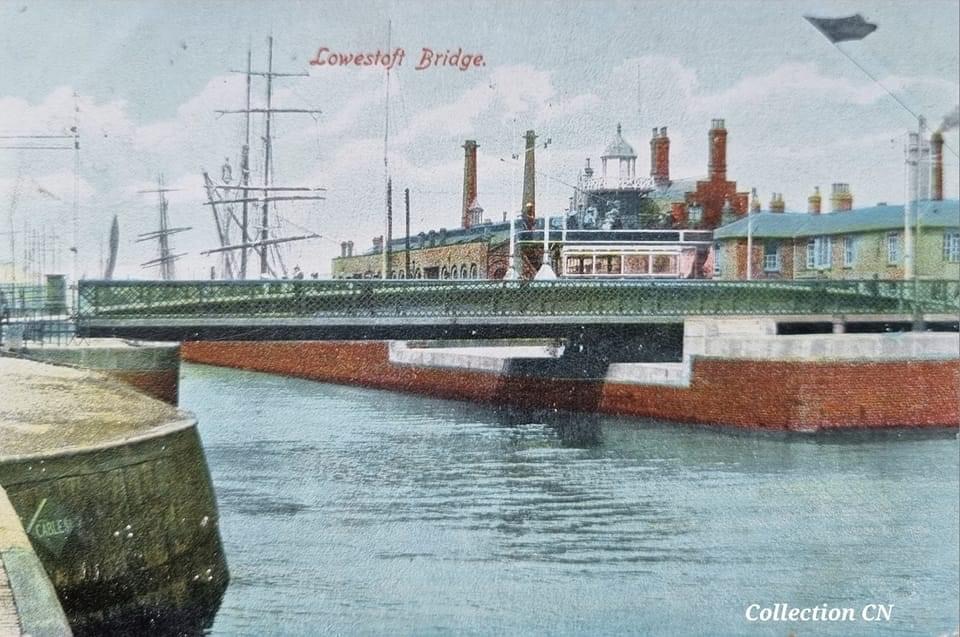


Looking due east down Lake Lothing towards the open reaches of the North Sea and, from there, across to the near countries of Western Europe. The bridge seen in the distance is the third permanent one to occupy this position, with the first one opening for business in June 1830 on completion of the harbour works referred to earlier in No. 13 of this series.
For centuries before then, all maritime activity had centred on the North Denes with ships anchored offshore in the sheltered inshore reaches, between the outer sandbanks and the beach, and with cargo carried in both directions by ferry-boats. The shingle-bank cut through to create the bridge channel was a feature both natural and man-made - for, although created by the southward drift of sediments deriving from erosion further up the coast, it was periodically carried away by tidal surges and had then to be rebuilt by human hand.
In February 1653, a local Commission of Sewers (a body consisting largely of gentry landowners) found that the Waveney marshes could flood up as far as Earsham (near Bungay), while another one of the same month in 1661 - “February fill-dyke”, of course, the time of flood - met at The Swan inn to consider the effects off another recent surge. This one had carried away the Mutford Bridge causeway and led to flooding of the marshes in thirty-seven parishes, and it was estimated that a sum of £600 would be needed to repair both the shingle-bank and causeway. The money was to be raised by imposing a levy on the places affected, commensurate with the degree of damage suffered.
The first harbour bridge was a double-leaf affair, both of which halves swung outwards into recesses in the channel walls, to allow vessels in and out of the Inner Harbour (as it became after Samuel Morton Peto had engineered the Outer extension). The machinery used was hand-operated and it was said in a newspaper of the time that so little effort was required that “a boy can open it with the greatest ease”. It remained in operation for sixty-seven years and was replaced in the Diamond Jubilee year of Queen Victoria (1897) by a single-span steam-driven swing bridge which turned inwards through ninety degrees and rested lengthways along the north wall of the bridge channel.
It was swift in operation, converted to electrical power at some point, and lasted for a total of seventy-two years before jamming in the open position during May 1969. Hansard Vol. 681 (18 July 1963) shows the local MP, James (“Jim”) Prior, flagging up the need for a replacement in view of the facility’s age - but it never went ahead. With the swing bridge stuck wide open, Lowestoft had a real problem (except for shipping), which was solved in part by the Army’s REME division getting stuck in and quickly providing a retractable Bailey bridge replacement for pedestrians, cyclists and motor-cyclists.
That still meant that all four-wheeled motor traffic had to go through Oulton Broad (whether heading north or south) for quite a number of weeks, before a temporary road-bridge - also built to allow ships in and out - was put in place to ease the congestion there. The swing bridge’s “seizure” did, of course, lead directly to construction of the third harbour bridge, the double-leaf bascule in use today - which opened on 19 March 1972. This has had its fair share of minor troubles over the years, including getting stuck on occasions in the partly-open or partly-closed position, but it still soldiers on giving good service. It, too, will presumably be replaced at some point by the fourth bridge to provide passage for traffic by land and sea at this point - but, in the meantime, we all have the Gull Wing Third Crossing to look forward to!
Once again, it has been a real pleasure to contribute to the LA&LHS Advent Picture series - so, Season’s Greetings and Blessings to all its members, to all readers of this page, and to people of all creeds and cultures everywhere.
Add new comment