
Before the Great War
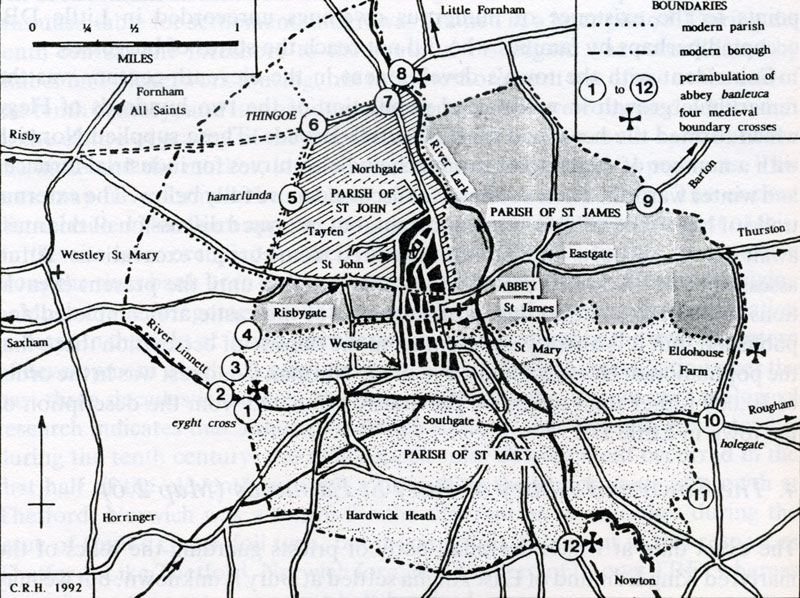

According to an Anglo-Saxon Charter, in 945 King Edmund gave up his royal rights to taxes and all feudal dues and fees in the area of Bury St Edmunds for about one mile around St Edmund's shrine. In 1968 P H Sawyer produced a catalogue called "Anglo-Saxon Charters: an Annotated List and Bibliography". This replaced earlier lists by J M Kemble, published in 1839-1848, and W Birch in 1885 to 1893. This charter of 945 is now catalogued as S 507, and further details can be seen by clicking on that reference.
Dr Cyril Hart largely accepted the authenticity of this charter and other recent research has described the content of this charter as "worthy of favourable reconsideration."
Dr Cyril Hart has produced the attached map which plots his interpretations of these landmarks. Such a boundary description is known as a "perambulation", and was the normal method of describing a location at this time.
The area now known as Hardwick Heath was included in this grant of land, and is visible in Dr Hart's map. The adjacent farm of Hencote was also held by the abbey.
980
Aelfwine gave 'Lawshela, Halistede and Ryseby' to Ramsey Abbey. Halistede is the name of Hawsted at this time.
1020
Aelfwine was Bishop of Ely, and it was him who masterminded for Cnut the establishment of Benedictine rule at Bury in 1020. He sent the first contingent of Benedictines to Bury from Ely and from Holm. Leofstan was one of those monks
1044
In a deed dated between 1044 and 1065 in the time of Edward the Confessor, Leofstan, the steward of Abbot Leofstan and his relative Stannard, gave Welnetham and Hawsted to the Abbey. This grant was numbered 364 by Cyril Hart, but no actual will is known to exist. Leofstan was the second Abbot of Bury, ruling from 1044 to 1065. It may be that his relationship with the Bishop of Ely allowed them to annexe Hawsted from Ramsey to Bury.
1086
In the Domesday Book Hawsted is written as Haldsteda and Hersteda. By this time Hawsted was one of the possessions of Bury St Edmunds abbey. However, Odo, Albold and Peter, and Agnet held land from the abbot which they could buy and sell, but the sake and soke and commendation continued to belong to St Edmund.
Hardwick did not appear in the Domesday Book.
1148
In the reign of King Stephen, (from 1135-1154) Cullum believed that the first mention of Hardwick was made in a grant from King Stephen to Abbot Ording of Hardwick. However, John Gage believed that this document was merely a confirmation of an earlier right. Ording was temporary abbot in 1138, and then from 1148 to 1157.
In the later Register of Werketone the cellerer was recorded as the tenant of Hardwick Heath and controlled the flocks and pasturage of that area. The cellerer had 400 sheep in this area. There were also 132 acres under cultivation. Certain parcels in Nechelesmere, Waterpit, Hokewell and Mill Wongs were exempt from tithes.
1242
Clive Paine records that by 1242 Hawsted was being spelled 'Haustede.'
1272
A survey of Hawsted made in the last year of Henry III mentions two manors in the village. These were the Manor of Hawsted hall and Talmache's, also apparently known later as Bokenham's. Cullum wrote (page 102) that in his time, (1784) the full style of Hawsted Manor was "The Manor of Hawsted Hall with Bokenhams".
1286
A survey of the abbot's lands in 1286 shows the manor of Hawsted held by Sir Thomas Eustace.
The second manor was held by Sir William Talmache, probably from about 1281.
1359
Sir William Clopton purchased Hawsted Manor, and other lands in that vill. At this time Hawsted Manor was 662 acres generating £11 in rents of which £2 had to be paid to the abbot.
1392
The Talmache manor became called Bokenham's when Alice Talmache married William Bokenham of Great Livermere.
The manor of Bokenham's alias Talmache was sold to Roger Drury in 1463
1505
In the 20 Henry VII (1505) Sir William Clopton sold the manor of Hawsted Hall to Sir Robert Drury. A previous Roger Drury had already held Bokenham's since 3 Edward IV (1463). The two manors in Hawsted were now both owned by the Drury family.
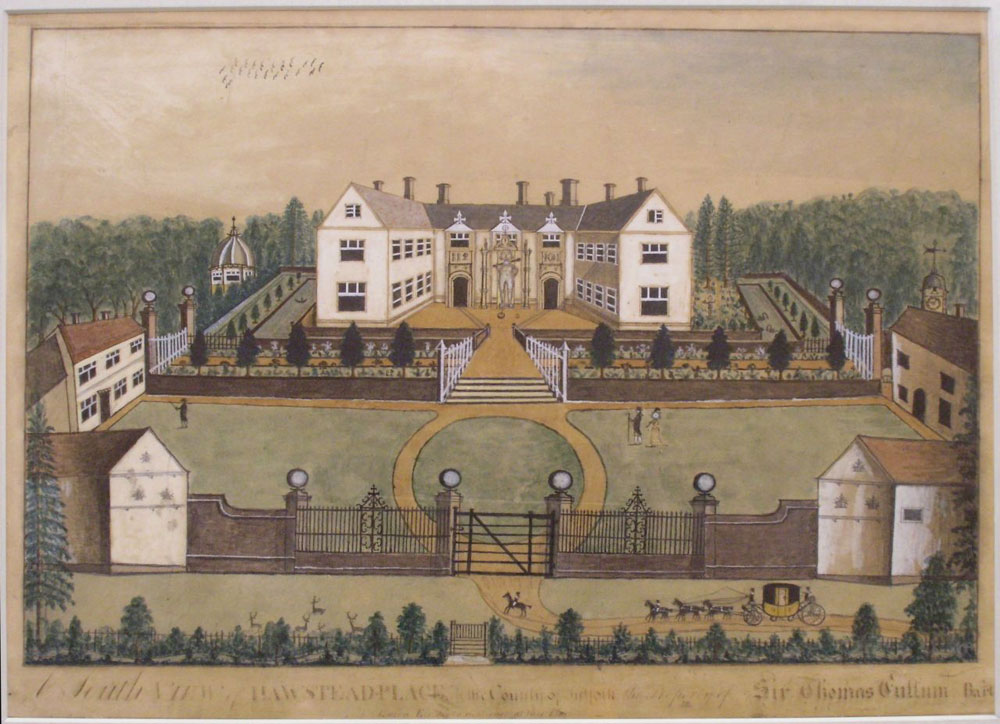
The main manor remained Bokenhams and it was there that the Drurys built or enlarged their "Place in Hawstead"
1510
In about 1510 a licence was obtained to "empark, make chase and crenellate". So their main building at Hawstead dates from this time. This included a square moat lined with bricks and a bridge at the south and a drawbridge to the north
1546
After 1540 King Henry VIII now began to convert the seized properties of the church into cash. The details of each sale were settled by the Court of Augmentations which was responsible for the disposal of former monastic lands for the crown. Nicholas Bacon was Solicitor to the Court of Augmentations from 1537 to 1546, and he had local connections. His father was Robert Bacon, of Drinkstone, Esquire and Sheep-reeve to the Abbey of Bury St. Edmunds.
The manor of Hardwick was granted to Sir Thomas Darcy, who was Lord Darcy of Chiche, (now known as St Osyth's) as part of the monastic disposals, although the exact area is unclear. "All woods....called Hardwycks Wood....50 acres in Bury St Edmunds, Nowton, Stanefield and Gt Horningsherth" were granted to Darcy. Darcy had already owned Horringer Parva since 1540.
Hardwick would then pass through several hands. Hardwick’s next owner was Sir Robert Southwell, Master of the Rolls of the Court of Chancery in 1541-1550. Sir Robert Southwell was granted several manors from Henry the VIII, several of which he sold on. Hardwick was sold to Sir Thomas Goodrick, who in 1597 bequeathed Hardwick Lodge to his wife. The estate was then sold to Thomas Stanton of Bury.
According to Cullum's Hawsted the farm known as Hencote was granted to Sir William Drury by Queen Mary. Cullum reckoned that Hencote "comprehends the unenclosed part of the present farm, (ie Hardwick) which lies within the bounds of Bury." It was thought to derive its name from the hens, chickens, geese, ducks and eggs, pigeons etc anciently paid as rent to the abbey. (Yates, 1805, p175)