
80 High Street
Current
FlintHouse
80
High Street
Lowestoft
NR32 1XN
United Kingdom
History


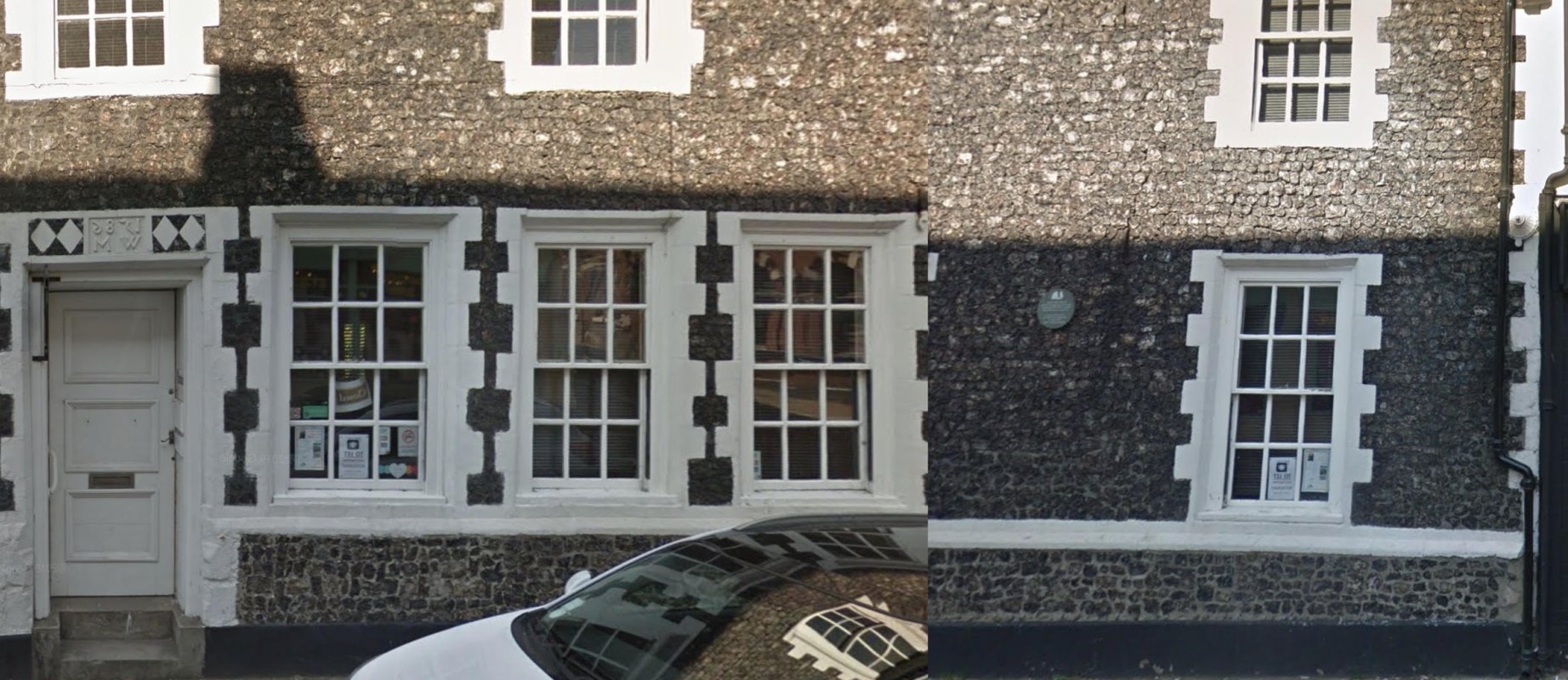
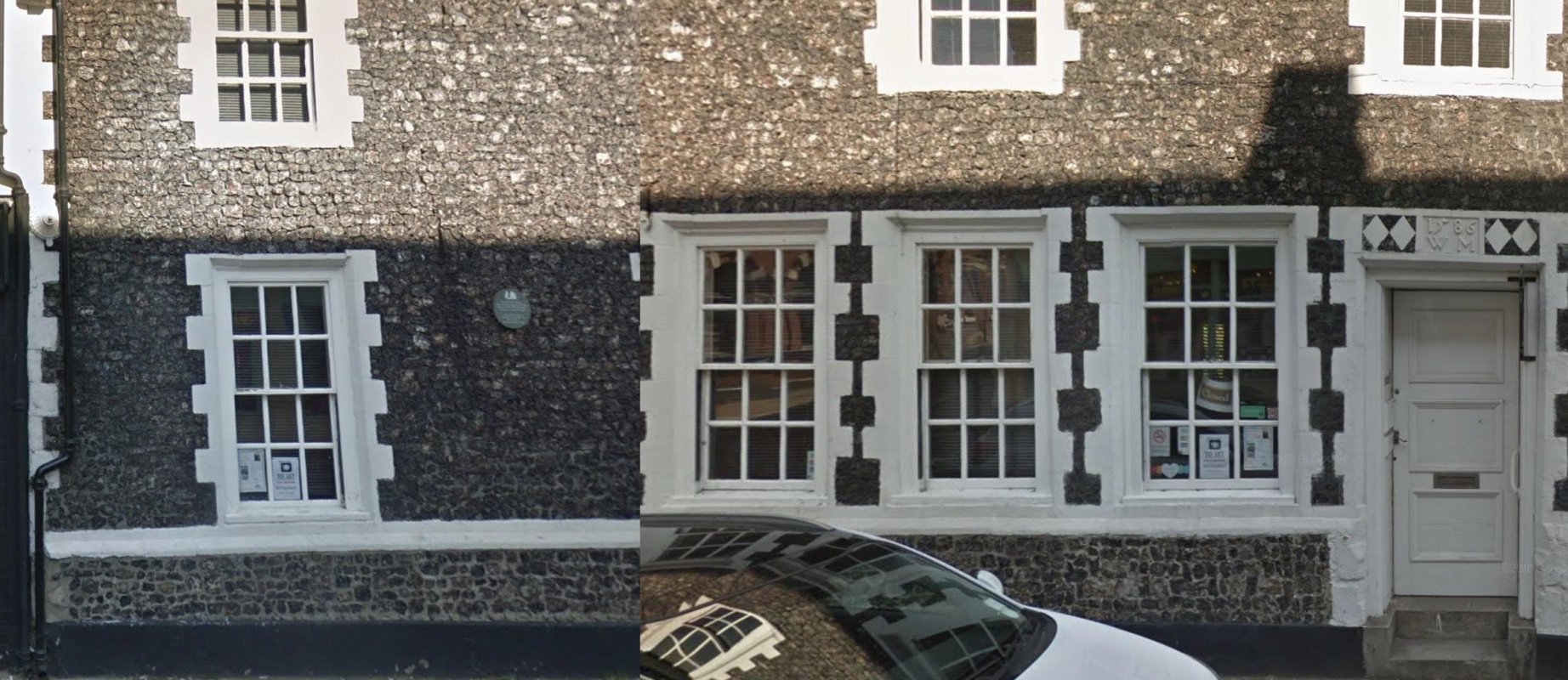
When built: The building was erected in 1586 and over the door is a plaque bearing that date with the initials W.M. for William and Mary Wilde. Brief history/features: This Grade II listed building with its fine knapped flint façade remained in the Wilde family well into the 18th century. After his death in 1738 one John Wilde endowed a Grammar school that was built on land at the rear of the house. Former Notable Owners: By the early 19th century it was the home of a local doctor William Worthington whose son, Francis S Worthington, FRCS, remained in Lowestoft and became a prominent member of the community. Little known fact: William Wilde, a grandson of the original owner, was captured in the Mediterranean by Algerine pirates in 1633 and in a letter to his father from a prison in Constantinople he describes how “… I was chained in the galleys by the leg and also both hands together, besides a chain to my back . . . I was forced to row. My allowance is bread and water, and am exposed naked to the extremities of both heat and cold…” he concludes by beseeching his father to “…show love to my wife and children . . .”
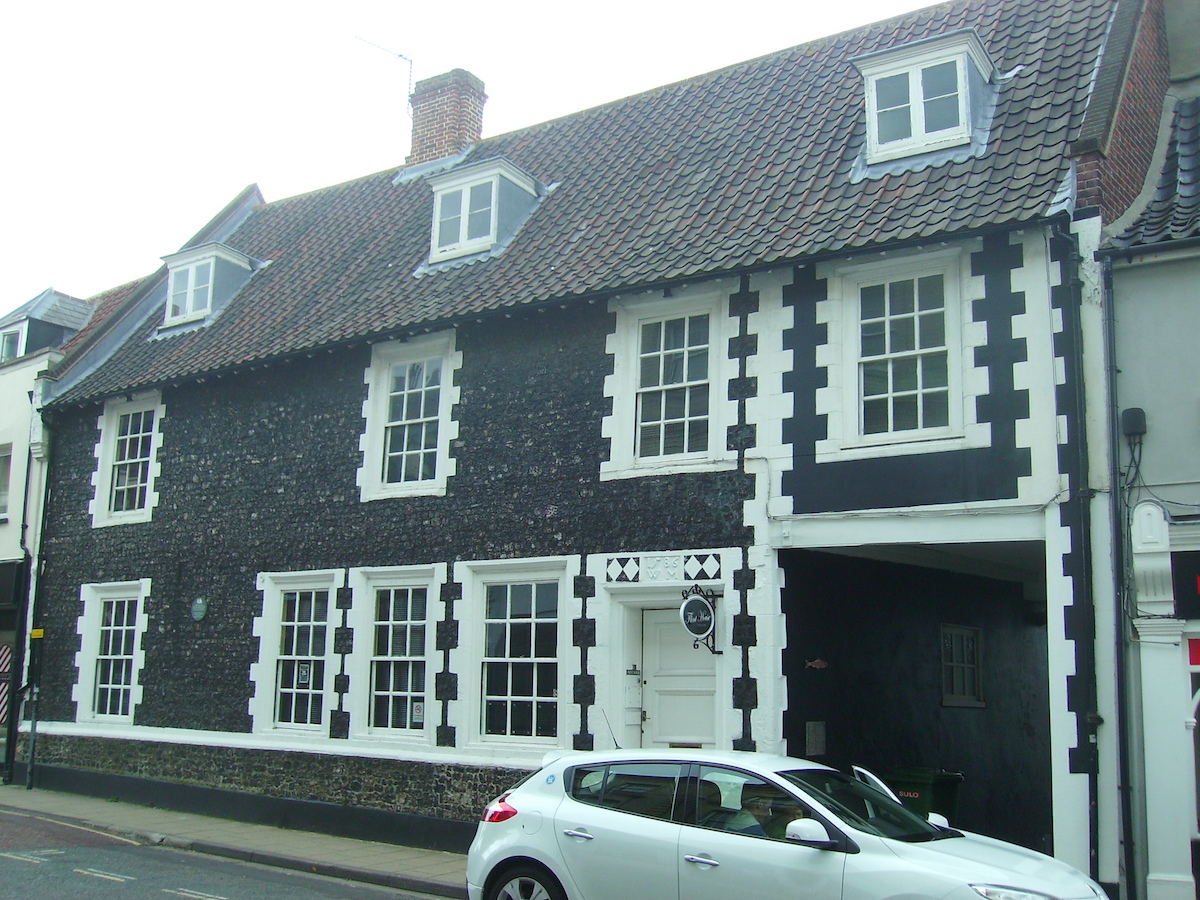
On the corner of Wilde's Score and the High Street is the South Flint House, built in 1586 and built from knapped flint it was the home of the Wilde family merchants and philanthropists. If you look at the picture of the doorway you can make out the monogram initials of the Christian names of William and Mary Wilde. In 1865 it was the town's library or as it was called the public reading rooms with William Artry as Librarian. Listed in the 1932 Kelly's Directory it is a Children's Dressmaker's run by Miss Doris Betts and by 2016 it is the Flint House Restaurant. If you get time please visit the Lowestoft Heritage Centre, at the rear of this building accessed via Wildes Score.
CREDIT: Crispin Hook
2022-2024 Flints Portuguese restaurant
Architecture
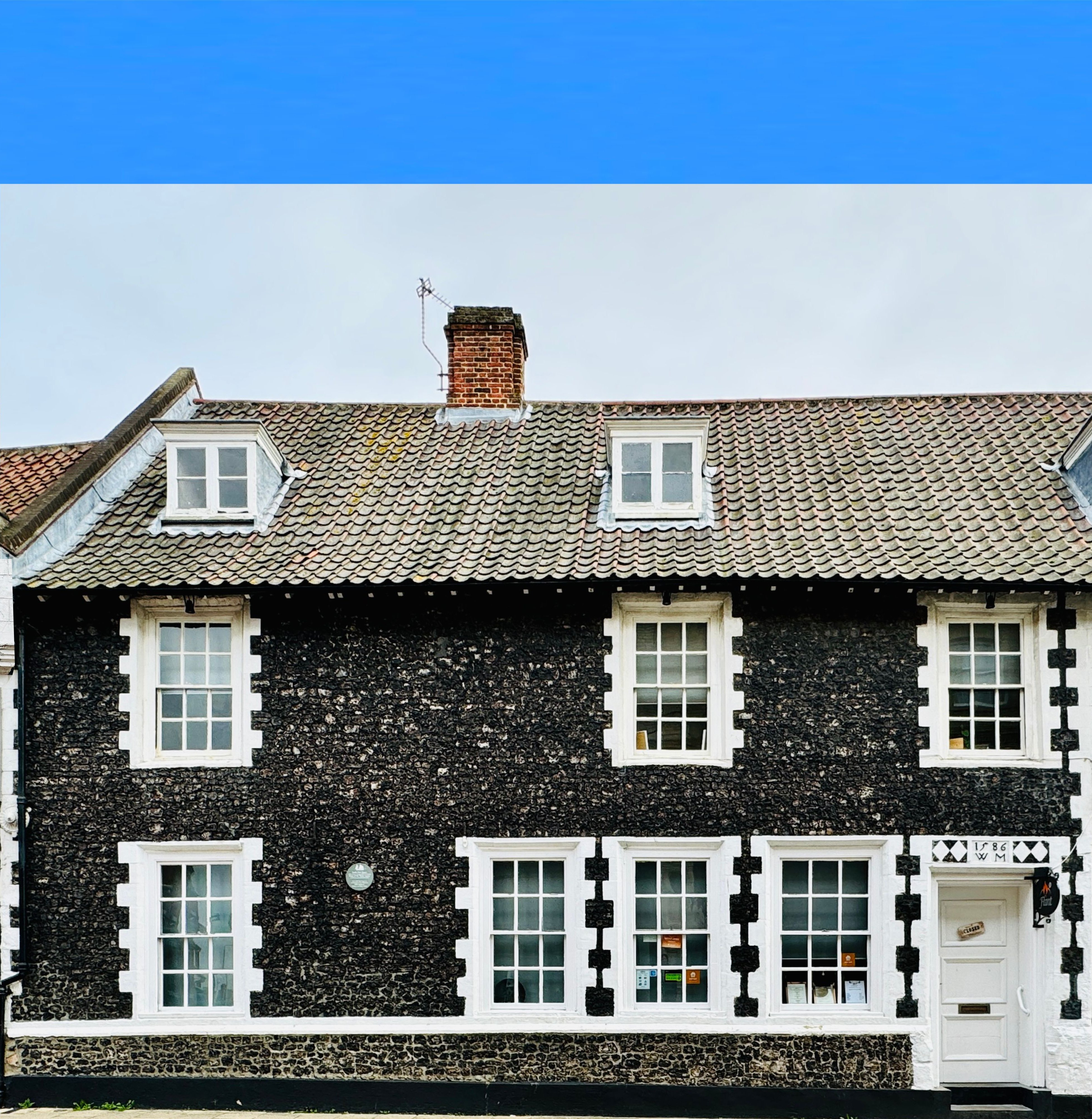
No. 80 High Street, with its impressive dressed flint facade and plinth was the home of the Wild(e) family for around 150 years. A date tablet above the door (fashioned into the lintel) records the year of construction (1586) and, underneath this, bears the Christian name initials (W and M) of Wyllyam Wyld (merchant) - parish register spelling - and his wife Mary Harman, who were married in August 1569.
The building has late 16th century oak, through-purlin, roof framing, with principal and common rafters - the former having both collars and wind-braces. There are also lower, added purlins for extra strength. Ashlaring is present from end to end on both sides and there are hardwood floorboards underlying later pine planking.
The interior contains two notable surviving original features. The main ground-floor space (the house's hall), to the south of the substantial chimney-stack, has a late 16th century fire-place with finely moulded stone uprights on either side and an original oak supporting beam above. This was shaped to simulate stone, in the form of a depressed four-centred arch, and it also has keying-cuts made into it to take a plaster skin.
In the room immediately above - what would have been the hall chamber ("master bedroom" in today's terminology) - there is another fire-place, with high-quality stone surrounds. The moulded uprights have a carved rose motif halfway up and are surmounted by a classic four-centred arch having sculpted spandrels at either end - one containing the W initial and the other one the M, and both set in shields.
The house, in every way, makes a statement about the people who had it built - not only in terms of their affluence and social standing, but also perhaps of their marital bond in the use made of their Christian name initials. The latter being there for all to see on the outside of the dwelling, above the front door - but also present within, in the intimacy of the bed-chamber.
The probate inventory of James Wilde (merchant), grandson of William Wild - 14 March 1684 - has survived and it shows a considerable degree of wealth on the part of the deceased. It also reveals the house's interior room-plan, which is still recognisable today. The grave-slab of William Wild (which was once located in the middle aisle of St. Margaret's Church, but is no longer present) recorded his death as occurring on 23 March 1611 - 1610, by the old-style Julian calendar - at the age of 87, and informed the reader of his inscription that he "lived harmless as a child".
The High Street dwelling (No. 80) carrying the family name and sometimes referred to as the "South Flint House" (by way of contrast with No. 27, the "North Flint House") was a new-build structure raised by William and Mary Wild on a plot of land previously belonging to the wife's father, Derick Harman. He died in May 1575 and left his house to his daughter, who was probably living with her husband in a house on what is now the site of No. 2 High Street. At some stage, William and Mary Wild (who had married in August 1569) must have demolished what had been her childhood home and replaced it with their impressive dwelling of 1586.
Derick Harman is described in a daughter's parish register baptism entry of February 1562 (1561, by the Julian calendar) as being a shoemaker by occupation, but his will of 9 May 1575 (he was buried eleven days later) refers to him as a merchant. It also gives his name as Richard Dericke (al. Harman). No explanation of the change of surname can be given, but the document shows him to have been of mixed occupation - which was common at the time. He had a boat used for freshwater fishing, he had a salt-store and fish-houses for curing red herrings, and he had a beehive. The inference(s) to be drawn suggest that he was probably a master-shoemaker who was also involved in fish-curing.
To the rear of No. 80 High Street, and built alongside the Score named after the Wilde family, stands the Old Schoolhouse building - now serving as the headquarters of the Lowestoft Heritage Workshop Centre. When the brothers John and James Wilde died (in 1738 and 1748, respectively), both unmarried and without children, the main line of the family came to an end. The older of the two, John Wilde, had made his will in July 1735 and in it he left his estate to be used in setting up and endowing a free grammar school for forty boys of the parish - an identical number to the one established in the year 1570 by Thomas Annot (merchant), which was still in operation.
The bequest was to be implemented following the death of a close family friend, Elizabeth Smithson, who was to be sole beneficiary for term of her life. In the event, she lived on until 1781 and it wasn't until 1788 that town's vicar (John Arrow) and churchwardens began to erect a building in fulfilment of John Wilde's will. The salary of the schoolmaster was to be £40 per annum and the first one appointed was called Lewis Webb. He held the post for only a short time, dying in March 1790, aged thirty-eight years.
Once the school had been established, No. 80 High Street served as the master's house for a considerable length of time. One of the conditions of the school's founding was that on the 23rd of December, every year, a service was to be held for the school in St. Margaret's Church during the late morning (and, should the 23rd be a Sunday, on the Monday immediately following). At this same service, the Vicar of Lowestoft was to preach a sermon, taking as his text "Train up a child in the way he should go: And when he is old, he will not depart from it." (Proverbs 22. 6).
This was still being done right up to the outbreak of the Second World War, when the school was closed down soon afterwards for the evacuation of Lowestoft children. Having received bomb damage during the conflict, it did not re-open. CREDIT:David Butcher
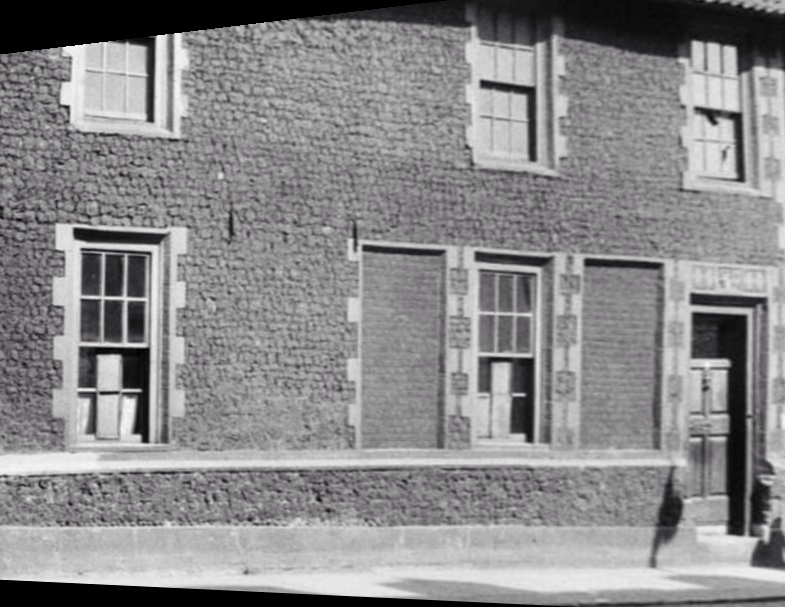
Number 80 the High Street known as the South Flint House. It's one of the very very few buildings, or perhaps the only building, that we definitely know when it was built, because somebody very conveniently put the day it was erected over the door. Built for the Wilde family in 1586. It's a Grade II listed building. This photograph was taken in 1900, but what's unique about this building is it must be... it's a reflection of the wealth of William Wilde and Mary his wife who had it built in that they could afford to have the whole front of the building covered with napped flint, flush work as you call it, so there's a brick wall and then it's been lined with this napped flint, a very expensive product.
And then if we come to a more modern view you can see the blocked up windows have now been restored. The other thing that's most important, here we've got what's known as a flying freehold over the top of this public right-of-way. That's a much recent, more recent addition. Early maps show there's nothing over there, so they they've constructed something so they don't block the public score, but they've tried to make it look as if it's part of the original building. But this is a wonderful piece of 16th century building work in Lowestoft. And of course finally there is the date William and Mary, WM Wilde and the date 1586 when the property was erected for them. . CREDIT: Ivan Bunn from transcript - Poetry People - High Street Histories
Surviving internal timber framing
Some boxed beams evident in places. The roof has complete original late 16th century trusses in place, with renewed pieces showing. A high-quality dwelling belonging to the Wilde family of merchants from 1586-1738, the plinth and dressed flint on the facade helping to show its high-status nature. CREDIT:David Butcher
TM5593NW HIGH STREET 914-1/8/37 (East side) 13/12/49 No.80 Wilde's House
GV II
House, now offices. Dated 1586. Tarred knapped flint with white-painted brick and stone dressings. Pantile roof. 2 storeys and dormer attic on a plinth course. To the extreme right (south) is a square-headed carriage arch leading to Wilde's Score. Left of this is a 3-panel door with a lintel in which are diamond panels and a plaque: 1586 W.M. Four C20 replica sashes to the left, irregularly disposed in groups of 3 and one. The outer 2 of the group of 3 are entirely C20 insertions. They have exposed boxes and chamfered painted reveals. 4 similar sashes light the first floor. Gabled roof with 3 flat-topped dormers fitted with C20 casements. Ridge stack left of centre. North and south re-built parapets on moulded kneelers. The rear elevation has 5 windows to each floor of irregular disposition. All were formerly mullioned, now all have late C20 casements. INTERIOR. All interior fittings either removed or boarded over. Late C16 roof structure with many renewals: principals with chamfered slots to accommodate the through purlin; added lower purlins; curved windbraces; collars. CREDIT: Historic England
Add new comment