
Fishing Seasons, Catching Methods and Curing Processes
The Cod Voyages
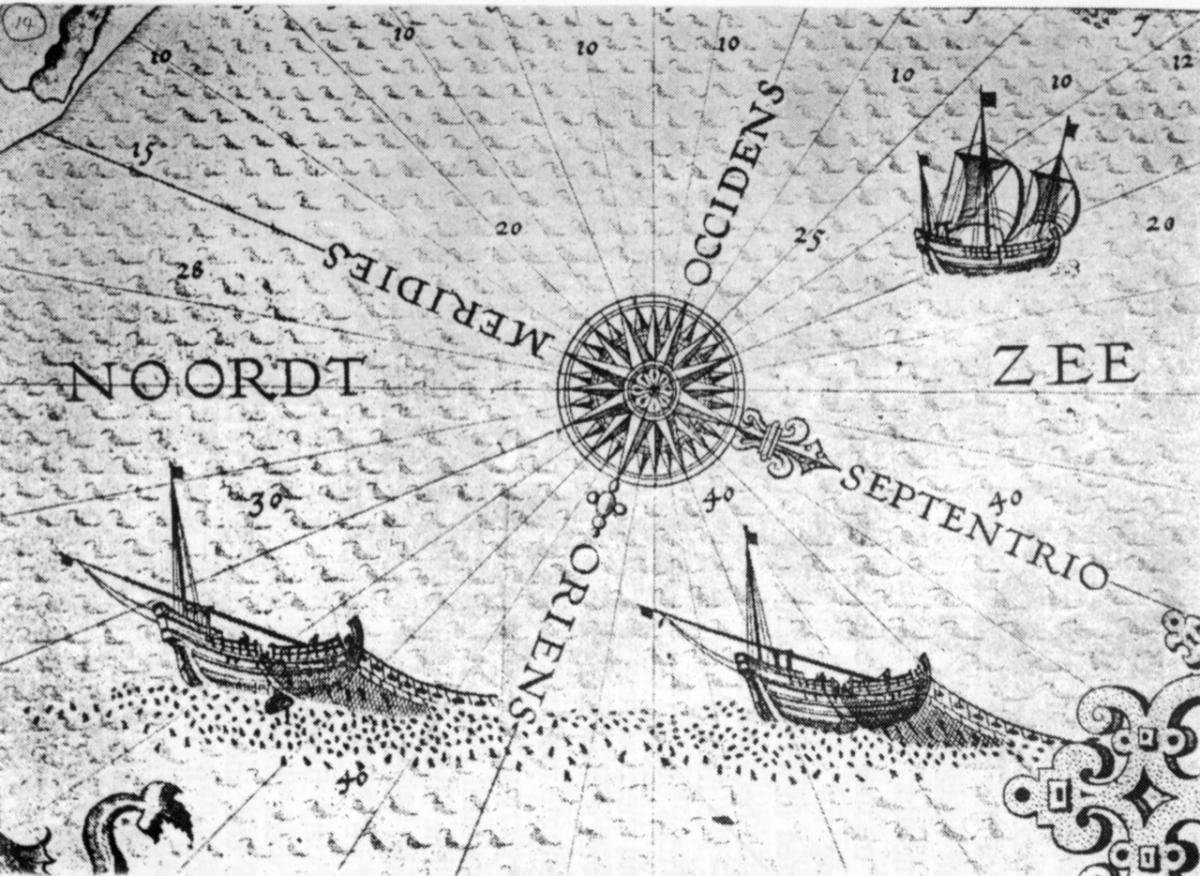
The spring and early summer sailing to Faeroe and Iceland from East Coast ports (line-fishing for cod and ling) may have begun as early as the beginning of the 15th century – possibly in the Scarborough area – and was a well-established feature by the start of the 16th. Lowestoft’s involvement is proven, but it is not possible to say how many vessels were regularly involved and over what sequence of years they were sent. There is a record of seven craft returning from Iceland in 1533, all of them between fifty-two and seventy-two tons burden, with a levy per boat payable to the Crown of either £4 or £6 (see 16th Century Merchant Ship Details, in the LO&N History pages). The number of East Anglian vessels engaged in the northern fishery that year was seventy-eight craft – a number which is said to have fallen to forty-three by 1550. By 1593, the number had risen to 111, but no Lowestoft vessels appear in the list. Nor does the town feature in Tobias Gentleman’s assessment of the Iceland fleet in 1614.
This is not surprising, since some vessels were also probably used for trading voyages. Alternatively, craft may have been engaged in other fishing activities. Thus, it would have been possible for a survey of vessels engaged in a fishery to have been carried out at a time when a port might not have had any boats involved. The fluctuations in the number of Lowestoft craft working in Icelandic waters between the 1530s and 1560s seems, on the slender evidence available, to have been considerable. The seven vessels which returned from the voyage in 1533 were referred to in the paragraph above. On 31 January 1566, an inquiry was held in town into the valuation of the vicarage, because the minister’s income had declined as a result of the decrease in the value of fishing tithes. The number of boats sailing north that year was said to be only one, whereas twenty years previously there had been thirteen or fourteen doggers involved in the Iceland fishery. This information is to be found in the Revd. John Arrow’s Memorandum Book – Norfolk Record Office, PD 589/92, pp. 72-9 – with three of the town’s leading merchants (Richard Mighells, Anthony Jettor and John Grudgefield) giving evidence.
It is unfortunate that no figures are available for Lowestoft’s Iceland fleet during practically the whole of the 17th century, since it has been estimated that the number of East Anglian boats committed to this voyage reached its peak in the 1630s, with about 200 craft involved – a total which had declined to seventy vessels a matter of forty years later. The town obviously had some kind of connection with the fishery during the early years of the 17th century because two probate inventories give evidence of it. Thomas Myghell (merchant), who died in February 1602, had fifty Iceland cod stored in his yard, while Thomas Grudgfild (merchant) had 1,800 in his salt-house, worth a total of £27. This works out at a value of 3½d. per fish, but whether that represents wholesale or retail price is not known. Grudgfild also had a one-third share in an Iceland bark, which was away from home, fishing northern waters at the time he died (May 1603), and the value of his part-interest was estimated to be £17 19s. 2d. The vessel was undoubtedly the boat called Richard, and he bequeathed his interest in it to his second son, James. If the craft did not return safely from Iceland, then James Grudgfild was to have £20 paid to him by his older brother, Thomas, out of the father’s estate which the latter had been left.
Edmund Gillingwater, in his History of the Ancient Town of Lowestoft (1790), pp. 109-10, makes reference (though without citing evidence) to the flourishing state of the Northern Fishery in the middle of the 17th century and talks of how, at one time, the Lowestoft fleet would return home not only with catches of cod and ling, but with woollen stockings, blankets and caps acquired by trading with the inhabitants of Iceland, Faeroe and the Shetland Isles. Such goods are perhaps further evidence of the mixed economy of the time (they certainly show a willingness on the part of people involved in fishing to deal in other items) and their carriage home may be compared with the way in which vessels from the Norfolk port of King’s Lynn brought back, from Iceland, quantities of hard-wearing wadmal cloth, in addition to their catches of fish.
It is possible that Lowestoft never had many boats committed to the Northern Fishery after about the middle of the 16th century (in spite of Gillingwater’s reference to its later, healthy state) – although the trade did continue on a limited scale until the middle of the 18th. In its latter stages, the voyage was very limited indeed. Any vessels making the journey to Iceland were included for tithe purposes with the various other craft engaged upon the North Sea spring lining voyage, and the accounts book shows only one boat involved in 1699 (owned and commanded by a man called Richard Browne). There was then a gap of ten years before a single vessel again sailed to the far north in 1710 and 1711 – this time commanded by James Pacy and belonging to a relative, Samuel Church (merchant).
Fifteen years later, a man called Gabriel Middleton, who was both owner and master of his boat, went to Iceland for six consecutive years (1726-31), before being joined in 1730 and 1731 by vessels belonging to William Balls and John Jex (merchants). The former of these two also sent a craft on the voyage in 1732, 1734, 1736, 1737 and 1743 – the last year being the final occasion recorded in the Tithe Accounts of an Iceland fishing venture being undertaken. Edmund Gillingwater (p. 109) says that the last Lowestoft voyage to Iceland took place in 1748, when a Mr. Copping sent a boat northwards, but there is no trace of this enterprise in the tithe records (Norfolk Record Office PD 589/80).
When working Iceland and Faeroe, both owner and the master would have tried to ensure that a vessel left for the fishing-grounds as soon as it was safe and convenient to do so. The voyage usually began in March or April and lasted until July/August, when the vessel returned to port in order to re-equip itself for the important autumn herring season. If good catches were made early on, it was possible for a boat to sail for its home-base, discharge its fish and return once more to northern waters (or to switch to the spring mackerel fishery) – this second sailing often seeing the vessels venture less far and working off the coasts of the Shetland Isles and Scotland. Because of the time involved in getting to Iceland or Faeroe (generally reckoned to have been a week, or more, in good conditions and perhaps even as much as a month in adverse ones), the Lowestoft boats had, well before the end of the seventeenth century, begun to operate three North Sea lining voyages closer to home: in the late winter and early spring, in the late spring and early summer, and in the autumn. They probably went no further north than Shetland on the first venture and concentrated their efforts on the Dogger Bank area thereafter. Cod, hake and ling would have been the species sought on the voyage to Shetland and the more northerly areas, cod and other demersal species on the grounds nearer home.
The vessels involved in what may be loosely termed the cod fishery would have carried a crew of at least ten to twelve or fourteen men (depending on size) and used an identical method of catching and processing the fish. The gear mainly employed was the great-line, of which there is a good description given in a book published in the late seventeenth century: John Collins, Salt and Fishery, a Discourse Thereof (1682), pp. 106-7. A heavy hempen line, some ninety fathoms in length (540 feet) and weighted at its far end, was paid out by hand over the side of the boat. Attached to the line, a little above the weight, was a cross-shaped piece of iron, and tied to the ends of this were four shorter, less substantial lines with baited hooks secured to them.
This device was operated by individual fishermen, but another, longer type of line had weights or small anchors fixed at periodic intervals along its length (to secure it to the seabed), with hooks individually fixed onto the line and set apart at intervals of three to six feet. This was paid out over the side of a small boat known as a skave (which was carried on board the main vessel specifically for the task) and allowed to lie on the seabed for a period of time, before it was hauled by crew members. This method of fishing necessitated vessels having larger crews because of the use of skaves. The Jaymes of Dunwich, which sailed for Iceland in December 1545, carried a crew of thirty men altogether, whose number included two skave masters, a soldier, a gunner, a carpenter and a cooper. See Evan Jones, ‘England’s Icelandic Fishery in the Early Modern Period’, in D.J. Starkey et al., The Sea Fisheries of England (2000), p. 109. The crew list reproduced here was originally part of an article by E.R. Cooper in The Mariners Mirror, 25 (1939); who also mentions it in his book, Memories of Bygone Dunwich, 2nd ed. (1948), p. 19.
The process was often referred to as line-laying and was a form of fishing practised in relatively shallow waters, its effectiveness drawing complaints from the Icelanders regarding depletion of their inshore fish stocks. The initial bait used in both cases consisted of fish which had been caught in a net carried specifically for the purpose – this so-called bait net probably being some kind of seine or trawl, which was dragged along the sea bed, or just above it, to catch any species available. Large specimens would have been cut up into pieces, smaller ones impaled whole upon the hooks. When the lines were hauled, some of the crew members disengaged the fish which had been caught and re-baited the lines, while others gutted and packed the catch. Once a line-fishing voyage had started, the lines themselves would have provided much of the bait used – in the form of small fish and species which were not processed for the journey home. The crew would also have eaten a certain amount of the fish caught.
There was a strict procedure to be followed to ensure that fish selected for processing stayed in the best possible condition until the return home. The catches of cod and ling were gutted, decapitated, split open and boned, salted thoroughly in a trough or tub, and then packed “sardine-fashion” in special compartments down in the hold. As each layer of fish was put down, more salt was sprinkled on to act as a preservative. It has been estimated that about two pounds of salt per fish was required, which means that considerable quantities must have been carried on board ship (see Evan Jones, ‘Icelandic Fishery’, in Starkey et al., Sea Fisheries, p. 109). Medium-size and larger fish were the ones processed; smaller specimens and unwanted species were either used for bait or eaten by the crews. All livers were placed in casks and left for two days, and the oil which floated to the top was skimmed off, strained and barrelled. The livers were then sealed in their casks for transportation home, because there was still oil to be had from them. Dried cod, known as stockfish, was sometimes purchased from the Icelanders and Faroese themselves, who had dried it on shore without the addition of salt. The name derives from the Dutch word stok, meaning “a pole”, because the Icelanders dried the cod in the open air by tying the fish in pairs to vertical posts.
As soon as a vessel reached Lowestoft, whether returning from Iceland or from fishing-grounds nearer at hand, it anchored in the offshore shallows and the salted fish, livers and liver-oil were taken ashore in ferry boats. The cod and ling were then washed and partially dried, before being re-processed. There were three main methods of doing this: one was to dry out the fish completely, sometimes after compacting the flesh by beating it with wooden paddles, thereby producing a type of stockfish; another was to allow them to desiccate more gently and become what were known as haberdines; and the third was to re-salt the catch and pack it into barrels. The drying process was carried out in a barf-house, which was an open-sided shed containing racks or shelves for fish to be laid on.
Once re-processing was complete, the fish was ready for sale, either locally or further afield. During the first half of the seventeenth century, stockfish (the coarsest variety) retailed at 3d. a pair, haberdines at 1s. 2d., re-salted Iceland fish at 1s. 5d. and North Sea ones at 1s. 10d. Haberdine is a variant of the Dutch word abberdaen, which in turn derives from laberdaen, a word for the Basque district of Labourd, where salted cod from Newfoundland had been a staple product for generations. Shipments of salted Icelandic or Faroese cod from Lowestoft to Southampton during the 1430s are recorded in the latter port’s records: see Christopher Woolgar, ‘Take This Penance Now, and Afterwards the Fare will improve: Seafood and Late Medieval Diet’, in Starkey et al., Sea Fisheries, p. 41.
Good use was made of the livers which had been saved from the initial oil-producing process on board ship. They were themselves processed further for the extraction of yet more train-oil, which was used to provide fuel for lamps and to dress leather – the first element of the term having its origins in either the Low German trân or the Middle Dutch traen, both of which mean “oil”. In Lowestoft, the livers were rendered down in iron coppers, which were located out on the Denes, north of the present-day Birds Eye factory. Edmund Gillingwater says that the trench in which they stood was visible at the time he was writing his book (c.1790), p. 110. And it is still just about discernible today (see North Denes Liver Trench, in the LO&N History pages).
A manor roll of 1610 (which is neither as detailed nor well presented as that of 1618) notes that a man called Simon Fyfyld (merchant and shoemaker) held land “sup le Denes ad faciend sum [sic] lez blubbers” – the last word in this strange mixture of Latin, French and English being one commonly used for cod livers, as well as for whale fat. Another reference to manufacture of oil is to be found in the accounts of the administration of the estate of Thomas Mighells (merchant), who died in September 1636. Among the many items sold by his executors was a quantity of oil and old barrels left at the coppers. Two local merchants, Francis Knights and Thomas Fullwood bought the goods for £10. There is also reference in the accounts to a payment of 2s, made to Erasmus Utber (gentleman) for measuring the quantity of oil. Extraction of oil from cod livers continued well into the eighteenth century and, in October 1720, Joseph Smithson (merchant) left his oldest son, Samuel, blubber pans and other utensils located on the Denes.
Fyfyld (the surname more commonly found as Fifield) lived in the house which is now 43-44, High Street. The faciend sum of the document is, of course, an error for faciendum (“making”). And the abbreviation sup, for the Latin preposition super (meaning “on” or “against”) suggests that he was either using part of the liver trench across the road from his house plot or was rendering cod livers down at the bottom of the cliff on his own land. The Mighells administration accounts (following his death)
are to be found in the front of the parish tithe book (Norfolk Record Office, PD 589/80), placed there by the Revd. John Tanner, who married into a branch of the Mighells family and used the accounts to prove the Lowestoft incumbent’s entitlement to a mortuary fee of 11s. for burials inside the church. Such a payment to Robert Hawes, vicar at the time of Mighells’ death, is listed among the various disbursements made.
The Herring Voyages
The focal point of fishing activity in Lowestoft was the annual Autumn herring voyage, lasting from mid/late September until the middle of November. There were lesser fisheries for the species in early spring and at midsummer, but the presence of the shoals was unpredictable and the quality of the fish inferior to those caught in the autumn. The October and November herrings particularly were in prime condition, full of milt and roe and with a low fat content to render them less perishable than the ones caught in the summer, both locally and elsewhere. The fat content of North Sea herrings can be as high as 25% of body-mass during the period May-July, when the species’ feeding is at its height, and it drops to below 5% during the winter. By October, the East Anglian stock of herring was hardly feeding at all and was in prime condition, ready to spawn down on the Sandettie Sands in the English Channel. See W. C. Hodgson, The Herring and Its Fishery(London, 1957), p. 110.
Catching and processing the fish was one of the corner-stones of the prosperity of both Lowestoft and Great Yarmouth (to say nothing of numerous other English and Scottish communities) and herrings remained of considerable economic importance in both towns right up to the decline of the North Sea fishery during the 1960s. For over three hundred years, from the 1350s through to the 1660s, Yarmouth used its considerable influence as a large port and major supplier of ships to the Crown (whenever required) to dominate Lowestoft and other coastal settlements. But the Suffolk community refused to be overawed and managed to develop its own economic independence.
Herrings were caught in drift-nets, known universally as flews. The meshes were made from hemp or linen twine, hence the frequent references to them as lints, and each individual mesh was about an inch square. The nets were probably made by the fishermen themselves, and by members of the family, and the twining wheel sometimes encountered in fishermen’s inventories was a device used to spin the material required. Lowestoft did not grow sufficient hemp to produce anything like enough twine and, in any case, the type of plant it did grow was more suited to linen manufacture. However, supplies of suitable material would have been brought in from outside sources – especially from the Baltic countries, with Riga hemp being especially favoured. The nets themselves were twenty yards long and of variable depth according to the depth of water fished. The six scores, nine scores and twelve scores which are referred to wills and inventories of the 16th and 17th centuries reveal their dimensions simply because the size of drift-nets was always calculated in scores of meshes depth. The nine scores seem to have been those most commonly used and they would have been about fifteen feet deep.
Each individual net consisted of four, separate knitted sections, laced together, the topmost and lowest of which – known, respectively, as the hoddy and the deepyne or deepen – were of thicker twine than the other two because of the greater strain imposed on the extremities. The four sections of mesh were marled onto a framework of hemp cord in order to give each net its form. Two of the nets, joined side to side, constituted one dole – a different use of the word from that applying to an individual share of the profits of a fishing voyage, but one which is commonly encountered in probate material.
In order to be able to function effectively, the various individual nets (or doles, as the case might be) had to be fixed along the top to a double cord with large, flat corks tied in at periodic intervals along its length. This gave the nets extra buoyancy in the water. Just before they were cast over the side of the boat, they were secured to a large hemp master-rope, known as the warp, and they hung suspended from this below the surface of the water – their weight, once they were soaked, being sufficiently heavy for them to hang down. The warp itself was held up on the surface by small wooden casks, known as buoy barrels or bowls, fixed at regular intervals along its length. According to one late 18th century source (Isaac Gillingwater, ‘A History of Lowestoft and Lothingland’ – c. 1800 – vol iii, p. 175), the Lowestoft boats shot just over mile of nets, and this matches details found in the parish Tithe Accounts (Norfolk Record Office, PD 589/80).
References there show that Lowestoft vessels usually worked fifty doles – in other words, one hundred single nets. At an individual length per net of twenty yards, this would have meant an overall length of 2,000 yards for the whole series – 240 yards longer than the mile. The best analogy that can be given of a fleet of drift-nets in the water (although simplistic) is that it resembled a continuous wall of netting stretching out ahead of the boat to which it was attached. Isaac Gillingwater, of course, was the older brother of Edmund Gillingwater and his unpublished manuscript is superior to his sibling’s printed work (the latter probably drawing on material present in the former). He lived in Lowestoft all his life (he was a barber/wig-maker); whereas Edmund had been non-resident in Harleston for a number of years when he published his own book in 1790.
Drift-nets were usually shot at about sunset, when the herrings rose from the seabed to swim in the upper levels. There, they became enmeshed by the gills and remained trapped until the nets were hauled. A vessel usually drifted along, hanging to its nets, for the duration of a tide (six hours), but the nets nearest the bow were periodically inspected by pulling in the warp to see if there were enough fish already caught to make hauling worthwhile. This might take two tides, or more, but once the master decided that the time was right, the nets were hauled. As they came in over the side of the boat, they were detached from the warp and the herrings shaken from the meshes. The warp was coiled neatly below decks ready to be used again, the nets were stowed on deck, and the herrings conveyed by chutes down into the hold. Once there, they were given a light salting, ready for the return to port. The work was hard and dangerous, with everything done by hand, and many hours were spent before the last net was safely on board. Gillingwater, ‘Lowestoft and Lothingland’, iii, p. 176, has a good description of the working practice on board a herring boat of the late 18th century. The procedures would not have differed greatly from those of previous centuries.
Lowestoft fishing-masters liked to make a viable catch in a single night, but the usual period of time was two or three nights, or even more. For most of the season, the boats were working within thirty to thirty-five miles of the town, so the distances to and from the fishing-grounds were not great. At the end of the eight-week season, the vessels were got ready to go North Sea line-fishing in the early months of the following year (at an earlier period, some of them probably converted to coastal trading). The voyage was not as profitable as lining for cod and ling in Icelandic waters, but it was less risky, through being conducted in waters much closer to home. And it was not so expensive to finance because of the smaller outlay on victuals. 18th century figures for the years 1748-89 show an average seasonal catch of 665 lasts of herring for a fleet averaging thirty-five vessels, which works out at almost 19 lasts per boat. The average sale price per last over the same period was just over £13, with an overall price-range per season ranging from £7 15s 0d. to £20 10s 0d, according to whether catches were scarce or plentiful. A last of herring was 12,000 fish – made up of 100 long hundreds of 120 fish, counted out by the fishermen in fours with two fish in each hand.
From the late 17th century onwards, herring fishing was mainly carried out by craft of some thirty to fifty tons burden (known as great boats), crewed by ten or eleven men, but there were also smaller vessels involved. The latter were somewhere between about twelve and eighteen feet long, with a single mast amidships, and they operated off the beach with a crew of two or three (perhaps even three or four) men. They do not appear in the tithe accounts until 1709 – where they are referred to as small boats – although they were in existence before that time. Their 15th and 16th century name at Dunwich was fartill or fortill boats and their autumn season was sometimes referred to as fartillfare or fortillfare – the name fartill probably deriving from Middle English fardel, meaning “bundle” or “burden” (a reference perhaps to such craft also being used to carry cargo to and from the shoreline). See Mark Bailey, The Bailiffs’ Minute Book of Dunwich, 1404-1430 (1992), pp. 89 & 120.
After the Autumn herring voyage was over, some of the small boats fished for sprats in December and January, while others went line-laying in local inshore waters for demersal species such as cod and whiting (and perhaps also for rays). When not in use for fishing, a number of the vessels would have operated as ferry boats, conveying cargoes to and from the shoreline. The question of why such craft suddenly appear in the Tithe Accounts, ten years after the surviving set of records begins, is one that cannot be answered conclusively. It may be that they had a different way of paying the vicar up till 1708, because that particular year (perhaps significantly) was the one in which John Tanner began his fifty-year incumbency. Whatever the reason, it can be seen from the records that their contribution to the minister’s income could, on occasions, match that of the great boats. They carried far fewer nets and caught fewer fish – but, in operating close to land with much smaller crews, their expenses were a great deal lower. The procedure for tithe payment revealed in the accounts is that the small boats paid the vicar an agreed sum of 3s. per vessel or gave him whatever sum half of one share of the end-of-season profits came to.
It is clear from the Tithe Book that some great boat masters owned small boats themselves and sometimes worked them during the autumn herring season, after having completed the earlier North Sea lining voyages and summer mackerel fishing. Meaning that any larger vessel which had its master go small-boating would have been put under the command of a another skipper (possibly the mate, stepping up). The references to shotten herrings which were caught by the small boats show that there was, during the early part of the 18th century, a source of inshore herring locally which spawned in the late summer/early autumn. Herrings that had spawned were past their best (until they had recovered and fattened once more), and they were therefore not worth as much as ones containing milt or roe. However, they were still curable and therefore commanded a price at market. The tithe accounts book shows that the number of small boats in operation did not rise as the number of great boats diminished, nor decline as the latter increased. Their level of activity was probably determined by the amount of inshore herring available from year to year.
The processing of herrings (apart from the initial, light salting on board ship) was carried out ashore. Before bloaters and kippers were developed as types of cure during the 19th century, there were two main methods of preserving the species. The first was developed in southern Sweden towards the end of the 13th century. It involved removing the gills and gut, after a neat incision with a knife had been made in the throat of the fish, and then packing the cleaned herrings into barrels, in layers or tiers, with a sprinkling of salt on each layer. Herring treated in this way were known as white herrings or pickled herrings and they were of considerable importance in the European economy. Great Yarmouth produced large quantities of them, though of inferior quality to Dutch ones, but Lowestoft never went in for curing them on a significant scale. At a later stage, during the 19th century, Scottish fishermen and shore-workers refined and improved this process further, into what became generally known as Scotch cure. And both Lowestoft and Great Yarmouth became heavily involved with it, hosting hundreds of herring drifters and thousands of fishermen and curing personnel from north of the border each Autumn.
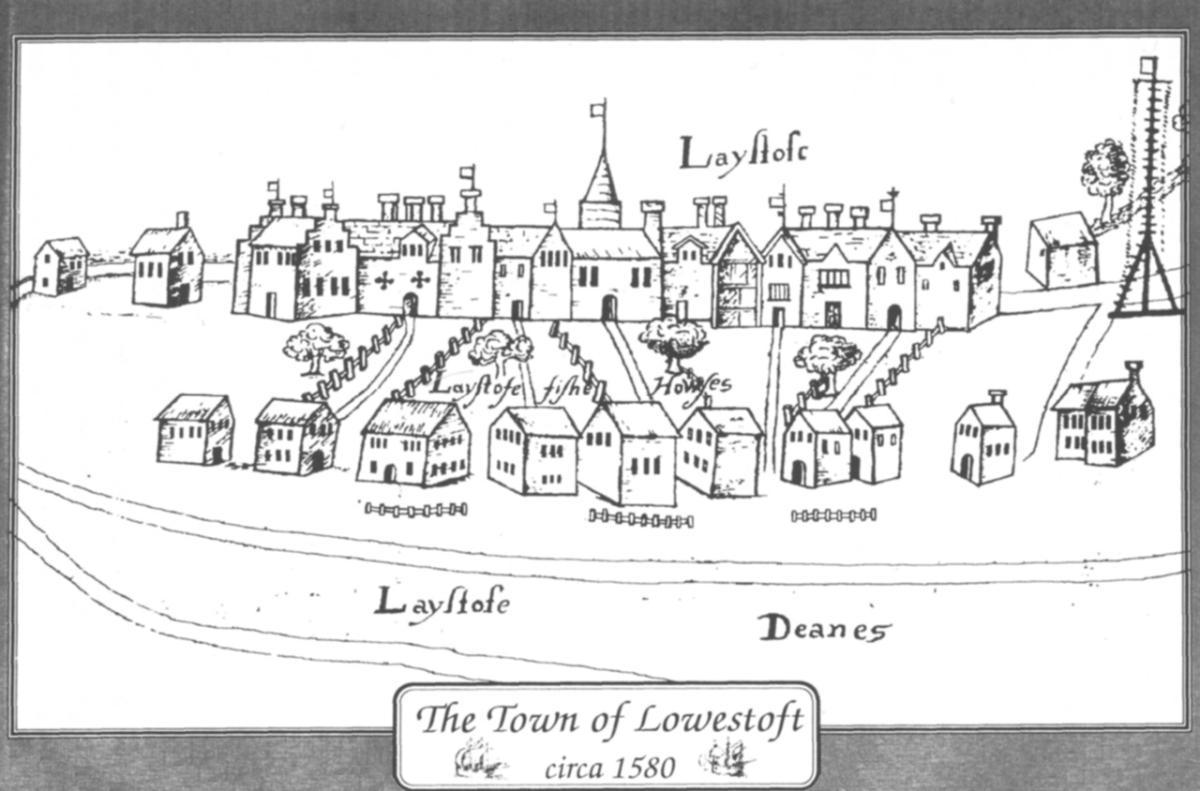
Lowestoft’s own particular speciality, traditionally, was the red herring – a fish that was left ungutted, dry-salted or brined for two or three days, and then smoked over slow-burning fires – a process which had been in operation from at least the first quarter of the 15th century, and probably even earlier. There are frequent references to fish-houses in wills and inventories of the 16th and 17th centuries, and a diagrammatic view of the town present in a map of the local coastline from Pakefield to Gorleston c. 1580 – Suffolk Archives (Ipswich), Acc. No. 368 – shows these buildings at the base of the cliff. Furthermore, the Lowestoft product was considered superior to that of Great Yarmouth, where red herrings tended to be made from inferior fish and pickles from better-quality ones. In Lowestoft, although shotten herrings were cured into reds (to fill a gap at a lean time of year, during the early spring), most of the product was made from fish in prime condition. The fish-houses themselves were built variously of timber, brick, flint and tile, but there is no specific information concerning size. The curing process relied upon the impregnating effect of smoke on the salted fish, which were hung suspended over slow fires burning every other day on the fish-house floors. It had nothing at all to do with heat.
There is a good contemporary description of the cure of red herrings in the late sixteenth century to be found in a court baron minute of December 1584. As part of the agreement whereby he sold the Swan Innmessuage on Lowestoft High Street –located on the plot of Nos. 41-42 – to John Archer (London fish merchant, operating in both Lowestoft and Great Yarmouth), George Phifeld (merchant) was to supply the purchaser with a certain quantity of red herrings. There were to be twenty lasts of them (i.e. 200 barrels, with the curer’s last being reckoned at 10,000 fish): described as “full red herrings, good able and marchant [saleable], of one night’s taking, to be roared in vats with sufficient salt before they be two nights old, dried with ashen billets of the best usual manner and order of making of herrings for Leghorn beyond the sea, with a bright and clear colour, and without gorge to be packed in such good and dry cask as usually is transported to Leghorn aforesaid.”
This account shows that the herrings were to be of the finest quality. First, they had to be full – that is, containing milt or roe. Next, they had to have been caught in a single night and conveyed immediately to port. They then had to have been dry-salted in vats (rather than in heaps on the floor) for no more than twenty-four hours, before being hung in the fish-house to be smoked over slow-burning ash billets (not oak). Finally, they were to be packed without gorge, which means that they had to placed carefully in the barrels – not crammed in just anyhow.
Two hundred years after Phifeld [al. Fifield] and Archer had made their arrangements, another account of the process is encountered in Edmund Gillingwater’s History of the Ancient Town of Lowestoft (1790), pp. 95-6 – with the process described being much the same as the one used right into the 20th century. The cure was longer and harder than the earlier one, and there is more detail given regarding it. The fish were deposited in heaps on the floor of the preparation-area, given a generous sprinkling of salt, then allowed to stand for two days – being periodically moved and re-heaped with wooden shovels, so as to distribute the salt thoroughly, in a process known as roaring or rousing (though this particular part of the activity is not referred to).
At the end of this time, they were washed and drained, before being threaded through mouth and gill-opening onto wooden rods about four feet in length. These speets – a variant of “spits” – were then lodged on wooden racks (known as loves) fixed to the sides of the fish-house. Once all the rods of herring were in place, slow fires of oak or ash billet-wood were lit on the floor and kept smouldering for anything up to a month. However, the smoking process (or drying, as it was often called) was not continuous and the fires were extinguished every other day and the oil of the herrings allowed to exude. At the end of the period of cure, they were packed into casks of thirty-two gallons capacity (each containing 1,000 fish), ready for sale. Many of them were exported to Mediterranean countries, but they were also popular in England as breakfast fare.
Two commodities of key importance in the curing of red herrings were salt and wood (the former was significant, too, in the processing of cod and ling). Grey salt, Bay salt and white salt are all regularly referred to in Lowestoft probate inventories, with considerable quantities sometimes held in store. There needed to be. No figures exist for the amount of salt used to produce red herrings, but estimates varying from half an ounce to an ounce and a half per fish have been arrived at for pickles, which means (if the mid-point of one ounce is adopted) that a last of these (12,000 fish) would have required about a third of a ton for the curing process. If the salt needed for herrings is added to that used in curing cod and ling, it can be seen that many tons of the commodity were used each year. White salt was of better quality than grey and was the type commonly used in curing fish. Bay salt was also of reasonable quality, having originally been imported from the Bay of Bourgneuf, to the south-west of Nantes, in France. By the late 16th century, the term had tended to become generic for any salt produced in coastal areas abutting onto the Bay of Biscay. This often required refining (by boiling it in sea water), in order to get rid of impurities.
Large quantities of oak and ash wood were also required, their function being twofold: to provide clapboards(barrel staves) for the coopering trade and to furnish billets for the smoking process. Ash was the species favoured for both uses, because it was less dense than oak (thereby leading to lighter casks) and burned less acridly. However, there was not enough of it grown to meet the need, and oak was the commoner of the two species used. So great was the demand for casks that oak staves were brought in from the Sussex weald and from German ports along the Baltic coastline – particularly into Yarmouth. Some idea of the passage of such materials can be derived from local Admiralty Court and Water Leet records of the second half of the 16th century, in which clapboards feature regularly as items of salvage washed ashore.
The lengths of timber used for barrels, both from local and outside sources, would have necessitated the cutting and shaping of high-grade material. But the billet-wood could have been produced from all kinds of small trees and odd-shaped branches, either as split sections or as whole pieces. An official statement of measurement of James II’s reign (1685-88), gives the billet’s dimensions as forty inches length by seven and a half inches circumference (just under two and a half inches diameter). Poles or rods of this size would have been grown in coppices and might possibly have been on the large size for use in fish-houses, requiring reduction in length. It may well have been that fish-houses used wood of varying length and thickness as fuel – and the term billet, therefore, might well have had a looser meaning than the official one.
The Beccles-Bungay area, which lay within a ten to fifteen mile radius of Lowestoft, has been identified as a major producer of billet-wood for Great Yarmouth, and it is possible that Lowestoft itself also drew upon this source. The town had comparatively little managed woodland itself, but parts of the Half-hundreds of Mutford and Lothingland were well endowed with coppices, plantations and parkland, and so were the neighbouring hundreds of Blything and Wangford. Mutford, Sotterley, Wrentham and Reydon (with extensive managed woodlands) all lay to the south of Lowestoft, while Somerleyton (with its notable estate) was located to the north-west. The probate inventory of Roger Hill, merchant (20 August 1588) – who lived at 31-32 High Street – records the sum of £40 owing to Richard Selling of Reydon for the delivery of 30,000 billets (see An Inventory of the Worldly Goods and Assets of Roger Hill, elsewhere in the History pages of LO&N). And a famous, damaged, Lowestoft porcelain blue-and-white mug dated 1768 (decorated by Richard Phillips and dedicated to John Cooper) shows the latter hanging speets of herring above two burning fires of billet-wood: Sheena Smith, Lowestoft Porcelain in Norwich Castle Museum (1975), p. 45.
It is a tribute to the efficiency of woodland management of the time that both Lowestoft and Yarmouth were kept supplied with the amount of billets required.
The Mackerel Voyage
Apart from lining for cod and other demersal species, and the autumn herring season, there was one other main voyage in which the larger Lowestoft fishing vessels were involved: the mackerel catching, which took place in late spring/early summer (May-June). The working method was essentially the same as for herrings, another pelagic species, except that the nets had a slightly larger mesh, not nearly so many of them were cast, and the fish were not salted down on board the boat. Because of their perishable nature, mackerel had to be landed as soon as possible after capture and a boat would stay out a second night only in the event of a very small catch. The fish were landed directly onto the beach, each boat’s catch being heaped up separately from those of other vessels, and the fish were sold either by pre-arranged contract or by public auction (Gillingwater, Lowestoft, pp. 108-9) The market for mackerel was a local one, with the towns of Suffolk and Norfolk at not too great a distance from Lowestoft being the ones served – and also the city of Norwich, with its important fish market on Fridays. By the end of the eighteenth century, fast-sailing cutters were also running the catches down to London (Gillingwater Lowestoft, p. 109).
The number of mackerel taken by any one boat was never as great as the number of herrings caught. A haul of between 1,000 and 2,000 fish would have been considered a good one. Writing towards the end of the 18th century, Edmund Gillingwater (p. 100) says that the vessels sailed “into the north-east” at the beginning of the season, which means that they were probably working the Winterton Ridge or Smith’s Knoll area. Mackerel were known to be present in both places, though the latter was to win its fame ultimately (during the first half of the twentieth century) as Western Europe’s premier herring ground. As the season progressed and the mackerel shoals migrated, the boats gradually moved southwards, nearer to Lowestoft – an identical sailing pattern to that which prevailed on the autumn herring voyage. The fishery lasted about six weeks, from the middle of May to the end of June, and it provided an alternative fishery to the second North Sea lining venture. It was never a great money-maker, in the way that herring was, but it did serve to keep vessels and men employed.
Sprat Activity
Occasional references to sprat nets in Lowestoft probate inventories show that this species was also caught – and almost certainly by the small inshore craft previously referred to in this article, using lighter, smaller-meshed drift-nets than those employed for herring. The fishery would have been a winter one during November and December, perhaps extending into January. But, it was never part of Lowestoft’s main commercial fishing activity and would have served simply to provide a source of nutritional food, to add to the local diet. Surviving records of fishing enterprise in Mark Bailey’s work, The Bailiffs’ Minute Book of Dunwich, 1404-1430 (1992), show that Sparlyngfar/Sperlyngfar (“sparling”, or “sperling” being the name commonly used, at the time, for the sprat) was an important seasonal venture in that town.
Some of the catch would have been consumed directly by the local population, but Dunwich (along with Southwold and Aldeburgh) also smoked this species into red sprats for export to other ports in England, as well as across the North Sea to Dutch communities.
Crew earnings and methods of payment
There is nothing in the Lowestoft records before 1750 that states directly how much the men engaged in fishing earned. Crew members were paid a share of the boat’s profits at the end of the voyage, on top of a sum agreed at the start of the fishing. The profits were the money remaining after various expenses (covenants, gear, provisions and repairs) had been met. If no profit had been made, then the men had no share to take up – though they had received their keep on board while the voyage was in progress and the sum agreed at the start of the venture was guaranteed. This payment was known as the covenant and it was disbursed in varying amounts, according to rank and seniority on board. The money was meant to provide a bare, subsistence wage for ordinary crew members and probably amounted to no more than 4d. a day. Masters and mates fared better, with respective payments of around 2s. and 1s. 6d. Most of the earnings cited below probably need to have the amount agreed by covenant added to them. In the absence of any covenant agreement, the value of the individual share was considerably higher.
Cod-lining boats each had thirty to thirty-five shares attached to them, which means that any profits were divided by the total number of shares in order to fix the value of the individual share or dole, as it was more commonly known (the word deriving from Old English dãl, meaning “a share”). It is likely that the Lowestoft fishermen and merchants used much the same share-system as that adopted in Great Yarmouth, whereby crew members were apportioned a share or a share and a quarter each, according to their rank and seniority, and the master of the vessel was allotted a share and a half. The fishermen may also have been allowed an agreed proportion of the catch as part of their payment, but they would have been expected to contribute a certain amount of the gear used on the voyage. With a crew of ten, the shares taken up by the fishermen would have added up to between eleven and thirteen, leaving the rest to be taken by the boat’s owner(s).
It is possible to work out from the Lowestoft Tithe Accounts (Norfolk Record Office, PD 589/80) how much the men earned on North Sea lining voyages undertaken during the late 17th and early 18th centuries. The vicar was entitled to one half-share (known commonly as Christ’s half-dole) of the profits of each vessel engaged in the various fishing voyages, and the money due is carefully recorded. The range is from nothing, when boats made no profit, up to £3 18s. 4½d. for a vessel engaged in the Michaelmas voyage of 1709. This means that the full share, or dole, on that occasion was £7 16s. 9d. – an exceptionally good pay-off, which would have earned crewmen nearly £1 a week (plus a weekly covenant payment of 2s.), if the voyage was of an average eight weeks’ duration.
Usually, the value of the dole was much lower, being in the range of 10s. to £3. The former sum would have meant a weekly payment of 1s. 3d. for ordinary crew members on an eight-week voyage and the latter would have produced 7s. 6d. (both being augmented by the weekly 2s. covenant payment). In terms of profitability, a ten-shilling dole indicates net profit of £15 to £17 10s. 0d. per boat (the difference resulting from the variation in the number of shares outlined two paragraphs above), a £3 dole net gain of £90 to £105. A perusal of the Lowestoft tithe accounts suggests that the yield of the springtime lining voyage generally declined as time went by, while the Michaelmas one became more productive – though without ever involving a large number of craft, because of the demands of the autumn herring season. A local Quarter Sessions wage-fixing of 1682 shows than an agricultural labourer would have earned 3s. a week, with food provided, and a building craftsman in the region of 4s. 6d. See Isaac Gillingwater, ‘Lowestoft and Lothingland’ vol. ii, pp. 1413-16 – Suffolk Archives (Ipswich), 193/1/2.
Also observable in the Tithe Accounts is the difference in the number of vessels fishing for cod and other demersal species (on the spring voyage particularly) before 1700, compared with the size of the fleet in the years following. Twenty to thirty craft were involved at the very end of the seventeenth century, a maximum number of eleven or twelve in the early 1700s, and only two or three thereafter. Unfortunately, no figures are available earlier than 1698, which makes it difficult to form an opinion about the cause of such noticeable reduction. It looks as if the end of the seventeenth century was a period of buoyancy for the spring and midsummer lining voyages, and the decline thereafter is unlikely to have resulted from a diminution in stocks of fish. However, it may have resulted partly from boatowners changing their sphere of interest from fishing to maritime trade, as Lowestoft’s status as a port began to cause a change of emphasis in commercial maritime activity.
The shares in herring fishing were apportioned differently from the system used in lining. A herring boat usually had seventy-five to eighty-five shares or doles, depending on the particular arrangements made, but the individual share’s value was again worked out in the manner adopted for line-fishing: any money remaining at the end of a voyage, after all expenses had been met, was divided by the total number of shares. After about 1730, some of the Lowestoft merchants and boatowners began to pay the fishermen either a weekly wage or an agreed price for every last of herrings caught (12,000 fish). This was because the autumn season had become unpredictable in yield and the men preferred not to be hostages to the vagaries of Nature. In fact, wage-payment is recorded as early as 1708 in the Tithe Accounts, with certain of the crews even at that time preferring to have the security of a fixed sum of money per week rather than taking their chance on a share-out at the end of a voyage.
There is one fortuitous, surviving set of accounts for a single fishing-master’s herring voyage in 1688, inserted into the leaves of the Tithe Book. Clearly, the figures are not necessarily typical because arrangements may have differed from vessel to vessel. On the other hand, the document serves to illustrate how the share or dole system worked. Samuel Hetch’s craft caught herrings worth £62 15s. 6¼d. Its expenses (fishing-gear, provisions, repairs and covenant payments) came to £41 13s. 7½d., which left a profit on the season of £21 1s. 11¼d. The vessel had seventy-four shares allotted, which meant that the value of the individual dole came to 5s. 6d. There were twelve crew members in this case (eleven men and a boy) and the shares were distributed in the following way: thirty-seven and a half to the vessel’s owner, nine and a half to the master, seven and a half to the mate, two and three-quarters and two respectively to two of the men, one and three-quarters to six others, one and a quarter to another, one to the boy, half to the vicar as his tithe payment, and one and a half to general purposes (the owner would probably have taken this as well).
This apportionment added up to £20 7s. 0d., which left 14s. 11¼d. to carry over to the next voyage or be taken by the boatowner. The number of shares held by the master and the mate show that they had contributed a lot of gear to the venture, but the settling was hardly a good one. The master received £2 19s 6d. for his two month’s work (just under 7s. 6d. per week), although a further 12s. a week covenant has to be taken into consideration. The crew members on one and three-quarter shares only received 9s. 7½d., which is a little over 1s. 2d. a week. A labourer at this time would have earned a weekly wage of about 3s. and a skilled craftsman about 4s. to 5s. (both with food provided), so the comparisons made are not especially favourable to fishing, even after the weekly covenant payments of 2s. have been added to the crewmen’s remuneration.
As far as the great boats are concerned in the earlier part of the eighteenth century, it is possible to work out the value of shares relating to the autumn herring fishery from the tithe accounts and arrive at an estimate of what the men earned. The value of the half-dole paid to the vicar ranged from nothing at all, when the boats made no profit, to £1 5s. 0d. The average half-dole payment for the period 1698-1725 was 14s., which means that the average full share worked out at £1 8s. 0d. – an end-of-voyage profit of £105 to £119 (bearing in mind the range of shares per boat, from seventy-five to eighty-five). Most crewmen would have been on one and a half to one and three-quarters shares, which means that they would have earned, on average, between £2 2s. 0d. and £2 9s. 0d. for the eight-week voyage, plus the additional weekly payment of 2s. agreed by covenant. Some seasons paid better than others, of course, but average earnings show that herring fishing was not notably lucrative for ordinary crew members, yielding about the same remuneration as that of rough masons and carpenters. Fishing boat masters and mates earned a good deal more than crewmen (at least three or four times as much in the case of the former, and two or three times for the latter), but they were expected to contribute much more gear.
The level of profitability for herring fishing in Great Yarmouth during the first half of the seventeenth century has been calculated at 8.8% in a good year (Anthony Michell’s 1977 Cambridge PhD thesis, ‘The Port and Town of Great Yarmouth’, p. 121). No comment can be made for Lowestoft as a whole because of insufficient information, but Samuel Hetch’s 1688 accounts show a net profit of about 20% for the owner in that particular year – though the calculation does not take account of depreciation in vessel and gear. From the crewmen’s point of view, the autumn voyage could provide a reasonable living, though it was not so good on craft which fell below average earnings level. Nothing is known about the system of payment employed on the small boats for their inshore fishery, but the suggestion inherent in the Tithe Accounts is that during a good season, given the smaller number of crew members and the lower running costs, earnings were probably better than those made on the larger vessels.
In general terms, the Autumn herring voyage offered a better prospect of making a living than the Spring/Summer mackerel fishing. The tithe accounts relating to the latter show that, between 1698 and 1725, the value of the half-dole payment to the vicar ranged from nothing at all to £1. The latter sum indicates an exceptional earning, however, because the average per boat worked out at only 6s. 4d. This means that the average value of the full share was 12s. 8d. (end-of-voyage profit of £47 10s. 0d. to £53 16s. 0d.). A boat engaged in the mackerel fishery was allotted the same number of shares as for the herring voyage (seventy-five to eighty-five) and had the same number of crew (ten). Thus, an ordinary hand working for either one and a half or one and three-quarters shares would have had average earnings of 19s. to £1 2s. 3d. for his six weeks labour – weekly remuneration of 3s. 2d. to 3s. 8d., additional to the 2s. covenant. All rates of reward cited are, of course, average ones. Lower ones, especially when accompanied by the unpredictability of employment, help to explain why fishermen with under-age children were sometimes in receipt of poor relief and why there are seventeen fishermen recorded among the 101 exemptions from payment in the Hearth Tax return of 1674.
An extra source of income on the herring and mackerel voyages was derived from working a handline over the side of the boat while it was hanging to its nets and drifting along on the tide. Any demersal species caught in this way (mainly cod, haddock, whiting and rays) were the fishermen’s to keep or sell. There is an interesting reference to the use of handlines in a Great Yarmouth apprentice indenture of March 1573, whereby Robert Catlyn of Bacton was to have half the profit of his line during herring and mackerel voyages throughout the whole ten years of his apprenticeship: Paul Rutledge (ed.), Great Yarmouth Apprentice Indentures, 1553-1665 (1979), p. 17. Interestingly enough, Lowestoft fishermen were still working handlines on the summer herring voyage to the Shetland Isles in the 1930s.
The table below presents statistics relating to the numbers of vessels involved in the different Lowestoft fishing voyages between 1698 and 1725, and it can be seen that they varied considerably. One reason for this, apart from possible fluctuations in shoal activity (of which there is no firm evidence), may lie in the dual use of vessels for both fishing and trading. It seems, generally, that trading voyages were more attractive to the seafarer. Life was no less risky and demanding, but the earnings were more predictable and regular. At the end of the 17th century, ordinary seamen were able to make 6s. or more per week, mates were paid 25s. to £1, and masters drew up to £1 10s. 0d. Payment of this nature may help to explain the increasing acquisition of dwelling houses in Lowestoft by the seafaring community, both for living in and renting, during the first thirty years of the 18th century. But the increase in fortunes was not limited solely to trading vessel personnel. Some of the more successful fishing boat masters and mates were also able to invest in real estate.
Table. Lowestoft fleet sizes: tithe book details (1698-1725)
| Voyage | Total | Max.no. in any year | Min.no. in any year | Median | Average | Comments | ||
|---|---|---|---|---|---|---|---|---|
| Spring lining | 187 | 30 | 1698 | 1 | 1717 | 5 | 8.1 | |
| Midsummer lining* | 88 | 24 | 1698 | 0 | 1706 | 2 | 3.8 | |
| Michaelmas lining | 66 | 6 | 1710 | 0 | 1700 | 3 | 2.9 | |
| Autumn herring (a) | 509 | 37 | 1699 | 5 | 1707 | 16 | 22.1 | Great boats |
| Autumn herring (b) | 223 | 28 | 1712 | 1 | 1711 | 11 | 13.1 | Small boats |
| Summer mackerel | 334 | 23 | 1699 | 7 | 1708 | 14 | 14.5 | |
*Note that there were also no boats involved in midsummer lining in the following years: 1708-12, 1719 & 1725.
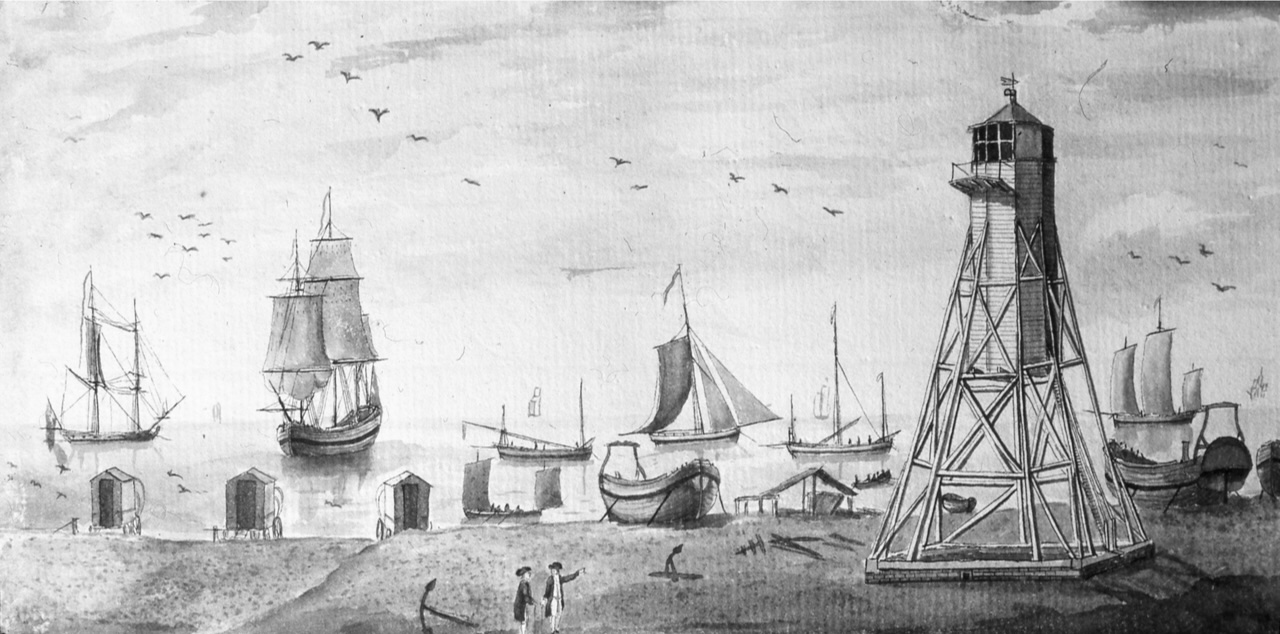
CAPTION: Richard Powles ink-and-wash study of the Lowlight (1784), showing trading vessels, three-masted fishing great boats, and the single-masted revenue cutter “Argus” - all lying offshore. Two great boats undergoing construction or repair also visible on the beach. Suffolk Archives (Ipswich), 193/2/1 - the Isaac Gillngwater collection of local illustrations
United Kingdom
Add new comment