
Historic Lowestoft Fires (1645, 1670, 1717 & 1780)

One of the things most dreaded during the Late Medieval and Early Modern periods, in townships of any size with a concentrated nucleus of houses and other buildings, was fire. And so, it can do no harm to start by giving an account of the most disastrous fire to have occurred in Lowestoft throughout throughout the whole of its recorded history. The country, as a whole, suffered from urban conflagrations of one kind or another over a period of about one hundred years, from the late 16th to the late 17th century – caused, in no small measure, by population growth leading to denser urban development, with the consequent increasing fire-risk exacerbated by the concentration of late medieval timber-framed buildings and thatched roofs in the townships themselves. Three local market towns may serve as examples, before turning to Lowestoft itself. Beccles had a serious fire on 26 November 1586, which destroyed eighty buildings, as well as the roof of the parish church’s nave and all internal woodwork, with the damage estimated at £20,000. Southwold suffered a similar disaster on 25 April 1659, with the loss of 238 houses, the town hall, the market cross, sundry shops, storehouses and other buildings – all, at a cost of over £40,000. And Bungay underwent its greatest ordeal on 1 March 1689 (1688, by use of the old Julian calendar), when 190 houses went up in flames – as well as one of its two parish churches (St. Mary’s), the grammar school, three almshouses and other buildings – adding up to the sum total of about £30,000.
Lowestoft’s fire was not on the same scale as these three, but it was bad enough nevertheless and Edmund Gillingwater features it in his published history (1790), pp. 60-2, drawing on information from the Lowestoft Town Book – a handwritten compendium of information relating to the town, written by various people over the years (including members of the Wilde family) and now lodged in the Norfolk Record Office, in its role as Diocesan repository of parochial material (PD 589/112). A microfilm copy is also available in the Lowestoft Archives Room (Acc. No. 283). The disaster occurred on Sunday, 10 March 1645 (1644, by use of the old Julian calendar), and caused damage to the value of £10,297 2s 4d. A total of fifty men are named as having suffered loss and Gillingwater presents the overall statistics (as does the Town Book) in five columns: person’s name, dwelling-houses (value), fish-houses (value), goods (value) and the overall cost of damage sustained. The people referred to constitute a broad cross-section of Lowestoft’s working population at upper level status, being largely merchants, tradespeople and master craftsmen. Their employees would also have suffered, of course, from the “knock-on” effect of their masters’ businesses being adversely affected by the fire.
It is not really possible to give a precise equivalent, in today’s terms, of the total value of the damage done, but it would probably run into several millions of pounds. What it is possible to do, because of Lowestoft’s excellent surviving manorial documentation (where property transfer is concerned) is to reconstruct exactly what part of town suffered damage on the fateful day. The fire began in a fish-house which was located below the site of the former No. 1 High Street, which is now a vacant plot of land (the 19th century house which stood there having been long demolished). It spread southwards and destroyed all the fish-houses along Whaplond Way (Whapload Road) as far as Rant Score – seventeen or eighteen in all – and twelve houses on the east side of the High Street (Nos. 47-63, using today’s postal addresses for the sites). The blaze also jumped across the High Street and destroyed or seriously damaged another five houses between Blue Anchor Lane (Duke’s Head Street) and Bell Lane (Crown Street East) – Nos. 143-149 today (See these (current) positions on Skyline) – as well as a further two dwellings located to the west of these. The amount of the individual losses sustained ranged from £704 0s 0d (Philip Rivet, merchant – Nos. 56-7 High Street – dwelling, fish-house and goods) down to £2 0s 0d (Daniel Sterry and Stephen Tripp – goods – location not known). No. 145, of course, was badly damaged by fire on 3 June 2023, to create some kind of “bridging the centuries” reference with regard to such unfortunate occurrences.
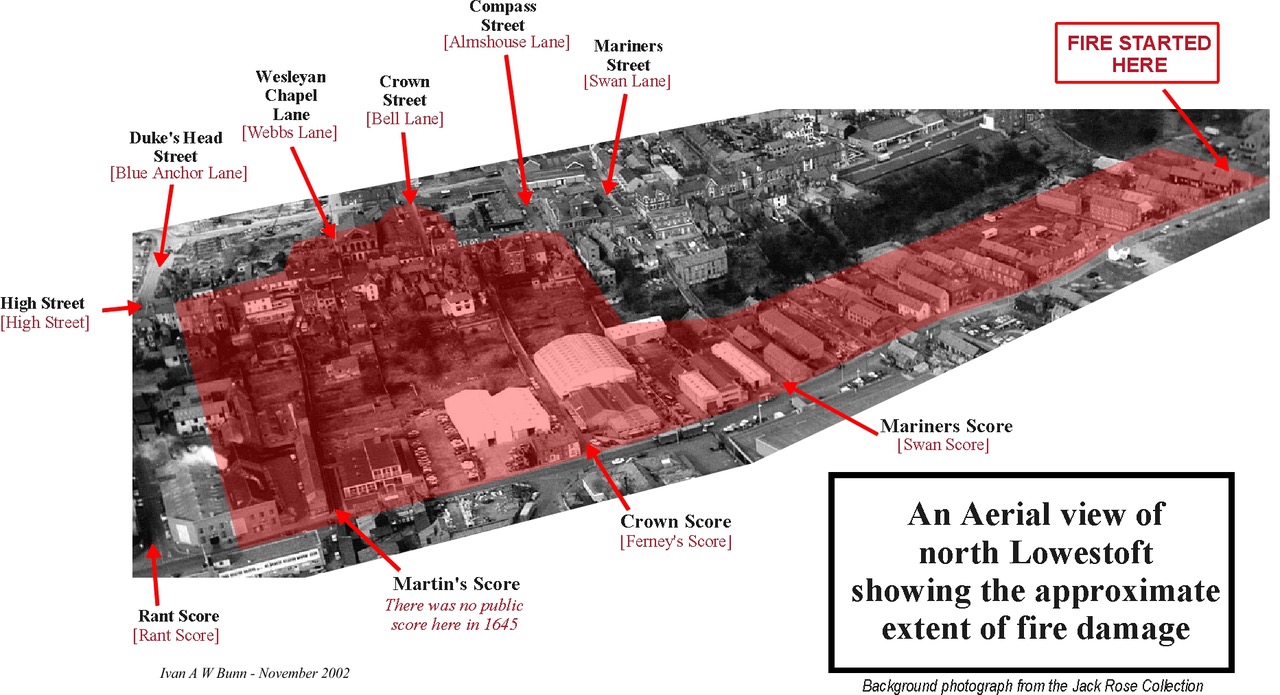
Given the time of year at which the fire of 1645 occurred, this suggests that a strong northerly or north-easterly wind was blowing, which must have carried the sparks from the initial blaze below No. 1 High Street southwards, along the row of fish-houses abutting onto Whaplond Way. The curing of red herrings, over the years, created an encrustation of soot and fish-oil on the inside walls of the buildings and also on the wooden racks which supported the rows of fish as they were being smoked. It is then conceivable that a change of wind direction to the east or south-east caused the conflagration to move up the cliff-face onto the High Street and bring about the destruction of houses from Rant Score northwards. The intensity of the blaze could (and did) then jump the relatively narrow gap of the High Street onto the other side and create damage there. It took the town some considerable time to recover from this disaster, the length of which can only be guessed at rather than known – but, greater detail concerning the fire itself can be found in a Heritage Workshop Centre publication by this writer and his friend and local history colleague, Ivan Bunn, entitled Lowestoft Burning: the Fire of 1645 (2003). The image used in this piece is to be found there.
The listing of the overall damage done, recorded in both the Town Book and Gillingwater’s published history was for the information of a commission of enquiry which came to Lowestoft on 24 April - some six weeks after the disaster had occurred. This body of men would have largely consisted of influential gentry from North-east Suffolk (including the Member of Parliament and local Justices of the Peace). After hearing the evidence of those affected and taking down the details, these pillars of the community would have drafted a brief, to be read out during Sunday morning service in churches both near and far, appealing for subscriptions to alleviate the hardship suffered. It was a procedure analogous with the charitable appeal of today and would certainly have met with some degree of success - though not to the extent of raising the amount calculated as the sum total of the damage caused. Any disbursements made from the money collected would probably have been carried out by the parish vicar and churchwardens, assisted perhaps by other leading townsmen.
Any brief requested for the relief of distress (of whatever kind) had to be verified by application to and approval from the Lord Chancellor who, if satisfied with the validity of the claim, authorised its issue. It was then printed out and distributed over a specified geographical area and the subscriptions made were collected by men appointed for these. They, in turn, handed the money over to the Archdeacons of the various dioceses involved and these high-ranking ecclesiastical officers would then see that the money reached the intended recipients. Thus, the Church of England was very much the mechanism of relief for all kinds of disaster in England (and further afield) during the Early Modern period. And some sense of this is given in one particular documentary source relating to Lowestoft itself.
Among the parochial records lodged in the Norfolk Record Office (PD 589/3) is a woollen burials register and vicar’s day-book (1678-1765), which came into being following the Woollen Burials Act of 1678 – a measure which required that everyone be buried in a woollen shroud as a means of boosting the national textiles industry. Anyone buried in linen cloth had to pay a £5 exemption fine, and a number of the wealthier members of the community did just that, using the penalty as a means of declaring their social superiority. After a time, the two distinctive modes of burial were no longer recorded and the register was then used by the Lowestoft incumbent to keep a day-to-day record of baptisms, marriages and burials as they occurred – which were then entered in the official parish register(s). Among the material to be found is a list of briefs issued in St. Margaret’s Church between August 1681 and September 1698 – the majority of which, as referred to previously in the book Lowestoft Cameos (2022), pp. 69-70, relate to fires in different parts of England but make no mention of that which ravaged Bungay in 1689.
Three other Lowestoft fires are referred to by Gillingwater (pp. 62-3), the first of which occurred on Sunday, 14 August 1670, and destroyed six houses and two barns filled with corn – the loss sustained thereby amounting to £350 0s 0d. The comparatively low cost of the damage and the mention of agricultural buildings suggests that the fire broke out somewhere on the western edge of the town, where the houses were smaller than on the High Street and where barns were situated so as to be easily accessible from the nearby agricultural land. A social geography is discernible in the town of Lowestoft of the time, whereby the affluent members of the community (merchants and the more important tradespeople) tended to live on the High Street, with the lesser craftsmen, artisans and labourers domiciled in the adjoining side-lanes to the west. A likely location for the fire, therefore, was somewhere in the Back Lane/Pond Pightle neighbourhood – identifiable for us today by the Factory Street-Elim Terrace area to the north-west of the large traffic roundabout at the confluence of Artillery Way, St. Peter’s Street and Jubilee Way.
The appeal issued for this blaze (which seems to have been local rather than national) is reproduced in full, as a footnote in Gillingwater, and is worth repeating to give some sense not only of the occurrence itself, but of the response of those seeking to alleviate distress. “Whereas, upon the 14th of August, 1670, being the Lord’s day, about twelve o’ clock at night, the wind being very high, there happened a sudden, dreadful, and lamentable fire in this town, which consumed six dwelling-houses with their goods, and two barns with corn; which loss upon examination, and in the judgement of workmen, amounted, at least, to three hundred and fifty pounds; to the utter ruin of six poor families, whose wives and children are left in great distress: in testimony of the truth thereof, we the minister, his majesty’s justices of the peace, and principal parishioners of Lowestoft, have hereunto subscribed our names; and do humbly recommend their condition to the Christian charity of your town, and beg the favour that you would promote it by such way and means as in your wisdom shall be thought meet, either by recommending it to your minister, or other ways; so that a speedy collection may be made answerable to their present distress. That they beholding God’s goodness handed to them by you, may bless and praise his holy name for the same. And what monies shall be collected and conveyed to our hands, we shall distribute it to those who are truly the object of charity; and thankfully remain etc.” John Youell, vicar, and several inhabitants - Sir John Rous [of Henham], Sir John Pettus [of Chediston], Sir Robert Kempe, John Bedingfield esq., Edward North esq.
Both Rous (the local MP) and Pettus had been leading supporters of Lowestoft’s successful fight during the early 1660s to free itself from Great Yarmouth’s attempts to control its maritime trade and the money raised by the appeal amounted to £36 10s 7d – with Pettus’s collection from different places standing at £7 16s 3d. Lowestoft itself raised £18 11s 3d, Pakefield/Kirkley £4 1s 7d and Beccles £6 1s 6d. One significant feature of the proclamation is the reference to the strength of the wind as a factor in the devastation caused. As was noted earlier, this was a likely contributor to the “great fire” of 1645 in enabling it to spread quickly and drastically from its point of origin. It was also a contributory cause in the fire of November 1717, which Gillingwater again faithfully records, using the words of the Revd. John Tanner, Vicar of Lowestoft from 1708-59.
“And on the 12th of November, 1717 [a Friday], about four in the morning, another sudden and terrible fire broke out in this town, in the fish-houses belonging to the co-heirs of captain Josiah Mighells, then in the occupation of Joseph Smithson, which, in a short space of time, entirely consumed the said houses; together with part of those houses belonging to William Mewse, which laid to the south, and part of those houses belonging to Mr. John Barker and Mr. Thomas Mighells on the north. The wind blew pretty fresh at south-east, so that the sparks flew over the town, and once actually fired the thatch of a house in Swan Lane (Mariners Street): but men and water being ready for that purpose, it was immediately stopped; and it pleasing God of his mercy both to damp the wind and to bring it more to the southward, the town escaped as a brand [a burning stick or piece of wood] plucked out of the fire; for which I hope we shall ever be thankful.”
It is a simple matter, using John Tanner’s most evocative description, to work out which part of town was affected. The fish-houses referred to were located at the bottom of the cliff, to the east of what are now Nos. 55, 56-7, 58 and 59-60 High Street, and the cost of the damage was put at £1,000 0s 0d – which suggests that the buildings were large ones, with substantial stores of material stored within or nearby. The fire had started in the premises below No. 58 (co-heirs of Josiah Mighells) and spread to those below Nos. 59-60 on the south side (William Mewse) and below Nos. 56-7 & 55 on the north (John Barker and Thomas Mighells). Three of the men referred in Tanner’s account were merchants (Messrs. Smithson, Barker and Mighells), while William Mewse was involved in the family butchery trade as well as having an interest in fish-curing. An interesting social perspective is in evidence here, too. Barker and Mighells (Miles, in its later derivative form), as leading civic figures, are given the courtesy title of Mr. – the abbreviated form of Master – while Smithson and Mewse are simply referred to by Christian names only, being of lesser civic stature. Such subtleties of rank are largely lost on us today.
There are also other things of interest to be noted. The co-heirs of Captain Josiah Mighells included John Tanner’s wife, Mary (née Knight), who – along with Matilda Pake and Elizabeth Rivet – was a member of the influential Mighells family group. Next comes the interesting comment made by John Tanner of there being men and water ready to tackle the fire, after it had spread to the roof of a house in Swan Lane. Does this mean that Lowestoft had some kind of early fire-engine ready to deal with emergencies? Certainly, a pump of some kind would have been needed for water to reach the burning thatch on the roof of a house. The 1645 fire had resulted in the replacement of thatch by tiles across much of the High Street itself, but it seems that the former had remained in use in the side-lanes which lay to the west of it.
The last of the Lowestoft fires to be mentioned by Edmund Gillingwater occurred on yet another Sunday (which makes it three out of four) and involved two of the town’s windmills at its northern end of town, located on what was known as Church Way (St. Margaret’s Road). The easternmost of these caught fire on Sunday, 30 July 1780 – cause unknown, but flour-dust is highly combustible – and the blaze was spread by a strong easterly wind to the other mill which stood about 200 yards away to the west, nearer to St. Margaret’s Church. According to Gillingwater, both of them were “totally consumed”. With Sundays featuring in three of the four recorded fires, was there perhaps something in the traditional Sabbath “day of rest” practice which made vigilance a little less forthcoming than was the case on the six other working days? All three cases involved work premises of one kind or another (fish-houses, barns and windmills), which may not have been under as much scrutiny on Sundays as they were during the rest of the week. The combustible potential of fish-houses is obvious, given their function, but both barns and mills contained materials which were also likely to catch fire if circumstances allowed this to happen.
United Kingdom
Add new comment