
St. Margaret’s Parish Church
Introduction
The Church of England, as it stands today, is an organisation which originated in the need for a Tudor monarch (Henry VIII) to produce a male heir and secure his family’s tenure of the Crown and which then became part of a North European, Protestant, theological revolution. It is currently undergoing one of its periodic phases of change. Its financial base has, for some considerable time, become increasingly insufficient to maintain the clerical structure of its ministry – even with decreasing numbers of people offering themselves for training as clergy – and its traditional parish organisation is no longer fully sustainable under present trends. Diminishing congregations (particularly in rural areas), with a top-heavy age profile, struggle to meet their financial obligations in paying for their priests and their problems are compounded by the need to maintain large and expensive structures – sometimes inconveniently located in the communities which they serve. Medieval churches, particularly, have a heavy burden of responsibility imposed on them. They all carry Grade I or Grade II* status (depending on their architectural and historical interest) as listed buildings, and the congregations have to maintain them as best they can. If the nation values its heritage, something will have to be done soon to make public funds available to preserve these ancient fabrics, especially the ones which have to close their doors through being no longer viable to keep in use.
At the time that St. Margaret’s Church was built, during the Late Medieval period, the Roman Catholic ecclesiastical structure throughout the whole of Western Europe was still largely intact and functional. A set of common beliefs was mainly adhered to by the various nations and their leaders – though dissatisfaction with Papal authority manifested itself from time to time, as did matters of Biblical interpretation and sacramental practice. John Wyclif and the Lollard movement in late 14th and early 15th century England, for instance, can be seen as foreshadowing the storm that was eventually to break in 1517 when Martin Luther nailed his ninety-five theses to the door of All Saints Church, Wittenberg. But, for the most part, Catholic Europe was united (in a religious sense) by a set of common beliefs and values, which were not always adhered to on a personal or national level but which would have at least elicited lip-service on the part of most people.
Just how much a local parish church mattered to its congregation is hard to assess – but its presence was often sufficiently important for those who could afford it to pay for its construction. Once built, it was as much a statement of civic pride and personal affluence as God’s house. But it was there for everyone, in the sense that people were baptised in its font, married at its door (within a porch, or not) and eventually laid to rest in its burial ground. The first two of these services provided were sacraments in their own right and, along with committal to mother earth, were the most fundamental acts for the majority of people. Of the other five recognised sacraments, one (the ordination of priests) did not concern them at all and another (mass) usually involved them directly only once a year – mainly, at Easter. The other three, confirmation, penance and extreme unction, were probably desultory in nature and dependent in part on an individual’s social and economic standing. The peasant, working the long and arduous hours that he (and she) did, would not have had a great deal of time for regular confession to the priest, or for the obligatory act of contrition which followed it – but someone of higher status might well have had. The last rites, as preparation for impending death, would have been irregular and spasmodic in administration and, again, more likely to have been given in the home to those of means and standing in the community. However, generalisation must not be carried too far and there were undoubtedly clergy of sufficient character (such as Chaucer’s “povre Person of a Toun”) who would have visited the sick assiduously, regardless of rank. As for the confirmation of children (theoretically, at about the age of two or three) to follow up and reinforce their baptism, that really was a lottery, with many bishops not being able (or willing) to do it. It wasn’t entirely their fault, as so many of them functioned as leading servants of The Crown, as well as of The Lord!
The church building had uses for the community outside of the three key events of baptism, marriage and burial. Its navewas used for parish meetings and gatherings of different kinds as and when necessary (including those of gildfraternities, where these existed), and the yard outside was also available for the periodic holding of religious spectacles to celebrate major feast-days and to stage church-ales – again, events held on days of religious significance and approximating loosely to the fetes of today. Times of holiday were important in the medieval calendar and the Church was the means of providing the entertainment and diversion so necessary to break the grinding routine of everyday toil. It was also the instrument of delivering a basic system of poor relief, the money being raised by the voluntary contributions of people who could afford it (collected as alms in church) and disbursed by the priest to those in need. There might even have been the opportunity for a handful of local boys (from families who could spare them) to attain a degree ofliteracy from their incumbent, if he was so inclined and competent to educate – and his own skills would certainly have been used from time to time to write documents of one kind or another and to read material for those not able to do it for themselves.
Such a broad and general view is limited by the very fact of its own simplification, but it may serve to give some sense of the ways in which the Late Medieval church touched people’s lives. Certainly, no one lived in isolation from its teachings and ceremonies and it was difficult in most communities, whether urban or rural, not to know who the local priest was and what he stood for. Even the largest towns and cities – some of them, like Norwich, containing a considerable number of separate parishes – would have had a sense of identity attaching to the individual churches which served those particular areas. And if the gifts made during the 14th and 15th centuries to both clergy and places of worship are anything to go by, there seems to have been genuine affection on the part of many people for their local parish church. This would have resulted, at least in part, from regular acquaintance with the building and its custodian, and from the wording of a number of late medieval wills it would seem that genuine friendships between priests and the members of congregations were sometimes formed.
Anglo-Saxon times
Edmund Gillingwater, in his A History of the Ancient Town of Lowestoft (1790), p. 255, took the building’s presence at face value and assumed that a church had existed in the town since soon after the introduction of Christianity into East Anglia by Felix the Burgundian in 631 A.D./CE This assumption, in turn, was repeated by Hugh Lees in his monograph on the building, its clergy and its registers – The Chronicles of a Suffolk Parish Church (1948), p. 1 – but it is very doubtful whether St. Margaret’s had such an ancient pedigree. There is no way of telling when the church was founded, but it was probably during the late Anglo-Saxon period – and, of course, it was not directly connected with Lowestoft itself, but with the township’s outlier, Akethorp. The building occupied an elevated position in the local landscape, about a half-mile in distance from the larger settlement and eventually, by process of adoption, became its parish hub.
The Domesday Survey (1086) refers indirectly to the existence of the church by naming the holder of Akethorp’s eighty-acre manor: Æthelmær (al. Aelmer), an Anglo-Saxon priest. His presence meant that of a church also, but without any endowment of land to make it taxable it might not have featured in the Domesday data. Significantly perhaps, the three churches specifically recorded in Lothingland Half-hundred – Burgh Castle, Flixton and Somerleyton – all had lands attached to them, and so did the four noted in the Mutford jurisdiction: Barnby, Mutford, Pakefield and Rushmere. However, Mutford Half-hundred almost certainly had its own equivalent to Akethorp in Kirkley township, as the place-name means “church in an open space, or clearing”. No priest is mentioned, but the incumbent of Pakefield, a community immediately adjoining, could easily have officiated. And it is also worth pointing out that there were Domesday churches in both Suffolk and Norfolk which had no endowments of land, but which are nevertheless referred to in the Survey.
Another matter relating to Anglo-Saxon churches also needs to be made at this point. In Christian theology, deriving from Christ’s own teachings, it is the people who constitute the Church – not the building in which they meet. And it is known, during Anglo-Saxon times, that congregations met in the open air at certain key landscape features to hold services. Akethorp’s church could well have been such an assembly, with the site of a future church building there, in the making, at a high-point in the local landscape. Not quite the highest – a distinction which belongs to the water-tower on Hollingsworth Road – but sufficiently elevated above the Lowestoft township below to be used as a meeting-point for religious acts of one kind or another. In approximate terms relating to today, the Domesday manor of Akethorp occupied the ground-space stretching from St. Margaret’s Church to the Benjamin Britten Academy of Music and Mathematics – this area later becoming accommodated within the parish of Lowestoft itself.
Priests in Anglo-Saxon times were sometimes known as alter-thegns, a term which recognises both their religious function and their social status. A number of them (such as Aelmer) held manorial titles, while others had holdings which simply lacked the name of manor. In both cases, they would have worked the land, usually with the help of men of lesser standing (Aelmer had three bordars). Their priestly duties were clearly defined: they were to instil Sabbath observance in their flocks (Saturday afternoon until Monday morning), to encourage attendance at church on Saturday evenings (for evensong) and Sunday mornings (for high mass), to preach whenever possible, to teach recitation of the Lord’s Prayer and the Creed and to educate children (male ones) if their parents were willing to have them undergo instruction. Receiving communion was encouraged among thelaity on a more regular basis than was the case after the Norman Conquest and it was administered in both kinds, not just the bread alone. Ritual gradually assumed more and more importance as the Late Medieval period wore on, until the people’s part in the celebration of mass became mainly that of spectators while the priest and his acolytes presented an act of holy theatre at the altar.
The dedication of Lowestoft’s church to St. Margaret of Antioch was, on the evidence of the patronchosen, a post-Conquest one. The Normans’ knowledge of the wider world, through being a continental people, brought them into contact with a greater range of Christian thought and practice than was the case among the insular English – and it is noticeable during the 12th and 13th centuries, as a pronounced expansion in the building of parish churches occurred, a greater variety of Christian saints (both male and female) featured in the naming of them. Anglo-Saxon dedications tended to draw upon associations linked with the earliest phase of Christianity, not with its later spread throughout the Roman world and its ultimate adoption by Constantine as the official religion of that vast empire. Hence, in Lothingland, the three Domesday churches mentioned were dedicated to St. Peter and St. Paul (Burgh Castle), St. Michael (Flixton) and St. Mary (Somerleyton), while the patron of the one implied by the presence of a priest (Akethorpe) cannot be known simply because there was probably no building to bear dedication.
In Mutford Half-hundred, the dedications of the Domesday churches – which, of course, were not usually recorded at the time of the Survey itself – were as follows: St. John the Baptist (Barnby), St. Andrew (Mutford), not known (Pakefield) and St. Michael (Rushmere). Kirkley, whose church is not recorded, probably had the same patron as the one of later times: St. Peter. Mutford parish itself actually had two churches at Domesday, both of them connected with the same estate. One disappeared at some point during the post-Conquest period. The church at Pakefield was what later became the northern mediety of the “two churches in one”, having a post-Conquest dedication to St. Margaret. The southern part, All Saints, had a connection with the manor of Rothenhall – this estate being the successor of a Domesday settlement of the same name absorbed by Pakefield and its neighbour, Kessingland.
From the late 11th century onwards (and particularly during the 12th and 13th centuries), as parishes firmed up in terms of their boundaries and as new ones formed from older settlements, Lothingland acquired fourteen new churches: Ashby, Belton, Bradwell, Corton, Flixton, Fritton, Gorleston, Gunton, Herringfleet, Hopton, Lound, Newton, Somerleyton and Southtown. Some of these were named after traditional patrons, while others adopted newer ones. Two of the foundations, Flixton and Somerleyton, were the result of topographical changes whereby new communities formed from older ones. A large part of Domesday Flixton went to form the new parish of Oulton (including the church of St. Michael) and a smaller building (St. Andrew) was raised to serve a much reduced community. Much of the eastern and south-eastern sectors of Somerleyton helped to create another newcomer, Blundeston, and the church of St. Mary was part of the area taken. A replacement building, also dedicated to St. Mary, was then built further to the west to serve a diminished Somerleyton. Additionally, Ashby, Bradwell, Gunton and Southtown were also post-Domesday creations, which then had to have churches of their own.
Two of the new Lothingland foundations, Fritton (St. Edmund) and Herringfleet (St. Margaret), have architectural features that suggest construction soon after the Conquest, in that Anglo-Saxon techniques are combined with Norman ones. Both have round towers, as do Ashby (St. Mary) – though with a later, much larger, octagonal modification – Belton (All Saints), Bradwell (St. Nicholas), Gunton (St. Peter) and Lound (St. John the Baptist). The rest of the towers, at Corton (St. Bartholomew), Gorleston (St. Andrew), Hopton (St. Margaret) and Somerleyton (St. Mary, as previously stated), are square – all of them being later rebuilds of earlier (probable) round ones. The ruined church of Flixton (St. Andrew) has vestigial remains of the nave only; the parish of Newton and its church have disappeared completely (a late 16th century vignette taken from a map of the coastline shows a building with a square tower); and Southtown church (St. Nicholas) has also long gone. Oulton (St. Michael) is a much modified version of a Norman tripartite building, with square central tower at the meeting-point of naveandchanceland with transeptslong demolished. Lowestoft (St. Margaret), lineal successor to Akethorpe, has a square-tower replacement of an earlier one (probably round, as was the fashion of the time). It was started during the first half of the 14th century (at the same time as the township was relocating to the cliff) and reached more than the halfway point before the effects of the Black Death (1348-9) put everything on hold until 100 years or more later.
Mutford Half-hundred is equally mixed in its types of church buildings and their dedications. The Domesday foundations recorded have already been referred to, three paragraphs above, but the decades following the great survey saw additional churches built at Carlton (St. Peter), Gisleham (Holy Trinity) and Kessingland (St. Edmund). Of the eight churches seen today, three have round towers (Gisleham, Mutford and Rushmere) and five have later, square ones (Barnby, Carlton, Kessingland, Kirkley and Pakefield).
A dedication in each half-hundred to Edmund of East Anglia, king and martyr, killed by the Danes in 869 A.D./CE and still England’s original and true patron saint (even though largely unrecognised), is extremely interesting. There are six surviving churches in Suffolk dedicated to him (plus the ruined abbey in Bury, where he was once buried) and thirteen in Norfolk. Four loose groupings manifest themselves in the two counties: Fritton, Kessingland and Southwold in North-east Suffolk; Downham Market, Emneth and Walpole Highway in North-west Norfolk; Caistor St. Edmund, Costessey, Norwich and Taverham in mid-Norfolk; and Acle, South Burlinghamn, Thurne and West Caister in South-east Norfolk.
Was their presence some way of asserting Anglo-Saxon identity in a changing world of Norman dominance? Or did it result from a conciliatory gesture made by a Norman lord in two particular Suffolk communities which happened to have a pronounced native freemanelement in the local population? In both cases, patronageof the church was vested in a former Domesday manor, with control of each estate passing to The Crown (in the case of Fritton) and to the Earl of Chester (in the case of Kessingland). There would have been no personal interest or input from either of these Overlords, their only concern being the rents due, but a lot would have depended on the surrogates charged with the day-to-day administration of both land and assets – a task that might well have included sanctioning the establishment of a parish church.
St. Margaret’s, Lowestoft, did not stand in isolation, then, as the centre of religious life in its own community. It was part of a wider structure, both in its own local area, in its diocese, in the realm of England and in Western Europe as a whole. The congregation would not necessarily have been aware of the wider geographical and theological context, nor perhaps some of the priests in the earlier stages of its existence – but, after The Conquest, the English Church became much more a part of the European mainstream in terms of organisation and sacramental practice. All the Anglo-Saxon bishops (apart from Wulstan of Worcester) were replaced by Norman successors and the indigenous native monasteries were increased in number from thirty-five or so to over fifty main establishments, with another seventy-five lesser houses and dependencies – all of them under the command of imported clergy. And not only was the structure of the native Church drastically reformed; a programme of construction in stone, in the Romanesque style, radically altered the layout and appearance of religious buildings.
Late Medieval era
What was once termed the Anglo-Saxon phase of English history (now referred to as Early Medieval) loosely coincides with a half-millennium period of development of Western Christianity, following the collapse of the Roman Empire. During this time, the Faith developed in a number of ways (not all of them good), spread into northern parts of Europe previously unevangelised and established uniformity of doctrine and practice centred on The Papacy. This overview does not take into account the so-called Great Schism, which took full effect in the year 1054 and made the Western and Orthodox churches into separate entities after a long period of difference between Rome and Constantinople focused on ecclesiastical procedures and theological differences.
The Roman Catholic time of primacy was a lengthy phase of growth and influence, the cohesion of which was eventually to be irrevocably torn apart in the second decade of the sixteenth century by the Protestant Reformation. During its earlier, formative phase, the English Church experienced three major developments of its own: the initial evangelisation of the country by Roman missionaries (beginning with Augustine in 597 A.D./CE); the established primacy of Rome in matters of doctrine and procedures over that of the native Celtic Church (decided upon at the Synod of Whitby in 664 A.D./CE); and the introduction of updated ideas and institutions from the European mainland following the Battle of Hastings in the year 1066.
Initially, following its evangelisation by Felix the Burgundian in 631 A.D./CE, East Anglia (consisting mainly of Norfolk and Suffolk) was formed into a single diocese centred on Domnoc (or Dunwich). In the year 672, probably because of the size of the area, Theodore of Canterbury (Archbishop) created the diocese of Elmham, with its mother church or cathedral located in the Norfolk community of North Elmham, five miles or so to the north of East Dereham. Thus, Dunwich became the diocese for Suffolk and Elmham that for Norfolk. By the 950s, both jurisdictions had been combined into a single entity bearing the name of Elmham and this was the way things remained, until transference of the diocese to Thetford in 1075 by Bishop Herfast, a Norman replacement of an Anglo-Saxon cleric. The new location was in use for only twenty years, as it was moved to Norwich in 1094-5 by Herbert de Losinga, upon his appointment to the post of bishop in 1091 – following the death of William de Beaufeu, Herfast’s successor. Norwich Diocese has remained in operation ever since, though the Diocese of St. Edmundsbury and Ipswich was created in January 1914 (out of part of Norwich Diocese and part of the Diocese of Ely) serve the county of Suffolk. Thus do wheels come circle in the onward flow of history.
Both Norwich and St. Edmundsbury retain something of their earlier, combined histories in having suffragan bishops named Thetford and Dunwich. The one part of Suffolk County remaining in Norwich Diocese is the extreme north-eastern sector: the old Hundred of Mutford and Lothingland, formed in 1763 from the two earlier half-hundreds for Poor Law administration and eventually becoming a rural district council in 1894. Its parishes (with the exception of those annexed to Norfolk in 1974, and of Barnby) now constitute Lothingland Deanery.
It is not possible to establish when, or if, a church building belonging specifically to Akethorp was constructed, nor at exactly what point it became the parish church of Lowestoft. But the congregation itself definitely formed one small part of three different dioceses within quite a short span of time, with three different locations for the mother church or cathedral. The nature of the first building erected on the site of St. Margaret’s is not known, but it maust have been post-Domesday (1086) and was probably of simple, rectangular form consisting of nave and chancelwith the division between the two obvious only from the inside. The structure would probably have been of flint masonry and it might also have had a round tower attached. It is not possible to make any further observations concerning its build, except to say that it almost certainly had a thatched roofand that reedwas the most likely material to have been used.
The church’s adoption by Lowestoft – or, at least, when it became viewed as serving the larger community nearby rather than its parent, Akethorp – probably occurred at some point between Domesday (1086) and the later years of Henry I’s reign (from 1100-35). In 1123, an Augustinian canonin London, named Rahere, established a priory in West Smithfield on land donated by The King. It was dedicated to St. Bartholomew the Great and it grew into one of the great religious houses and hospitals, not only in the capital but the country as well. At some point, between 1123 and 1135, Henry I made a gift to the priory of five churches located on lands belonging to the manor of Lothingland Half-hundred: those of Gorleston, Little Yarmouth (or Southtown), Northville, Belton and Lowestoft – all of which must therefore have been built at some point after Domesday (the Akethorp/Lowestoft area having a Christian congregation and priest, at that time, but not a building in which to worship). Exactly why the monarch should have chosen to make this particular endowment can never be known.
St. Margaret, Lowestoft, and St. Andrew, Gorleston, both remain in use today, their respective sitings still retaining topographical prominence in built-up urban surroundings. St. Nicholas, Southtown, which later became the church of an Augustinian priory founded during the late 13th century, has long gone – but the presence of the religious house itself (which actually accommodated friars) is perpetuated in the name Priory Lane at the northern end of Gorleston town. The chapel of St. Mary, Northville, stood on the west side of the present-day Southtown Road, just to the south of where the former Southtown railway station once stood, and it was demolished in 1548. All Saints parish church, Belton, is still standing above ground and involved in Christian ministry – a medieval survivor in a village largely changed out of all recognition by the spread of extensive, late 20th century housing development.
Part of the arrangement, in the gift of the five Lothingland churches to St. Bartholomew’s Priory, was that the convent appointed vicars to staff them in return for receiving their great tithes and other emoluments. Augustinian canons secular (like those at St. Bartholomew’s) did not live in a closed community, like their brother canons regular, but were members of an order intended to go out and perform ministry in the wider world – a task that made them ideal to serve as parish priests. At some point, an arrangement was made between the London priory and the diocese of Norwich regarding the appointment of clergy to the Lothingland parishes, whereby the right of nominationwas vested in the Bishop when a vacancy occurred but the act of presentation (or appointment) of the nominee lay with the Prior and Convent – after the said nominee had met with him and senior clergy and been found acceptable. Thus was some kind of balance maintained between local and outside interests.
After passing into the hands of St. Bartholomew’s Priory, St. Margaret’s Church had a connection with it for some 400 years, before the Dissolution of the Monasteries severed the link in 1539. At some point, after 1086, the Domesday congregation of Akethorp/Lowestoft probably raised the first structure on the site still in use. But, neither this structure, nor its much larger successor, would have been built by the London priory. The myth of religious houses building parish churches up and down the length of the land has been long exploded; their main interest in acquiring or receiving parish churches was to appoint clergy and receive rents and tithesin return.
In Lowestoft’s case, the great tithes (the most valuable ones) would have consisted of the money due on grain only, the parish having very little productive, managed woodland for the production of timberand not much grassland for making hayon any significant scale. When the Rev. John Tanner, Vicar of Lowestoft (1708-59), was able to purchase the great (or rectorial) tithes in 1719 – mortgaging himself to the limit in order to do so for the benefit of the living itself, and not for personal gain – he increased the incumbent’s annual income by £70 from a fluctuating average of c. £40-£65 .
The medieval incumbents of St. Margaret’s (as was the case with their post-Reformation successors) lived on the parochial small tithes and on the crops grown on their portion of the glebe-land. The tithes consisted of herbage (all field crops other than corn), lactage (milk and dairy products), pigs and poultry, and one half of an individual share of the profit made by each fishing vessel in operation (known as Christ’s half-dole). The ten per cent of produce due to the priest was either paid in kind, to be stored in the parish tithe barn, or commuted to an agreed (and more convenient) cash payment. If late medieval wills are anything to go by, parishioners were often in arrears with their tithe payments and the settling of such debts feature prominently among the bequests made. Presumably, if things were to be right with The Almighty, following death, being in debt to his earthly surrogate was no way to begin Eternity!
A rental of Easter 1306 (3 April), incorporating all of St. Bartholomew’s Priory’s possessions outside London, provides interesting information on St. Margaret’s Church. The annual value to the priory of the church and its tithes was £9 6s 8d (£4 13s 4d, church; £4 13s 4d, tithes) out of an overall value of £26 (£6, church; £20, tithes). The money deriving from the church itself would have been the result of various feesdue for services provided and obligations met, and it is interesting to note that the lesser tithes at this time were worth more than the great ones – unlike the situation referred to two paragraphs above. This would seem to suggest that less grain was produced in Lowestoft during the Late Medieval period than was the case later on, when agricultural improvements (particularly the use of crop rotation to avoid resting land every third year) had improved yields considerably and led to more consistent levels of production and when more land had been put under the plough.
In addition to the income from fees and tithes, the priory also received the rental money due from the church’s glebe-land, which was largely leased to tenants. There is no mention of the priest’s own share of the land, but he would have had an area either to tend himself or pay someone else to do it for him. Originally, the glebewould have been part of the manorial demesne, given to St. Bartholomew’s Priory as part of the church-endowment. Henry I probably had little or no direct knowledge of his manor of Lothingland, so it was probably someone with local knowledge and influence who was instrumental in arranging the transfer of the five churches: the overseerof the royal lands, most likely, Hugh Bigod (the son of Roger Bigod, Sheriff of Norfolk and Suffolk – William I’s “enforcer” in East Anglia). Gorleston was the hub of the manor at Domesday, with 600 acres of arable land; Lowestoft and Belton were outliers, with 450 and 120 acres respectively. Thus, there was ample capacity to convey the churches gifted to their new patron with an endowment of land and accompanying rents.
The Lowestoft glebe-land was probably dispersed through the three common fields
rather than concentrated in one place. There were nine tenants altogether, whose annual combined rent came to 6s 10d (payable at Michaelmas, and six of them were also responsible for the payment of a specified number of hens and cockerels as part of their lease-agreements. The birds were to be taken to Gorleston on 26 December (St. Stephen’s Day) and handed over to members of the Bacon family, who held title to Gorleston manor from The Crown, and to William de Leegh [Leigh], the incumbent of both St. Andrew’s Church, Gorleston and St. Margaret’s Church, Lowestoft. A meal for the tenants was to be provided, as part of the procedure.
The year 1306 was the very point at which the manors of Lothingland and Lowestoft were transferred by Edward I to his nephew, John de Dreux, Earl of Richmond, so the matter of tenants taking their fowls over to Gorleston (a distance of some seven miles) is one of those interesting throwbacks so often encountered in manorial history. It was a procedure probably dating back to the mid-12th century, when the Lowestoft glebe-landwas first rented out to tenants by St. Bartholomew’s Priory and when Gorleston was still the focal point of the Half-hundred manor. The matter of Gorleston and Lowestoft sharing a priest at this time is interesting also and, given the implication of his being based in the former town, he probably employed a curate to officiate in the latter.
Table 11. Glebe tenants & rents (1306)
| Name | Status | Holding | Rent | Poultry |
| Thomas son of Walter | Villein | 1 messuage and 5½ acres | 17½d | 2 hens & 1 cock |
| Nicholas Brun | Villein | 1 messuage & 5¼ acres | 18d | 2 hens |
| Nicholas le Niweman [Newman] | Villein | 1 messuage & 3¾ acres | 12½d | 2 hens one year & 1 the next |
| Richard Thowre [Thrower] | Villein | 1 messuage & 2 acres | 5d | |
| Adam de Rothenhale | Villein | 7½ acres | 24d | 3 hens & 1 cock |
| Edmund son of the Deacon | Freeman | ¼ acre | 1d | |
| John de Goseford & Henry Basset | Freeman | 1 acre | 3½d | 1 cock |
| William Rymshale [Ryveshale] | Freeman | ½ acre | ½d | |
| 4 houses & 25¾ acres | 6s 10d | 9(8) hens & 3 cocks = 1s 3d value |
• These holdings show varyinglevels of rent, which probably reflect particular conditions of some kind relating to location and soil quality.
• The villein houses (referred to in “messuage”) were almost certainly in the township, with the strips of land – located in the common fields – attached to each one worked by the occupants at any given time.
• The three freeman holdings were probably individual strips of land.
• The half-acre held by William Rymshale had formerly been in the tenancy of William Regnald [Reynald], the largest identifiable landholder in the 1274 Lothingland Hundred Roll.
• The reference to four freemenis the only direct one to persons of this status, connected with Lowestoft during the Late Medieval period, found up until now by the writer. Edmund, son of the Deacon, might have been connected with any of the three tenants bearing that title who feature in the Hundred Roll data. The other three men do not seem to have had antecedents there and may have moved into Lowestoft during the interim. Members of the Ryveshale family feature prominently in documentation relating to illegal trading practice in local inshore waters during the 14th century.
• Three of the four villeins referred to also have no apparent connection with people referred to in Hundred Roll material – but Thomas, son of Walter, may have been related to Richard Walter(s) mentioned there.
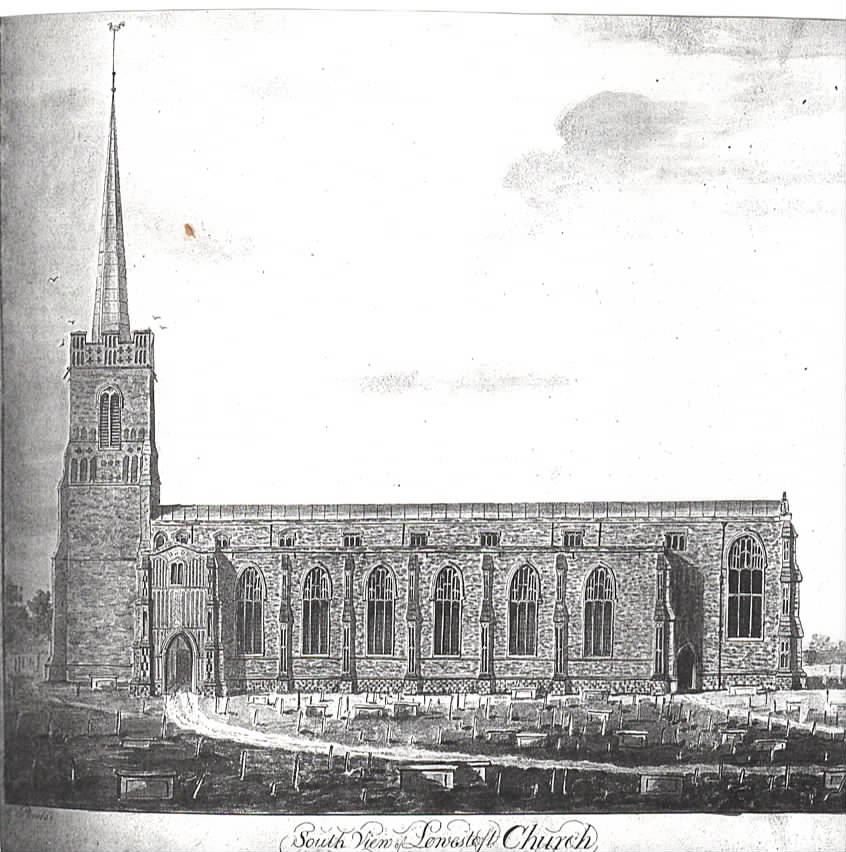
Another vital aspect of Lowestoft’s development during the early 14th century is that it was the time when the town relocated itself to a cliff-top location from its original site, at the bottom of the hill surmounted by the parish church. As it is seen today, St. Margaret’s is one of Suffolk’s great Perpendicular glories and deserving of being much better known than it is. Externally, it is on a par with Southwold, Blythburgh, Lavenham, Long Melford and others. It is also (at 182 feet) the third longest church in the county, after St. Mary (213 feet) and St. James (195 feet), Bury St. Edmunds – the latter being the cathedral of St. Edmundsbury and Ipswich Diocese. However, it is the nave and integral chancel, the side aisles, the south porch and upper part of the tower (not the spire) which date from the period c. 1440-80; the building’s extremities (half or more of the tower and the crypt beneath the high altar) being over one hundred years older, having their origins in the first half of the 14th century. With both of these major projects, the finance must have come largely from within the community – even if it is not possible to imagine or determine how.
St Margaret’s imposing presence is a combination of its siting and its construction – just like the church of The Holy Trinity at Blythburgh, standing above the marshes of the river from which the parish takes its name. Both churches have large integral naves and chancels, which are out of proportion with earlier, 14th century towers – the latter never updated, in each case, to match the rest of the building, probably because of the inconvenience and cost. St. Margaret’s tower is, in any case, an impressive structure for its period (early 14th century, on the evidence of the first stage’s west-facing Y-tracery window and the second-stage lancetabove), of good size and solid proportions. It would appear that three stages were completed, before work came to a halt – probably, as a result of the Black Death. At the other end of the church, similar interruption occurred. A crypt had been constructed, beneath where the high altar was to be located (possibly to function as a charnel house, for the storage of human bones exhumed from recycled graves, which were re-used at periodic intervals in churchyards of limited area) – and that was as far as things progressed. It was to be about another hundred years before construction resumed.
In common with other parts of the country during 1348-9, Lowestoft probably lost half or more of its population from plague. Demographic and economic recovery would have been slow, but it eventually progressed sufficiently to allow the townspeople to complete the building of their grand new civic church. Once the chancel was constructed (allowing the priest to celebrate mass) and the adjoining section of the nave was standing, demolition of the earlier church could proceed and its replacement be brought to completion. The fourth stage of the tower (in which the bells were hung) was built and a battlemented parapet added, with flushwork decoration along its four faces. A wooden, leaded spire was then set within the parapet, to give the steeple a finished height of 120 feet – work which may well have taken place as late as 1500. The main body of the building had north and south aisles added to the nave giving it an overall, external width of 62 feet, and the main entrance to the church (on the south side) was given a sumptuous, two-storey porch to grandify it. No expense seems to have been spared in making St. Margaret’s a statement of belief in God Almighty, of the community’s pride in itself, and of its increasing affluence.
It is no part of this narrative to create a church-guide, but the construction of St. Margaret’s Church, inside and out, shows craftsmanship of the highest order. The southern elevation of the building – the side approached from the town – is eye-catching and ornate (the northern side being plainer and comparatively unadorned), with superb fenestration of the aisles and with the buttressing enhanced by flushwork panels set within delicately canopied limestone frames. This work is continued at the east end of the church, where the great, five-light window takes up more than half the surface area of the wall and has skilfully contrived tracery, in which the height of the transoms is varied to create a most striking alternating pattern. The porch, too, is impressive, with lavish use of arcaded flushwork on its exterior, and the ceiling of the lower section is supported by a tierceron rib-vault with three bosses at the intersections. Inside the main building, the nave and aisle arcades (six bays in extent) have finely moulded piers and arches and are surmounted by an excellent timbered roof of castellated tie-beams supported by hammerbeams – this woodwork being restored in 1897-8 by G.F. Bodley, one of the leading Victorian church architects. Most of the medieval fittings have been removed or replaced at different stages of the church’s development, but a brass eagle lectern of early 16th century date (1504) has survived and is still in use – as is the fine (but mutilated) font on its raised, triple platform at the western end of the spacious and beautifully proportioned interior.
A lifetime’s work carried out by the late Peter Northeast, who spent over forty years transcribing and analysing Suffolk wills of the late medieval period, showed little information relating to the main constructional aspects of raising parish churches but a great deal of detail connected with exterior modification and interior embellishment. This feature holds true for St. Margaret’s Church, and therefore the people who raised the money to pay for its construction must remain anonymous. It is doubly impressive that the town’s inhabitants felt able to embark upon the raising of such a large edifice at the same time as they were relocating their township and that, having recovered from the most disastrous epidemic ever to hit this country, they were prepared to see the work through to its conclusion. The building stands as a tribute to their determination and dedication, reinforced in all likelihood by pride in membership of one or other of the five religious gilds which existed in the parish during the mid-late 15th century. More significantly, it demonstrates the economic power of the town, in terms of the wealth its leading citizens were able to spend on the edifice.
One small insight into the resumed building of St. Margaret’s, during this period, may perhaps be found in a will dating from the third decade of the sixteenth century. It was made on 15 April 1529 by Richard Jetur [Jettor] of Wyberton [East or West], near Boston in Lincolnshire, as he prepared to visit the shrine of St. James the Great at Compostela in Northern Spain. Among the early clauses in the document are recorded the gift of 10s to the high altar in Laystoft [sic], Suffolk, and the sum of £14 for “the reparation of the glass windows in the said church of Laystofte, on the north side, to be made after the same work that my father caused to be made in the windows of the south side of the same church.” Richard Jetur was a younger son of John Jettor [or Jetour], a leading Lowestoft merchant and member of one of the town’s wealthiest families (if not the wealthiest of all). He had six children, all of whom were below the age of twenty (at which point they were to receive their respective legacies), so he would probably have been forty years of age or more when he made his last will and testament. Two of the children were from his first marriage, the other four from a later union, and the elder pair (Robert and Margery) were obviously living in Lowestoft with their father’s older brother John.
The reference to Jetur’s father having work “caused to be made in the windows of the south side” of St. Margaret’s Church is interesting, as it could refer to the windows of the south aisle or of the nave clerestory above, or to both. It is sometimes difficult when trying to interpret the wording of medieval (and later) documents and establish accurate meaning, but there seems to be the implication at least, in the statement made here, that it was the glass of the windows being referred to, not the stone frames and tracery. Glazing was a very expensive process, but it may not necessarily have been considered as part of the structure of a church – which leaves the question of who provided the money for building still unanswered. In all probability, John Jettor made notable contributions towards this cost, but it was the glazing of the south-facing windows which his son, Richard, had in mind when he made his will. Exactly when the work was carried out cannot be established, but it could have been as late as 1500. And if it was, and there had been similar activity on the north side of the church, what had caused this to require reparation within three decades of its having been done?
There are three possibilities. The first is that the work had not been done particularly well in the first place, either in the manufacture of the glass or in the fitting of it; the second is that severe weather, in the form of a northerly winter gale, might have inflicted hailstone damage (there are examples of this having happened in both medieval and modern times); and the third is replacement of the glass in the cause of keeping up with the latest fashion in religious decoration. Medieval churches were constantly being modernised and re-embellished by private donation, and the seriousness of the loss of Christian artwork caused by The Reformation cannot be emphasised enough. The Protestant triumph did irreparable damage to this country’s creative legacy and there is a warning to be had from the activity of zealots, whatever the faith they practise or purport to follow.
According to the 1524 Lay Subsidy, Richard Jetur’s older brother, John, was the wealthiest of all the inhabitants of Lowestoft, paying £6 on movable goods worth £101. The family had come into Lowestoft at some point during the fifteenth century and its members quickly established themselves among the town’s mercantile elite. Their impact in the community and their commitment to its parish church may perhaps be seen in the number of graves they occupied within the walls of the building. Some very interesting remarks are appended at the end of the first surviving parish register book by the vicar of the time, James Rous (Norfolk Record Office, PD 589/1). In recording the arrival of the Puritan visitor (Francis Jessop, of Beccles), on 12 June 1644, he writes about the removal of the memorial brasses from the floor of the church carried out by this man and his assistants. Jessop’s commission authorised him to remove all inscriptions in the church with orate pro anima (often shortened to ora paia) written or engraved upon them, but he went far beyond this and removed practically every brass there was. Rous described him as “a wretched commissioner not able to read or find out that wch his commission injoined him to remove”. He claimed that “there were taken up in the middle ally [sic] twelve pieces belonging to twelve severall generations of the Jettors.”
There are ninety-five grave-slabs of one kind or another, marking burials, to be found inside the church, thirty-eight of them medieval and fifty-seven dating from the seventeenth and eighteenth century – meticulously recorded by Hugh Lees, in his The Chronicles of a Suffolk Parish Church (1948), pp. 18 & 291-2. James Rous’s claim concerning the Jettor brasses removed from the middle aisle (the nave’s) should not be taken literally in the modern sense, of memorials covering a time-span of 250-300 years. What he meant was that twelve brasses commemorating different members of the family were taken up, and this may be accepted as fact.
Eleven medieval slabs are situated in the floor of the middle aisle out of a total of sixteen such markers in all – with eight of them having indents only and three retaining remains of brasses (one of which is early 16th century and commemorates Margaret Parker, ob. 1507; Jessup and helpers overlooked her, somehow). Two of the indent-only markers have later, 18th century inscriptions added: to Francis Kettebrow [Kettleborough] (ob. 1721) and to a former incumbent, John Arrow, and his wife Rebecca (ob. 1789 and 1784). Four of the later slabs date from the 17th century and commemorate members of the Wilde, Canham and Daynes families, while a fifth is of early 19th century origins and marks the resting-place of John Brown (ob. 1803), a Lowestoft man who had moved to Great Yarmouth but wished to be buried in his native town. Any of these later stones could easily have replaced medieval ones and therefore a total of twelve Jettor brasses, as described by Rous is entirely believable. He would not have been mistaken, in any case.
The interior of St. Margaret’s is a cemetery for the town’s “great and good” (of all ages) of the Medieval and Early Modern periods, with elegant memorials of the latter time adorning the walls also. Practically the whole of the north aisle floor is covered with medieval slabs, with only a single grave (containing the remains of mother and daughter, Mary Mighells and Elizabeth Rivet), out of the total of sixteen, dating from the reigns of William and Mary and the early years of George II. Ten of the medieval gravestones have indents of effigies and inscriptions, or of inscriptions only; two have illegible inscriptions; and one is blank. There is also a truncated slab bearing an inscription indent at the extreme southern end of north aisle’s benched area and a fine matrix (without the brass) of a former, late 15th century incumbent (Thomas Scrope) in its War Memorial Chapel, at the opposite end. The latter was moved at some time during the nineteenth century from its original position in the middle of the chancel’s floor.
Two medieval slabs remain in the chancel, on either side of the aisle. One of them (south side) carries the indent of a coat of arms or merchant’s mark, the other (north side) an inscription indent. Returning down the south aisle, towards the west end of the church, there are four medieval slabs out of a total of ten set in the floor. The first of them has the remains of a brass showing shrouded skeletons. After an interposing mid-eighteenth century slab, to a member of the Arnold family, there comes one with an indent of effigies, inscription and shields, followed by a damaged brass depicting a man and his wife (the latter, headless) and with two groups of children missing from the matrix. This latter memorial also has a merchant’s mark in evidence, as well as the badge of the Salt-fishmongers’ Company, a London-based livery organisation. Next to it is the slab of William Colby (ob. 1534), commemorated by his name and year of death on a small brass plate. This man was the wealthiest inhabitant of Pakefield, shown in the 1524 Lay Subsidy as paying £1 10s 0d on movable goods worth £30. He may well have moved into Lowestoft at some point afterwards. Finally, there are four inscription-indent stones immediately west of the font, which is largely surrounded by much later memorials.
One fortunate survival which illustrates the practice of burying people inside the church, rather than out in the yard, is to be found towards the end of England’s long time as a Roman Catholic country. In his will of 16 April 1535, John Goddard (merchant), another of the town’s wealthiest citizens, made the following request: “to be buried within the church of St. Margaret, within the chancel door, whereas I do sit, upon the north side”. If his wish was carried out (and there is no reason to believe that it was not), then his place of inhumation probably lies somewhere beneath grave-slabs of the late 17th and early 18th century. As one of the town’s trading elite and a likely contributor of money to the church, Goddard’s will shows that he had both a privileged position from which to observe the celebration of mass and the conduct of other services and, ultimately, one where he could be laid to rest. The chancel of a medieval church was separated from the nave by a wooden screen, to differentiate between the priest’s domain and that of the laity, and to be allowed beyond this division was a privilege not given to everyone. In fact, it was extremely unusual to find a layman allowed into the chancel and Goddard must have been of some special standing (perhaps as a major donor towards the construction of the church) to allow him access.
The fee paid to be paid to the vicar for burial inside the church during late medieval times is not known, but by the fourth decade of the 17th century it was 11s. This is revealed in the accounts of the administration of Thomas Mighells (merchant), who made his last will and testament on 26 July 1636 (probate granted 3 November 1636) and wished to be buried within the walls of St. Margaret’s. The document itemising the sale of Mighells’ worldly goods, the collecting of money owing to him, the settling of his debts and the apprenticing of his eight-year old son, James, only survived by accident, and it makes for fascinating reading. It is to be found inserted into the pages of the Lowestoft tithe accounts (Norfolk Record Office, 589/90 – put there at some stage by John Tanner (incumbent from 1708-59) to prove Vicar’s entitlement to such payment. He had married into the branch of the Mighells family and had found the accounts among his in-laws’ effects.
The interior of the church as seen today, benched throughout during the 1870s with solid oak, is very different from what would have been seen c. 1500. The restored roof gives some idea of the use of colour in a late medieval church, as does the font cover, which was the creation of church architect and restorer J.N. Comper – one of the last great exponents of the Neo-Gothic tradition. There is also an ornate wooden screen separating the War Memorial Chapel from the rest of the north aisle – similar in style to a medieval one but lacking its bright colours and the painted figures of saints or angels on the dado (the chapel was dedicated in April 1923, as a memorial to the townsmen killed during the First World War). At one time, such a screen would have run across the whole width of the interior, richly embellished and coloured, with the rood (cross) crowning it beneath the chancel arch.
The rood-group itself, consisting of Jesus on the cross flanked by his Mother and St. John the Evangelist (sometimes, St. John the Baptist, his cousin), was an object of veneration in medieval times and much care and attention was given to it. The great double beam on which it was set was, in fact, a narrow walkway along which an attendant could move, in order to keep wax lights perpetually burning before the crucifixion scene. The approach to it was by a stairway constructed within the width of the wall (aisle or nave, depending on the design of the church) and there is one to be seen next to the War Memorial Chapel’s screen. Of all the symbols of Roman Catholic practice within a church, it was probably the rood which caused many Protestant reformers most offence and the majority of crucifixion-groups were among the first things to be taken down during the reign of Edward VI (1547-53). His sister Mary restored them during her brief reign (1553-8), then down they came again when Elizabeth I acceded to the throne (1558).
Apart from the illumination of the rood beam, lights of different significance were a major feature of a late medieval church interior – and St. Margaret’s was no exception. Symbolically, they represented the triumph of good over evil; in practical terms, they served to focus the attention on specific features and to create the sense of a living building during the hours of darkness. Wills of the period make reference to four different lights, with the testators leaving money to fund the purchase of beeswax candles in order to maintain a constant illuminating presence. The common light found referred to was the hanging sanctuary lamp in front of the high altar, which burned night and day without fail, representing Christ as the Light of the World and proclaiming that his body and blood were ever-present in the holy elements held within their tabernacle. The light to the Blessed Virgin Mary would have stood before a statue of her and the infant Christ, mounted either on a bracket or set within a niche and probably located in the chapel dedicated to her. Another image of her, holding the body of her crucified son, would have been the Our Lady of Pity mentioned from time to time – again, with a light burning perpetually in front of it. Finally, the Sepulchre light would have been located in an arched recess (with decorative surrounding tracery) in the north wall of the sanctuary – this particular space representing Christ’s tomb. On Good Friday, the holy wafer (or host) was put in a box, placed in the sepulchre (which was then veiled over) and brought out on Easter Day for celebration of the high mass – a cyclical ritual representing the death and resurrection of Our Lord.
There was one other light known to have been located inside the church. It was dedicated to St. Rock (or Roch), a high-born, 14th century native of Montpellier, in France. At one point in his life, he performed relieving work in northern Italy (he is known there as St. Rocco) during an epidemic, from which he achieved cult status and, following the Black Death, became invoked as protection against plague. His feast day was held on 16 August and he may have been celebrated in Lowestoft because of residual memory recalling how the initial stages of building the large, new St. Margaret’s had been disrupted and brought to a halt in the first place. A one-acre piece of land next to the south-western corner of the churchyard had been given at some point to endow a light in his memory, the income deriving from the rent generated by hire of the ground. It had been taken from the glebe, so one of the Lowestoft vicars (with the approval of St. Bartholomew’s Priory) must have originally been responsible for its donation. The land was referred to as St. Rook’s in later times – and here was also a light to St. Rock in the parish church of St. Bartholomew, Corton, a couple or so miles away to the north.
Ritual practice of the time is further revealed in references to tabernacles. These were ornate boxes for reservation of the bread and wine used to celebrate mass and there would have been two of them, kept for use on the high altar itself. Two others are specifically referred to, dedicated to St. Margaret and St. Mary Magdalene, but these would have been portable cases made of wood or stone, embellished with tracery and intended to house an image or statue of a saint. The former would have been located in the chapelcommemorating the church’s patroness, the latter perhaps in a space used for hearing confessions. Mary Magdalene (or Mary of Magdala) was the great Christian symbol of penitence during Late Medieval times, the model of a reformed life – this stemming from a legend identifying her as a reformed prostitute. She was, however, a woman of wealth and standing in the Galilean community – one of the most trusted members of Christ’s inner circle and the person who first discovered that he had risen from the dead.
There were no less than seven altars within St. Margaret’s Church towards the end of the 15th century – five of them connected with religious fraternities or gilds. The two exceptions were the high (main) altar itself and that of the sepulchre, which would have stood close to it. The others would have been located within chapels formed by partitioning off spaces within the two side-aisles and their dedications were to the Blessed Virgin Mary, St. Margaret, The Holy Trinity, St. Gregory and St. George. Together, they form a typical selection of medieval patrons and patronesses and the gilds represented by them would have been socio-religious groups of people whose spiritual lives found focus through association with their chosen objects of devotion. The different patronal feast-days would have been celebrated with processions and feasts; vigils would have been kept on the evenings preceding; prayers would have been offered within the various chapels for the souls of departed members; and masses would have been said or sung in the same cause. Major festivals would have been celebrated also, with all due ceremony – a notable one being Corpus Christi, on the Thursday following Trinity Sunday, when the creation of the Eucharist itself was commemorated.
In the absence of any gild records surviving, or any churchwardens’ books of the period (in which their business might have been recorded), a good overview of typical activity is to be had elsewhere. The three main distinguishing features of gilds have been outlined in the previous paragraph: a religious patron, a base in the local parish church, and an annual patronal mass and feast. Reference was also made to the saying of prayers for departed members, but there was more to gild function than religious observance alone. Social and economic matters came within the remit, also. Care was taken of sick members, financial support given to those of the respective fraternities who were in need, and fund-raising undertaken for what would currently be termed “community projects” aimed at improving the town. Local politics featured in the members’ protection of what they saw as important areas of commercial interest and means of social control were exercised through the ethos of the fraternities and their sense of moral purpose. Note has also been taken of the positive effect on local economies resulting from the (sometimes) lavish spending on the annual processions and feasts – and comment has been made, too, on the effect of gilds as instruments of community cohesion and divisiveness (both features having been duly noted by different observers). Rivalries no doubt existed, and tensions sometimes came to the fore, but with their duly elected officers (wardens, stewards and councils) and their religious and civic function, gilds made an important contribution to the life of any late medieval community and also reflected its economic strength.
In the Addenda appended to his history of the town (p. 483), Edmund Gillingwater says that he had been “credibly informed” that there had once been two or three gilds in the town. He goes on to identify them as “trading companies” and speaks of the difficulty of determining which houses (i.e. gildhalls belonged to them). As far as is known, there is no surviving evidence of the presence trade gilds in Lowestoft during Late Medieval times and, while Gillingwater makes reference to religious gilds and their function, he obviously did not know of their existence in the town. The nearest he got was to speculating whether or not the light kept burning to St. Rock belonged to a gild. It has been observed that the growth of religious gilds became numerous in towns after the middle of the fourteenth century, which may possibly suggest that they were part of a recovery process from the psychological trauma caused by the Back Death – a re-founding of religious faith and practice in a changed and chastened world.
It is not known when the Lowestoft gilds were formed, but they were certainly active by the mid-late 15th century. They were probably directly involved in building the new nave and chancel and it is likely that the Vicar himself was connected with them. Chaplains are also referred to in documentation relating to the town and it is likely that they, too, were associated with the fraternities and were probably paid by members for the services they provided. The most tangible evidence today of gild activity is the presence of a banner-stave locker, in the north-west corner of the nave of St. Margaret’s. This tall, narrow recess within the fabric of the wall, with its canopied stone hood and its pierced, traceried door (not an original one), was used to store the rods on which ceremonial banners were set for processional use. Its presence is probably mainly down to chance, but it is an interesting survival nevertheless and gives another of those tantalising glances into a lost world.
The location of the gild altars is not revealed and there is little or no visible evidence to suggest where they stood. It is reasonable to suppose that the one dedicated to The Virgin was situated at the east end of the south aisle, where the organ now stands, as this would have been a prime setting (being on the favoured, lighter side of the building) for a lady chapel. Equally, with St. Margaret of Antioch being patroness of the church, it is conceivable that her dedicated space might have been situated on the north side in an identical position, occupying the area now taken up by the War Memorial Chapel – though any altar in the chapel would not have been dedicated to her, as that honour would have been accorded to the high altar itself. The space devoted to The Holy Trinity was possibly located in the upper room of the south porch. The central boss of the vaulted, stone ceiling below depicts The Trinity in the form of God the Father, shown as an old man (how else would mere mortals be able to depict The Creator?), supporting his crucified Son between his knees and with the Holy Spirit, in the form of a dove, carved upon his breast.
It is likely that members of the gild gave the money to build the porch and commissioned the boss to represent their organisation, and use of the parvis(e) above as their chapel is a far more likely explanation of its purpose than a later story that grew up concerning it. At some point, the room became known as TheMaids’ Chamber, in which two sisters (Elizabeth and Katherine) are said to have lived as recluses. These ladies, having withdrawn from the world, performed a charitable act on behalf of their fellow townspeople and paid for public wells to be dug a quarter of a mile or so from their cell, on the eastern edge of Church Green. These then became known as Basket Wells, by an adoption of pet forms of their names, Bess and Kate: a far more fanciful origin than simply sinking shafts into the ground and lining them with wicker – which is almost certainlytghe origin of the name. Interestingly enough, in her will of 6 January 1496, Katherine Wylton left an undisclosed sum of money for the repair and maintenance of the wells for a period of ten years – but she was no anchorite.
Other bequests make reference to the three chapels either directly or indirectly, some of them showing the connection of townswomen with the gilds. On 17 February 1497, Margaret Wullysby left half an acre of land in the North Field to be sold and the money used to provide “a common curtain in the chapel of Our Lady” – a hanging, perhaps, to act as a screen for the doorway. Alice Hatter, whose husband John (a wealthy citizen of the town) had predeceased her, may (along with him) have had an affiliation to the gild of St. Margaret, because in her will of 14 November 1508 she left her sister, Mary Wrenne, “a token of silver enclosing a lock of St. Margaret’s hair”, with a little pax attached to it. This object of personal devotion was obviously a treasured personal possession – one of a large number of such items to be found in the late medieval period associated with holy relics of very dubious provenance. Finally, on 1 December 1506, Robert Jetor left an acre of land butting onto Folde Lane [location unknown] to be rented out for twenty years and the money used to provide a lamp to burn for twenty years “on holy days” in the Holy Trinity gild chapel – at the end of which time the plot was to be sold and the money used to fund the saying of prayers for his soul. The holy days are not specified, but one of them would almost certainly have been Trinity Sunday.
The chapels to St. George and St. Gregory may well have been set up at the western extremities of the two side-aisles, flanking the tower archway. There would have been sufficient room on either side to incorporate the parcloses required, even on the south side of the church, where the doorway to the south porch’s staircase was located. George, of course, was a soldier-saint and well on the way to becoming the country’s national figurehead after having begun life (in England, at least!) as patron of the Order of the Garter, inaugurated by Edward III in 1348 as the country’s highest order of chivalry. St. Gregory was Pope Gregory I (known also as Gregory the Great), one of the foremost scholars of the Western Church and often referred to as one of the four Latin Doctors (the other three being Ambrose, Augustine and Jerome). One interpretation of the possible symbolism lying behind the choice of these two men as gild patrons is that one represents action (as well as being symbolic of the triumph of good over evil) and the other learning.
Further symbolism within the church’s interior would have been found in the wall paintings which would almost certainly have once been there. Popular, instructive Bible stories (the selection varied) were represented, to draw the eye and exercise the mind, and cautionary legends were sometimes present also. Probably the best known example of the latter during late medieval times was the story of The Thee Quick and the Three Dead, shown as three kings on horseback confronted by three skeletons, surmounted (or underwritten) by the caption: “As you are now, so once were we; as we are now, so you shall be.” It was a powerful reminder of the fragility of human life, delivered (it has to be said) in an era when people probably had sufficient evidence of the statement’s truth in their everyday lives.
Two specific references to paintings within the church are to be found in late 15th century wills. On 10 December 1524, Margery Lowis left the sum of £10 to her husband Geoffrey to pay for a picture of St. Christopher (and also to provide a tabernacle) – this, in fulfilling the wishes of her father, William Jetour. St. Christopher, of course, was a popular apocryphal figure, the patron of travellers, who had carried the Christ-child across the flooding river near his cell one stormy night (the Greek Christophoros means “one who carries Christ”). It was believed that whoever looked upon an image of him would come to no harm that day, which is why depictions of this particular saint were among the most common of all paintings to be found within medieval churches – usually on the wall opposite the main entrance. In St. Margaret’s case, this would have meant the north wall – a location where two fine examples in local churches may still be seen. The church of St. Edmund, Fritton, has a good 15th century representation of the saint in which it may be seen, on close scrutiny, that his staff is in fact an eel-pick – a delightful example of something in everyday use in a marshland environment being worked into the picture. The other image is to be found in St. John the Baptist, Lound, where a modern version by J.N. Comper (part of his restoration of the interior in 1914) takes the eye – even down to a detail of the creator’s Rolls Royce car driving up a hillside!
The other painting referred to in connection with St. Margaret’s Church is to be found in the will of Katherine Wylton, previously referred to. She wished for a picture of St. Sebastian to be executed somewhere within the building. Again, this late 3rd century martyr was a very popular figure during medieval times, though most surviving images of him are Renaissance paintings showing him tied to either tree or post and stuck with arrows. He was a Roman soldier of Gaulish origins, killed during the time of the emperor Diocletian (c. 288 A.D./CE) for his adoption of Christian beliefs. His execution was attempted with bows and arrows, but he is said to have survived this and to have been later clubbed to death. Because of his military background, he became a patron of soldiers and his initial ordeal also associated him with archers. It would be interesting to know why a Lowestoft woman should have chosen to commemorate this particular early Christian hero.
Vicars of the parish
Much has been written so far of the church’s origins and of the building, but what of its clergy? Both Gillingwater (p. 340) and Hugh Lees (p.38) have lists of priests in their respective works (the latter drawing upon the former and continuing up until 1938), but each contains errors that require correction. Gillingwater made use of Bishops’ registers to identify the Lowestoft incumbents, beginning with the appointment of John Ayshe [Ashe] in February 1308. This man’s predecessor, of course, was William de Leegh [Leigh], referred to earlier in the material relating to Lowestoft glebe-land – and, so, he must be given the distinction of being the first recorded priest of St. Margaret’s, though (as has been noted) he held the benefice in plurality with that of St. Andrew, Gorleston. He wasn’t the only medieval priest in Lowestoft to have held two livings, as will be seen.
Ayshe’s successor was Richard of Walcote [Walcot], in November 1330, and he was followed soon afterwards in September 1331 by John of Garboldesham [Garboldisham], who was rector also of the North Suffolk parish of Ringsfield. He, in turn, was succeeded by Matthew of Rollesby in June 1339, who held Burgh Castle as rector, and yet another pluralist came along in February 1347 in the person of John Everard, who was rural dean of Brooke in South Norfolk. He seems to have survived the ravages of the Black Death and was replaced in February 1360 by John of Welberham [Wilbraham], who served also as rector at Lound. Wilbraham was the last recorded of the 14th century pluralists and was succeeded five years after his appointment (in February 1365) by William Homfrey [Humphrey], who remained in post until his death in September 1383.
There is no way of knowing whether the four men who were appointed to St. Margaret’s, but who had other responsibilities, spent time in the parish. Lound was about four miles from Lowestoft, which was relatively close, but thereafter the distance (and the time spent travelling) increased. Burgh Castle was eight miles away, Ringsfield ten miles and Brooke fifteen – and these are distances given as the crow files, not the greater length of journey by road. The priests named would not have had the capacity to exercise a full-time time ministry and, if they did, then curates must have functioned in the other parishes held. Conversely, if the other parishes were the centres of their activities, then curates must have had cure of souls in Lowestoft. John Everard, as rural dean of Brooke, certainly wouldn’t have had the time to devote to the parishioners of Lowestoft.
After William Homfrey’s incumbency had come to an end, there seems to have been a hiatus of some kind in recording the sequence of Lowestoft vicars. Gillingwater draws a line against the year 1383 and appends the word Apostolicus beside it. On the line beneath is the name William Smoggett, with the year 1385 placed beside it. Apostolicus must refer to the Pope rather than the Bishop of Norwich, for whom the abbreviation Epi is used throughout the source of information (from episcopus), but this was the time of the Great Schism (1378-1417) referred to earlier, when two rival popes were trying to exercise control over The Church from Rome and Avignon. William Smoggett was never appointed as priest at St. Margaret’s. Revocation of his presentation is recorded on 1 July 1387 (he is described as a chaplain) on the plea of Robert Aylesham [Aylsham] that the living was not vacant and that incorrect information had been given to The King, who was controlling the temporalities (the secular assets of property and rents) of the Bishop of Norwich at the time. Eight months later, on 25 February 1388, Aylesham was confirmed as Vicar of Lowestoft.
He must have been in post from at least 1385 (possibly, 1384), because Richard II had assumed punitive financial control of Norwich Diocese in October 1383. The Bishop, Henry Despenser (a notable soldier-cleric), had led a five-month campaign into Flanders (May-September 1383), ostensibly in support of the city of Ghent in its opposition to the French-backed Anti-pope, Clement VII, who presided over the breakaway papacy in Avignon. The expedition was termed a crusade, but it had as much commercial and economic motivation as religious significance and was in some ways a continuation of the Hundred Years War by the back door. It ended with the failed attempt to take the city of Ypres and Despenser had to face impeachment by Parliament on his return – at which point The King took control of his temporalities. Eventually, he managed to re-establish himself as a leading figure in public life and restitution of diocesan resources was made during 1385.
John Aylesham seems to have remained at St. Margaret’s until 1410. He was succeeded by Simon Baret [Barrett] who, like his predecessor, does not appear in the published list(s) of incumbents. The first reference to him is to be found in a record of 4 April 1413, when a papal indult [licence] was granted allowing him the use of a portable altar. He is described as Simon, son of Simon Baret of Heacham and perpetual vicar of Lowestoft (perpetual vicar being the term used for a clergyman who lived off the small tithes of his parish) and six months later he was petitioning the Antipope, Benedict XIII, for ratification of his appointment by Pope Gregory XII (following the death of Robert Aylesham) for fear of “molestation” in his post. No further details are given, but this particular record, of 2 October 1413, shows that Baret was a bachelor of canon and civil law and that he had been in post for three and a half years.
Permission to have a portable altar for personal use is found referred to a number of times in Papal registers of the 15th century – and not exclusively for clergy. It would have been kept in the home and could have been taken with other possessions on journeys at home and abroad, for the celebration of mass as and when required. Among the grants recorded is one of 6 April 1468 to Simon Dolfin, nobleman, “lord of a place in Lowystoft”, and another of 10 May 1438 to John Fastolf, lord of one the two manors belonging to the parish of Oulton. Another privilege awarded regularly to members of both clergy and laity was the personal choice of a confessor to grant full remission of sins at the hour of death. One such concession is to be found on 7 March 1411, when William and Mabel Pye of Lowystoft [sic] were accorded the honour. The husband, it may be worth revealing, had been involved in act of piracy carried out in local waters seven years earlier against German shipping. Perhaps this was one of the things to be remembered in his final confession!
That the incumbency of William Baret was not without complications is suggested further than his own fears concerning “molestation” in the nomination of Adam Gele (chaplain) for the post, in April 1407. This was done by Henry IV, the Norwich Diocese temporalities once more being in royal hands – this time the result of an interregnum between the death of Henry Despenser (23 August 1406) and the consecration of his successor, Alexander Tottington (23 October 1407). Gele was the man who had been granted a pardon in September 1398 for raping Margaret, wife of Richard Olderyng [Oldrin] of Rushmere, at her house in Lowestoft – breaking through her fence and forcing his way into the dwelling on two separate occasions (27 October 1395 and 5 February 1397) to reach the object of his desire. There is no further information on either Gele or Baret, but the presence of the former (especially if he was a gild chaplain at St. Margaret’s) may have been what caused the latter to express concern regarding his tenure as vicar.
If Baret managed to stay in post until the next officially listed incumbent, then his period of service was a comparatively long one. William Sekynton [Seckington] was appointed in January 1432 and he was vicar for ten years, being succeeded by John Mildewell in June 1442. Mildewell was followed in December 1456 by Thomas Shirecroft, who seems to have been the shortest-serving priest of all, being replaced three months later by John Manyngham [Manningham] in March 1457. Manyngham performed his parish duties for over twenty years and three years into his incumbency, in June 1460, he was given a dispensation to hold one other benefice for life. This was a privilege allowed to many clergy during the medieval period, but by no means all of the grantees exercised their right (they had to be offered preferment, in any case) – and there is no evidence that John Manyngham did. In fact, the dispensation was repeated fourteen years later, in October 1474, with no evidence once again that the right was ever implemented. Personal circumstances regarding the man are revealed in a record of August 1472, in which he is shown to have held an M.A. degree and to have had a deformed left shoulder, arm and hand (what would once have been commonly described as a withered arm). A dispensation was granted to him to retain his position and continue his ministry, even though his disability had not been made known when he was appointed.
His physical condition was obviously of concern to him during his later years in Lowestoft. He worried that he would lose strength in the arm (which was shorter than the right one), reaching a point where he would find it difficult to exercise his priestly function. Reassurance, however, was given to him from the highest level and Pius II authorised his continuation in office as long as his handicap did not become too much to bear. This directive also made reference to the fact that he was the brother of a knight called Sir Oliver Manyngham. The most distinctive feature of his time in Lowestoft was perhaps his endowment of almshouses in the town, which were located on the north side of Fair Lane [now Dove Street] near its junction with West Lane [now Jubilee Way] and which, with various changes made, remained in operation well into the Early Modern period. The buildings are referred to in a manorial rental of June 1545 as “the allmes howssis late master manyngom” and they carried an annual payment to the lord of the manor of 10d. There was one other set of charitable houses also, which stood on the west side of the High Street at its southern end [currently shop units, Nos. 113-115], but which do not seem to have had a clerical connection in their founding. The 1545 rental describes them as “the allmes howssis sumtym [some time] John Reynolds” and they were assessed at 6d annual rent.
The priest who eventually succeeded John Manyngham was Thomas Scrope (member of the noble family of that name), who was appointed in May 1478. He has been previously referred to in this chapter (relating to burial slabs in the floor of St. Margaret’s) and was already well into his eighties when he took up his post. According to Gillingwater, he had been a notable itinerant preacher in his day – even when suffragan bishopin Norwich Diocese under Walter Lyhert and James Goldwell – and it may be that the gift stayed with him in his later years and was able to edify his Lowestoft congregation. He died on 15 January 1491 and was succeeded by Robert Tomson [Thompson] in March of the same year. Tomson was followed in March 1507 by John Wheteacre [Wheatacre] and he, in turn, by Edward Lee in October 1508. Lee’s incumbency lasted only about eighteen months, for John Bayley [Bailey] replaced him in May 1510 and served a similarly short period of time, making way for John Brown in October 1511.
Brown was the longest-serving of the recorded, medieval priests at St. Margaret’s, his ministry there coming to an end in 1540. The last decade of his incumbency was arguably the most turbulent time of all in the history of the English Church: Henry VIII’s divorce from Catherine of Aragon, his marriage to Ann Boleyn and the subsequent break with Rome, his assumption of titular head of the national church, and the Dissolution of the Monasteries. With all of this, set against the background of growing Protestant influence emanating from Germany and Switzerland. What effect such profound change would have had upon the parish of Lowestoft cannot be known and even the suppression of St. Bartholomew’s Priory in 1539 would probably not have mattered to any significant degree, the great tithes simply passing from its control into private hands (Sir Richard Rich, the perjured Solicitor-General initially, and then a London family named Burnell).
What the people of Lowestoft would have witnessed during the time of its next two incumbents, John Blomevyle [Bloomfield] and Thomas Downing was the sequence of change in the liturgy and practice of the English Church. Blomevyle was instituted in September 1540 and served as priest until 1555. He would have taken up his post at a time when the first, officially sanctioned English translation of the Bible had been produced and was just finding its way into parish churches (1539) – not so much for use during services as to act as a work of reference for anyone wishing to access its text. He would have then have experienced the Protestant reformation implemented under Edward VI, during whose reign (1547-53) he would have seen abolition of the mass; abandonment of the use of Latin during church services (in favour of English); the adoption of the Forty-two Articles of Faith; the removal of images and paintings inside churches such as might lead to “superstition”; the destruction of rood lofts; the introduction of an English prayer book;and the suppression of chantry chapels. Thus, St. Margaret’s would have lost much of its artwork inside the building and its five gild chapels would have ceased to function. No more ceremonies and processions on high days, no more prayers being made for departed members, and no more masses offered for the repose of their souls.
The will of John Goddard (April 1535) has already been referred to in connection with his privileged burial-place on the north side of the chancel, near the entry-door from the outside. Another of his expressed wishes was to have “an honest priest, being a singing-man, that shall sing for me and my friends in the church of St. Margaret of Lowestofte for the space of two years, and he to have every [each] year for his wages £6”. It is likely that Goddard was an officer of the St. Margaret Gild and that his request for burial was therefore within its chapel, at the northern end of the north aisle of the church. He was well within the “safety-period” for obitsto be uttered on his behalf following his death, probably within the gild chapel itself, but in historical terms the time for such practice was drawing to a close.
Blomevyle would have lived through all of the Edwardian upheaval and shaped his conscience and practice as best he could. Then, having made all of the radical adjustments necessary, he would have been faced with the restitution of Roman Catholic practice under Edward VI’s much older half-sister, Mary (1553-8). Henry VIII, though separating the national church from Rome, had remained Catholic in belief throughout his reign, simply making himself head of ecclesiastical organisation. His daughter, however, returned the apostate country to the authority of The Pope and did her best to reverse the Protestant measures adopted by her half-brother. Thus, the traditional Latin mass was restored; stone altars were rebuilt in place of wooden communion tables; images, ornaments and vestments were re-introduced; married clergy were removed from their posts; and trial and punishment for Protestant heresy was carried out – culminating in the notorious burnings at Smithfield and in various provincial towns throughout the realm (including nearby Beccles).
Halfway through the Marian reaction, Blomevyle resigned from St. Margaret’s – presumably, because he did not agree with the changes in religious policy. He was replaced in June 1555 by Thomas Downing, who had also served as Vicar of Besthorpe (in South Norfolk) from March 1528. The two parishes were combined into one living for the term of his life, because the income from each of them was modest. The likelihood is that he did not spend a great deal of time in Lowestoft, given his long-standing Norfolk connections, and his incumbency was a short one in any case as he died in 1559, not long after the accession of Elizabeth I and the country’s return to Protestantism. There must then have been an interregnum, before he was succeeded in 1561 by William Nashe, who was to serve the town for thirteen years, marrying into the Witchingham family (mariners and blacksmiths) and producing children – among whom was the future Elizabethan wit and satirical writer, Thomas Nashe. The year of his arrival in Lowestoft is, coincidentally, the earliest year of survival for the parish registers and a fitting point at which to end this sequential account of the town’s clergy.
There remains the opportunity to say something of the Lowestoft medieval clergy’s function and practice within the parish. Cure of souls was the priest’s main responsibility, together with observance of the daily round of set services and the celebration of major feasts in the Christian calendar (Christmas, Epiphany, Passiontide, Easter, Pentecost, Ascension, Trinity and Corpus Christi). The patronal festival of St. Margaret (20 July) would also have been a notable high day during the year, with the festivities shared by the whole congregation and members of the patron’s gild. The daily office was probably not as strictly observed as the routine within monastic communities and it would probably have been a matter of personal discipline on the part of individual priests as to whether (or not) the first two services of the day, matins (post-midnight) and lauds (dawn), were said. The pair were often conflated, in any case, and carried out at some point during the “small hours”. It is likely that the first main service of the day at St. Margaret’s would have been prime (6 a.m.), followed by terce (9 a.m.), sext (noon), none (3 p.m.) and vespers (early evening). Compline was the final service of the day, said after supper – and, again, this was one which may not have been regularly observed.
The daily mass (simplified in form rather than the full, high variety) would probably have been celebrated at terce, though sext was also a possibility (some priests may have observed both). It was also possible in Lowestoft to hold services in the Town Chapel, which had been built on a High Street site, next to the Corn Cross, and which was intended for public devotion during the winter when the roadways to the parish church were difficult to traverse. It is doubtful whether mass would have been celebrated there and nor is it known whether baptisms or marriages were conducted. The only clue as to possible uses and procedures is to be found in a post-Reformation record of 11 November 1570, when John Parkhurst, Bishop of Norwich, issued a licence for public prayers to be said in the building but prohibited the celebration of communion (as it had become) or the carrying out of baptisms. The sacrament of marriage is not referred to and burial serviceswould obviously have had to be carried out at St. Margaret’s. It is likely that the bishop was following earlier practice concerning the chapel, but there is no conclusive proof of this. A copy of his directive is to be found inserted in the pages of the parish Tithe Book, put there by the Rev. John Tanner (Norfolk Record Office, PD 589/80).
With regard to the priest’s domestic accommodation, using the evidence available, it would seem that the vicarage house had two sites at different phases of its existence. The 1274 Hundred Roll implies that it was within the earlier of the two townships, but at a later period it was situated at the south-west corner of the churchyard. The first location would have meant a half-mile walk up and down the hill for the incumbent – not a great distance, it has to be said (especially in the minds of people living in an age without modern means of transport), but not as convenient as a dwelling abutting onto the churchyard wall. According to Gillingwater (p. 251), this house was destroyed by fire in 1546 and it is not known whether or not it was rebuilt. It was definitely not on site when the 1618 Manor Roll was compiled, because the quarter-acre, triangular-shaped plot on which it had stood is simply described as “a piece of arable land” held by the vicar, John Gleason. Whoever wrote up the document was obviously using an earlier, less complete record of 1610 because John Gleason had died that year and been succeeded by Robert Hawes.
Altogether, Gleason had three pieces of glebe-land next to the churchyard, the other two (one acre and a half-acre in size, respectively) lying to the south of the wall, abutting onto St. Rook’s acre on the western side. This gave him one and three-quarter acres altogether and he seems to have farmed it. His burial is recorded in the parish registers on 26 June 1610 and, though his will has not survived, the probate inventory of his worldly goods (dated 2 July 1610) is still able to be studied. It shows that he had a crop of barley worth 13s standing on the half-acre field and that he owned “a little old horse”, two pigs, six hens and a cockerel, and three geese. He lived in a house just off the High Street, in Webb’s Lane (Wesleyan Chapel Lane), and the dwelling contained some hemp fibre and a spinning-wheel. According to a note in the first surviving register-book made by Thomas Warde (yeoman), the parish clerk of the time, John Gleason’s house had suffered a fire on 6 March 1606, in which the previous register had been destroyed. Luckily, Gleason had made a paper copy (its predecessor would have been vellum), which then became the official register.
During the incumbency of Robert Hawes, Gleason’s successor, it would seem that a new vicarage-house was built close to the church again – unless it had been there since its predecessor was destroyed in 1546 and Gleason used his residence in town in preference to it (or even in tandem with it). The 1618 Manor Roll shows that Gleason’s former residence was held by Thomas Smiter (yeoman), in addition to an inn close by (The Pye), but it also makes reference to Robert Hawes holding “one house called The Vicarage and a piece of arable land” situated next to Park Close and Church Green. This places the house on the larger of the two arable pieces (one acre in size) immediately south of the churchyard wall. Again, like his predecessor, Hawes was involved in farming. No probate inventory is available for him, but his will of 26 August 1639 shows that he owned horses and beef cattle, while stocks of corn, wool, and hemp are also referred to. His burial took place on 3 September 1639, which shows that he was in a very fragile state of health when he made his will (as was John Gleason) – a situation which was fairly typical of the time.
The evidence of these two 17th century clergymen working their glebe-land for field-crops and grazing livestock elsewhere is as near as it is possible to get regarding the Lowestoft incumbents being involved with farming. And it may not have been typical of the practice of their medieval predecessors. The time that clergymen spent on church services after The Reformation was far less than had been the case in Late Medieval times. There was no longer the daily round of at least five or six offices to perform (including one celebration of mass), the days of obligation during the year were greatly reduced in number, and use of the church by religious gilds had ceased. A conscientious vicar of the 17th and 18th century probably held matins [morning prayer] every day and possibly evensong as well, preached morning and afternoon on a Sunday, and celebrated communion either once a month or quarterly (Christmas, Easter, Whitsun and Michaelmas) – again, on a Sunday. Even with a pastoral duty of visiting the sick and the distressed, and conducting services of baptism, marriage and burial, he probably had more time at his disposal than his earlier counterpart.
One responsibility remained with Church of England clergy after the Reformation: keeping the chancel in good repair (the nave being the responsibility of the churchwardens and congregation). If the incumbent was a rector, enjoying the benefit of the whole of the parish’s tithe value, then the burden was his alone. If, however, as at Lowestoft, he was a vicar and in receipt of the small tithes only, then he acted as agent on behalf of the organisation or individual who held the great tithes: St. Bartholomew’s Priory, West Smithfield, before the Dissolution of the Monasteries and a series of private individuals afterwards, beginning with Sir Richard Rich. A further duty laid upon the medieval incumbents of St. Margaret’s was responsibility for keeping the various service books and ornaments in good order – the latter almost certainly referring to chalice, paten, vestments, altar cloths and the like, as well as to candlesticks and other artifacts used in the visual embellishment and beautification of ritual and practice. They were also responsible for the upkeep of the vicarage house and its surrounds, and an archdeacon’s visitation of 1533 noted that the churchyard fencing was defective – “the fault of the vicar in the part of it of which the repairs relate to him” (i.e. the section which abutted onto his house).
According to an inquisition held at the beginning of the reign of Elizabeth I (accession date, 17 November 1558), the valuation of the Lowestoft vicarage was put at £25 17s 10½d (cf. £26, in 1306). This was exclusive of the great tithes, which were now in private hands, and the calculation was reckoned by the churchwardens to be too high. A second enquiry duly took place on 31 January 1566 and its proceedings were duly noted by the Revd. John Tanner and added to the pages of the Town Book (Norfolk Record Office, PD589/112) – a handwritten compendium of hand-written material relating to the town, contributed by leading citizens during the17th and 18th centuries. A microfilm copy of it is available in Suffolk Archives (Ipswich). The commissioners took evidence from five leading residents of the town – Richard Mighells (c. fifty-five years old), Anthony Jettour (c. forty-three years), John Grudgefield (c. eighty-four years), Thomas Webb (c. forty-eight years and recently moved to Norwich) and Richard Gooch (c. fifty years) – and, as a result of their testimony regarding the church’s income, the figure was lowered to £9 4s 5d. However, there was a sting in the tail and, in an order to see that the church was liable for the payment of first fruits and tenths, it was raised to £10 1s 0d.
First fruits (or annates) and tenths were taxes paid by every church and chapel during medieval times and sent to Rome. The former were an agreed proportion (it varied) of the church’s income paid by an incumbent during his first year of office, with a ten per cent proportion paid annually thereafter. In 1540, with Henry VIII in charge of the English Church and the monasteries dissolved, The Court of First Fruits and Tenths was set up to collect money sent previously to Rome and divert it to The Crown. Churches with an annual income of £10 or less were exempt, which is why the Lowestoft valuation was adjusted upwards by one shilling to make it liable for payment. Eventually, in 1703, the money collected was converted to Queen Anne’s Bounty – a scheme devised by the monarch and sympathetic bishops to assist clergy in parishes with low incomes. Thereafter, any church with an income of less than £50 per annum was exempt from payment of the tax and the poorest ministers had their stipends augmented by the money collected from wealthier parishes.
• This account of the Lowestoft township’s relocation to the cliff-top is a re-shaping and corrective update of Chapter 6 in this writer’s book Medieval Lowestoft (2016).
CREDIT: David Butcher
United Kingdom
Add new comment