
Lothingland Invasion Scare (1584)
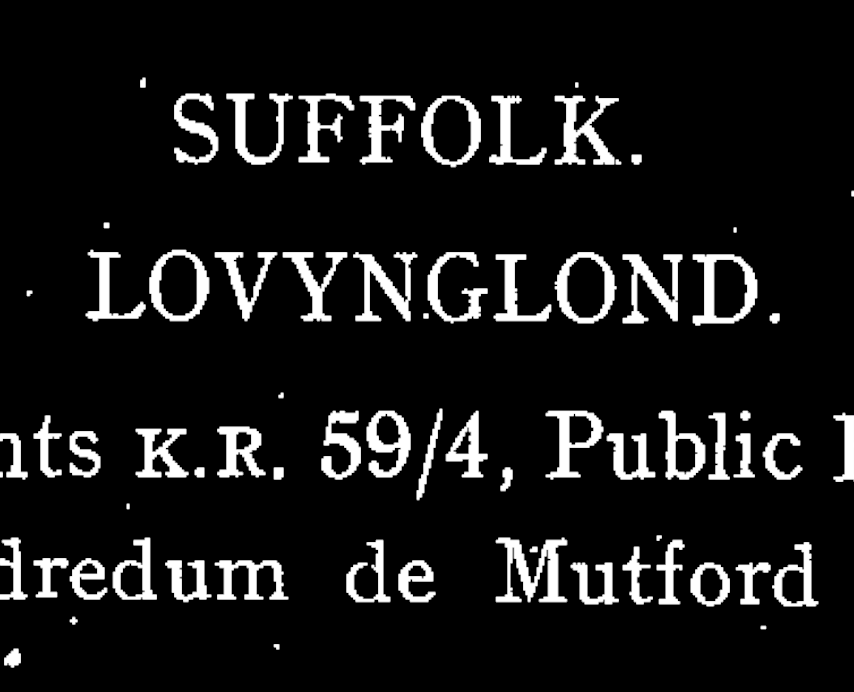
A constant matter of concern during the reign of Henry VIII (1509-47) was that of foreign invasion - particularly by France with the aid of its ally, Scotland. In 1535, a national audit of England’s defensive ability against foreign aggression was ordered by Henry VIII. With there being no regular Army of any kind at the time, lists had to be made of adult males able to fight in all areas of the country – and it was all done, hundred by hundred, to total up the numbers for every shire. The roll made of the “able-bodied men” of Lothingland, written up and dated 23 May, names a total of 292 individuals overall – with Lowestoft providing 146 of them (46%) and with three widows included because of the weapons belonging to their late husbands. Armaments consisted mainly of bills and bows and arrows, with a minority of the men also possessing steel helmets and body armour (mainly breastplates). No firearms of any kind are recorded. The information cited here is to be found in E. Powell, ‘Muster Rolls of the Territorials in Tudor Times’, in Proceedings of the Suffolk Institute of Archaeology and History, vol. xvi (part 1) - 1916 - pp. 36-41.
Forty-nine years later, in January 1584 (though the year is given as 1583, under use of the old Julian calendar), another national muster enquiry was carried out because of fears regarding possible conflict with Spain. The Lothingland list drawn up was dated 16th of the month and a total of 473 able-bodied males between the ages of sixteen and sixty was arrived at. However, Lowestoft and Gunton were not included, for some reason, and their tally was added to the rest of the hundred at some point after 25 March (the Julian date of the New Year and also the Feast of the Annunciation of the Blessed Virgin Mary). Lowestoft’s figure, this time round, was 243 and Gunton’s 10 - making a total of 726 for the half-hundred, with the Lowestoft element constituting 33% of the whole. It also included four widows, seven men described as senex (Latin for “old” or “aged”), one as blind, two as sick and three as absent. The overall weaponry for the half-hundred was still mainly the same as in 1535, but with a number of firearms (calivers - an early type of musket) also in evidence. Of the forty-three pieces recorded, twelve were to be found in Gorleston and nineteen in Lowestoft – probably, mainly for protective use among the maritime community while at sea. The remaining ones, in other parishes, were largely owned by members of the gentry, quite possibly for sporting purposes. Once again, the information presented derives from E. Powell, ‘Muster Rolls of the Territorials in Tudor Times’, in Proceedings of the Suffolk Institute of Archaeology and History, vol. xix (part 1) - 1919 - pp. 52-71.
Concerns about war with Spain had a direct and significant connection with Lothingland Half-hundred itself during the same year that the muster was taken. The Elizabethan government was worried about an invasion being launched from the Spanish occupied Netherlands, with an army under the command of the Duke of Parma – an Italian soldier and one of Western Europe’s leading military commanders (his mother was a half-sister of King Philip II of Spain). The Island of Lothingland was identified as being the most likely part of the East Coast for an invading force to land – not only because it was the nearest and most convenient point to Holland, but because it had a number of leading Roman Catholic gentry living in, or associated with, its parishes whose loyalty to the Crown was suspect because of their adherence to “the Old Religion”, and who (it was presumed) might well collaborate with a Spanish incursion. To this end, four well known Suffolk gentlemen (strong in their support of the Protestant “New Religion”) were commissioned to carry out an assessment of Lothingland’s potential as a place fit for hostile military action. They were Robert Jermyn of Rushbrooke, Robert Ashfield of Stowlangtoft (his brother-in-law), Thomas Poley of Boxted and Robert Wrote (al. Wrott), lord of the manor of Gunton. The last named of these was crucial for his local knowledge of Lothingland, in order for any kind of investigative action to be successful.
The report of these four men was drawn up on 27 June 1584, at Rushbrooke, and duly submitted to the Royal Council. It gave a detailed overall account of Lothingland’s topography and recommended that the three gun emplacements at Lowestoft (built during 1540-1) be refurbished – obviously identifying the town as the likely landing-place because of the anchorage provided by its sheltered haven, situated between the Holm and Corton sandbanks and the shoreline itself. It also described how one of the two coastal warning beacons – commissioned by the Marquis of Northampton in 1552 – had fallen into disrepair and been replaced by a windmill, recommending that this matter be addressed (it wasn’t!). And it also gave a brief, overall summary of a Muster compiled earlier in the year, followed by an assessment of Lothingland’s agricultural capacity to provide provisions for an invader. It was worded, thus: “The Island is verie fertile and yeldeth store of Corn Cattall and other victuall able to mauntayne itself and to help others, so as the strength is greater to the possessor.”
There then followed a detailed account of the suspect Roman Catholic gentlemen, naming the parishes where they lived or had connections, together with an assessment of their detrimental influence on the good governance of the Lothingland area. It would be both over-lengthy and unnecessary to name them here, but the most suspect of them all (because he was Justice of the Peace for Lothingland Half-hundred) was John Jernegan of Belton. His influence, real or imagined, was described in great detail. A map of Lothingland formed part of the commissioners’ report, with all of the suspects named and attached to their parishes of residence and/or influence – and, although somewhat sketchily produced with each community represented by a crude drawing of its church (and with Gorleston shown to the north of Southtown!), it is nevertheless generally accurate topographically. The commissioners’ greatest fear is made manifest at the end of their report: the vulnerability of Great Yarmouth, should an invading force land in Lothingland. It was, of course, the most important community by far, in terms of size and maritime activity, on the East Anglian coast between King’s Lynn and Ipswich, and the opinion was expressed that it would not be able resist attack for even a single day! And, although this is not referred to, the city of Norwich (England’s second largest, after London) was only twenty-one miles away – two days’ march, at the most.
In the event, no attack came, and it was four more years before the Armada sailed and England found itself under threat.
For further reading or consultation regarding the Spanish invasion scare, see V.B. Redstone, ‘The Island of Lothingland, 1584’, in The Proceedings of the Suffolk Institute of Archaeology and History, XX (part 1) - 1928 - pp. 1-8. This can be found online via the organisation’s website, as can the other SIAH material referred to earlier.
As a codicil to the text above, it is perhaps appropriate to add the comments of Thomas Howard, Duke of Norfolk, relating to Lowestoft and made in May 1545 as he conducted a survey of East Coast defences against a possible attack from France (see Letters and Papers, Foreign and Domestic, Henry VIII, vol. XX(1), no. 717 - 1905 - p. 370). The spelling used is in modern form, except for that of the name of the town which is shown as given, out of interest. “At Laystofte, for small ships of 10 or 12 feet draught, are two very good roads [inshore anchorages] called the North Road and the South Road, in either of which mean [small] ships may ride against all winds. Between the landing place and the town is at least 40 score [840] ‘tailor’s yards’ [960, in all], and the landing place is more than half a mile in length. The town have made bulwarks [gun batteries] of earth at each end of the road and in the middle, with three or four small iron pieces [cannon] in each. The town is as pretty a place as I know any few on the sea coasts, and as thrifty [reliable] and honest people in the same, and right well builded; but surely [certainly] if an army royal [large force] should come thither, considering the bulwarks which should beat [traverse] the road, be but of earth, as banks made of turves, and so far distant from the town, I think it should be no great adventure [risk] for a good puissance [force] to land there and burn the said town.” He then went on to praise Great Yarmouth’s architectural qualities, but also commented on the weakness of its defensive walls [built in the 13th century, during the reign of Henry III] against cannon fire directed at them from the sea.
CREDIT: David Butcher
United Kingdom
Related page
Tags
Comments
My Birth Certificate says …
My Birth Certificate says Lothingland. on it and that was from 1948
Very interesting read.
Very interesting read.
Fascinating, thank you.
Fascinating, thank you.
Add new comment