
Lowestoft Churchwardens’ Accounts (1714-36)
The pages reproduced below, in as near as possible their original format, are to be found in volume 3, section 4, of Robert Reeve’s four volume manuscript ‘A History of Lowestoft and Lothingland’ (c. 1810) – Suffolk Archives (Ipswich), 193/3/4. Nothing is recorded for the years 1719, 1722, 1728 and 1733. Reeve (a local solicitor), who lived at No. 49 High Street, was steward of the manor and he must have transcribed this material from an original source of some kind.
Square brackets has been used to clarify certain aspects of the text. The use of ye for the, at the time, resulted from y once serving as an abbreviation/substitute for th.
| 1714: | Paid Mr. Clarke for the Ponde house | 10s |
| various sums for repairs to “ye No:[rth] End Wells” | ||
| To letting the water of [off] the Common | 2s |
• Location of the Pond House is not known, but it may have been a freehold property next to the pond located on the opposite side of the road facing the market place (used for watering the livestock traded there) – what is now the top end of Arnold Street. The use of Mr. here – being a mark of respect, at the time, for a man of some social standing – might possibly refer to the Revd. Gregory Clarke, Rector of Blundeston (1706-26), whose wife Anne was the only child of William Wells (merchant and brewer), who had married into the Wilde family and who owned property in the town (including The Crown hotel). She inherited it all and converted her legacy to joint ownership with her husband.
• The North End Wells referred to may well have been the so-called Basket Wells (their sides being lined with wicker panels) which were located next to a common drying-ground for linen – once, widely known as The Bleach and located off Church Road opposite St. Margaret’s Primary Academy School. No charge is recorded for the work carried out. The wells were probably two or three in number and of shallow nature, owing to the high water-table present in their location.
• The common referred to may possibly have been the North Common – the Belle Vue Park area of today.
| 1715: | To Dan: [Daniel] Manning for clearing a water cours[e] | |
| upon the Danes [Denes] | 1s | |
| To expense at proclaiming King George | 4s | |
| To expense at fireing ye [the] Guns at proclaiming ye King | 3s 6d |
• Daniel Manning (tanner) had his house and tannery works on Whaplond Way (now Whapload Road) immediately to the north of what is now Lighthouse Score.
• King George I (great-grandson of James I and elector of Hanover, in Germany) was officially proclaimed in London as Queen Anne’s successor on 1 August 1714 – the day that she died. His coronation was held on 20 October 1714.
• The proclamation was printed for despatch all over the kingdom, but there is no way of knowing when it was read out in Lowestoft.
• Reference made to firing the guns in celebration relates to ordnance located in the three coastal batteries. The guns most likely fired were the three at Ness Point.
| 1716: | To Cattridge [cartridge] paper & making | 1s 2d |
| To Beer & wine upon a rejoicing day | 9s 10d | |
| To expence upon a rejoicing day | 10s 2d | |
| To John Blaque same day | 1s 5d | |
| To cash paid for clearing ye road to Church | 1s 6d | |
| To cash paid for clearing ye snow of [off] the Church stairs | ||
| To clearing ye road of snow to ye Church | 7d |
• Cartridge paper was the heavy-duty material produced for making gunpowder-charges for use in muskets and cannon – the latter once again being fired to mark a national event of some kind.
• The celebration (rejoicing) here was for failure of the Jacobite Rebellion of 1715-16, when James Edward Stuart (the “Old Pretender”), son of the deposed James II, launched an unsuccessful attempt to regain the English throne. The uprising petered
out during February 1716.
• The beer and wine given out on the day was obviously paid for out of parish funds, together with other unnamed public disbursements.
• John Blaque was the parish clerk of the time – a post he took up after arriving in Lowestoft from Hereford during the late 17th century and marrying a local widow named Dorothy Bennett on 14 March 1695 (1694, by Julian Calendar). His burial is recorded in the parish registers on 9 February 1724 (1723, by Julian Calendar) and John Spicer was chosen by Revd. John Tanner to succeed him.
• The road to the Church would have been Church Way (now St. Margaret’s Road), which had begun its life over 400 years before as the central baulk to the commonly held and worked North Field and which facilitated access to the agricultural strips of land which lay to either side of it. Later on, it came to serve as a public roadway.
• The Church stairs would have been steps of some kind leading into the churchyard. No charge for clearing them is recorded.
| 1717: | Repairs to Town Wells | |
| To 14 moles catching on the Church Green | 2s 11d | |
| To Edm[un]d Jessups bill for Green Well | 11s 10d | |
| To money spent on Thanksgiving day | 7s 4d | |
| To John Blaque for Carteridges [cartridges] | 6d | |
| To Cuddon clearing ye Draines at ye Wells | 2s 6d | |
| Other repairs | ||
| To cutting a drain to let the water of [off] the Daines [Denes] | 6d | |
| To Daniel Manning for clearing water cours[e] also | 10s | |
| To charge in getting James Postles ser[van]t married | 15s |
• The town wells referred to may have been the Basket Wells featuring in the second note on 1714. Or it may have related to other sources of supply. No sum is indicated for the work carried out.
• Church Green, a large area of common land situated between the town and the parish church, was used mainly for the grazing of milking-cattle. Its location, using current reference points, would be much of the land between St. Margaret’s Road to the north and St. Peter’s Street to the south, with Boston Road/Oxford Road to the east and Rotterdam Road to the west. Mole activity was apparently of a sufficient
problem here to require attention.
• Edmund Jessup (mason-bricklayer) had obviously carried out repairs to the middle-
of-town Green Well, which stood at the western end of Frary Lane (now Wesleyan Chapel Lane) where it met Gun Lane – a location now probably lying under Jubilee Way. Originally, when the township moved onto the cliff-top site (c. 1300-50) – and before its houses spread westwards – the well would have been quite close to the Fair Green/Goose Green area.
• No record exists for a national thanksgiving day during 1717 – though the Triple Alliance of Britain, France and Holland (4 January) may have been celebrated. Or, perhaps, this was a purely local occasion which is not able to be identified
• David Cudden/Cuddon (husbandman) lived on Rant Score. He was fined 3d at the annual maznorial Leet Court of 1706 for emptying a chamber-pot of urine into the roadway – probably from an upstairs window of his house.
• The wells he attended to are not named, but may have been the Basket Wells. He
was certainly ideally placed for digging a drainage ditch down on the Denes. As was Daniel Manning (tanner), referred to previously in 1715 for clearing a watercourse.
• No charge for the “Other repairs” referred to are recorded.
• The servant of James Postle (cordwainer) was almost certainly both female and pregnant. There is no identifiable record of her marriage in the parish registers during 1717 and she may well have been married out of Lowestoft. It would have been seen as necessary to get her wed (preferably – but not always exclusively – to the father of the child) for the sake of respectability and to save any parish expense incurred in the upbringing of an illegitimate boy or girl.
| 1718: | To money p[ai]d for stops & ropes for ye So.[South] End Well | 1s 9d |
| To a 5 f[ee]t of plank to mend ye wells | 9s 2d | |
| To p[ai]d 16 men for watching 1 night at ye fire | £1 2s 6d | |
| To p[ai]d 6 for D[itt][o | 6s | |
| To p[aid] for carrying ye powder from & to Church | 1s | |
| To mending ye Church gates cage posts | 1s 6d | |
| To cleaning the Green Well | 6d | |
| To money disburst for the repairs of ye Church | £102 7s 4d | |
| To gathering the Church rates | 5s | |
| To the town buckets mending | £1 0s 0d |
• The exact location of this well is not known, but it was probably somewhere in the location of what is now the bottom end of Old Nelson Street.
• The significant amount of money recorded here possibly refers to a number of planks of five feet length (rather than a single one) used in repairs to the town wells in general and may also include labour costs.
• The fire referred to was probably the one which had occurred on 12 November 1727 – starting at 4 a.m. in the morning in fish-houses on Whaplond Way (Whapload Road) below what are now Nos. 55-60 High Street, with the sparks being blown by a strong south-easterly wind as far as Swan Lane (Mariners Street) – where the thatch of a house ignited and was quickly brought under control. Drawing upon an account by the Revd. John Tanner, Edmund Gillingwater recorded the incident on p. 63 of his published history of the town (1790).
• Powder being taken to and from the Church may refer to gunpowder being used for some undisclosed purpose (other than celebratory firing of cannon). The upper rooms of church porches often served as parish arnouries.
• The description of the church gate as having “cage posts” may refer to the four uprights supporting the roof of a lych gate, with timbering or walling on either side (sometimes with added seating). With the Old English word lych meaning “corpse”, roofed gates of this kind were used to leave a coffin in place overnight, before burial the following day.
• Location of the Green Well was given in the notes for 1717. It was probably the most used of the town’s three common drinking-water facilities. Many of the High Street houses had their own wells in the back-yards, sometimes for sole use and sometimes shared with neighbours who had right of access.
• The Church repairs, whatever they were, seem to have been of an extensive nature.
• Church rates were abolished by Act of Parliament in 1868. Up until then, they were an annual charge made on parishioners who could afford to pay, with the amount set by the two churchwardens in agreement with their fellow citizens. The money collected by the wardens was used for church repairs, paying the parish clerk and sexton (grave-digger and keeper of the churchyard) and any other church-related expenses (such as paying the marriage costs of James Postle’s pregnant servant).
• The town buckets referred to were probably leather fire-buckets, which could have
been filled with either sand or water, according to convenience or need. They could have been kept in either (or both) the Church porch upper room or somewhere in the Town Chamber (High Street site of present-day Town Hall).
| 1720: | p[ai]d Cuddon on ye Churchgreen water | 6d |
| To clearing of ye Church green of mal[l]ows | 1s 9d | |
| P[ai]d D Man[n]ing for looking after ye drains on denes | 10d |
• Church Green (sometimes found referred to as “the common cow pasture of Lowestoft”) had drainage ditches in places and David Cuddon/Cudden (husbandman) had carried out some kind of work relating to them.
• The mallows referred to could have been Common Mallow (Malva sylvestris), Dwarf Mallow (Malva neglecta)or Marsh Mallow (Althaea officanalis) – all three, even. These plants, if ingested to any notable degree by cattle or horses, could cause muscular weakness and failure known as “mallow staggers”. In extreme cases, even death. The roots and leaves were used for a number of medicinal purposes.
• Daniel Manning (tanner) has been previously referred to in connection with drainage on the Denes, which was almost certainly a system of ditches and sumps.
| 1721: | To plank and posts mend. ye No.[rth] end Well | 3s |
| To Anderson for cutting down ye Henbane | ||
| To Sweeping the town House chimney yearly | ||
| To marrying the wido[w] Smith | £2 10s 8d |
• Being specifically named in this manner, the North End Well might seem to suggest another common watering-place – but it is not possible to identify its location. Equally, it could have been one of the so-called Basket Wells.
• The Henbane (Hyoscyamus niger) referred to is a member of the Nightshade family
and generally referred to as Black Henbane or Stinking Nightshade. Its location is not referred to, but might well have been Church Green, because the plant is toxic to livestock – though mainly avoided by grazing animals because of its unpleasant smell
and taste. Both the plant and its seeds had a number of medicinal uses.
• The surname Anderson does not feature in the parish registers, but a William Annison is to be found as the father of children baptised in 1716, 1718 and 1719.
• No record is given of the cost of cutting down the henbane, nor of sweeping the Town Chamber’s chimney.
• The Town House referred to was the Town Chamber, which stood on the site of the present-day Town Hall. It consisted of an arcaded corn-trading area at ground level, with public meeting-room above (used also as the venue for the town’s Free Grammar School). An earlier building had been demolished and rebuilt in 1698.
• A number of widows (three in all) were married in St, Margaret’s Church during 1720 (Julian Calendar), but the name Smith does not feature. Again, probably an out-of-parish ceremony organised for whatever reasons dictated. Speculation in the matter cannot really be made, but it would seem that some kind of advantage to the parish was a consideration as well as to the woman herself.
| 1723: | To catching Moles on the Church Green | 2s 1d |
| To expence when set out ye town doles | 2s 9d | |
| To salary p[ai]d the sexton | £1 6s 8d | |
| To a Coat for him | 18s | |
| To a proclamation & 2 prayer books for the thanksgiving day for deliverance from the plague. | 1s 6d | |
| To John Sepens work & stock for gates to enclose the Cross | £9 10s 0d | |
| To Mr. Blowers for Hooks & hinges plates barrs Lock for ye same | £2 18s 1d | |
| To Caleb Aldred for masons work at ye same time | 9s | |
| To 12 stones for the Town doles | £1 14s 6d | |
| To cutting them & putting them down | 9s | |
| To the apparitor for sheeting and attending a woman doing penance | 2s 6d |
• Moles were a periodic nuisance to be dealt with in grazing areas, mainly when damp conditions brought them nearer to the surface.
• The Town doles were areas of land dispersed throughout the parish, surviving from the stripped-up medieval field system, which had largely been given over to enclosure. They were administered by the churchwardens and would have been rented out to create parish income.
• The sexton looked after the churchyard and dug graves. The one referred to here was Francis Adams (fisherman), who had replaced Cuthbert Jackson following the latter’s death in December 1721 (buried on the 21st, aged ninety years). His appointment is made known by reference to him in the burial registration of his daughter Elizabeth on 13 August 1725.
• Deliverance from the plague in 1723 referred to a Church service proclaimed to be held on 25 April (Easter Sunday) in thanksgiving for the country having escaped a major outbreak of bubonic plague of the Continent – especially in Marseille, 1720-22.
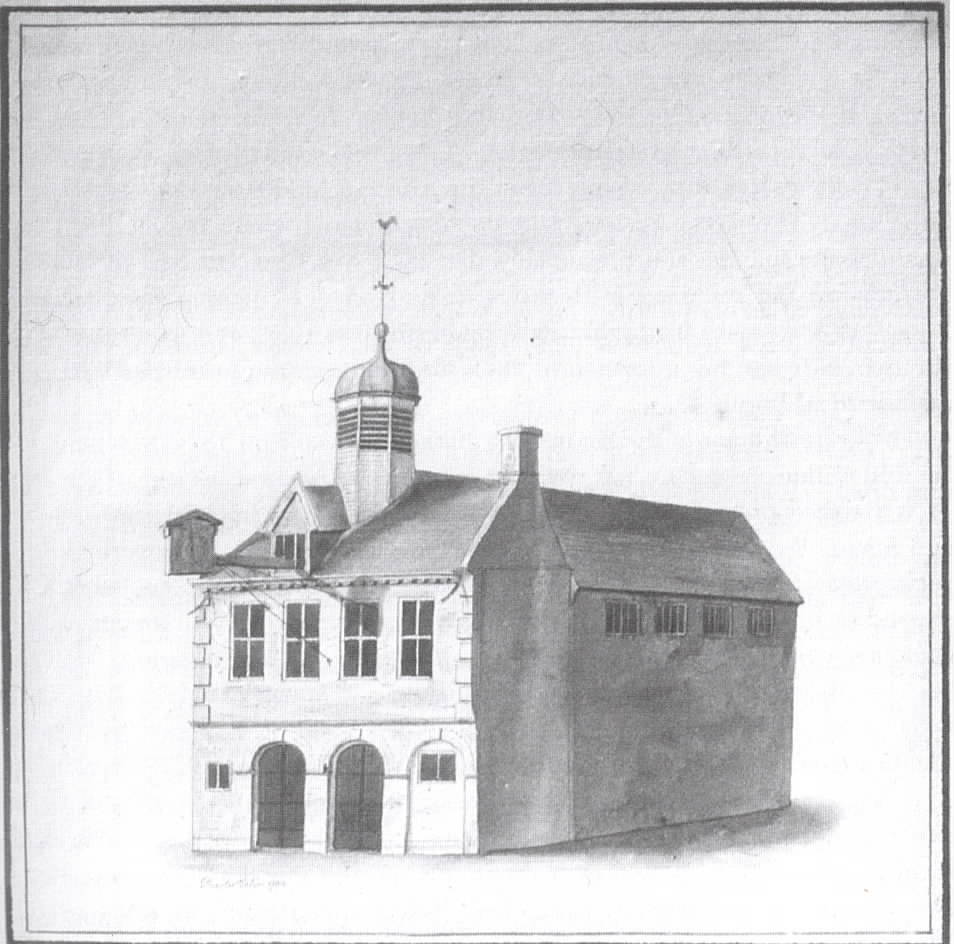
• John Sepens (carpenter) had obviously taken on work to enclose the Corn Cross, in some way – this being the arcaded ground-level structure where trading in grain took place and which supported a large public meeting-room above – the whole building
being generally known as either the Town House or the Town Chamber.
• A replacement structure had replaced an earlier one in 1698 and an ink-and-wash study of it, executed by local artist Richard Powles in 1784, shows it facing onto the High Street (on the present-day site of Lowestoft Town Hall) with its arcaded front having three folding doors – which would seem to have been connected with at least part of the work carried out by John Sepens.
• Caleb Aldred (mason) assisted with certain building jobs and Mr. [Benjamin] Blowers (locksmith) supplied metal fittings for the work carried out. The use of Mr. (Mister), at the time, was a mark of respect, so he would appear to have been some of standing in the local community.
• The 12 stones would have been limestone blocks of some kind (probably lime-washed for visibility) used to mark the position of the individual pieces of dole land – the number of which is not known, but may well have been twelve in number.
• The apparitor was a woman or man of good reputation in the parish, who was responsible for the dressing of penitents in the required white sheet (mainly, but not solely, women) – the punishment for having been found guilty in an ecclesiastical court of sexual misdemeanour outside of marriage, usually of a regular and ongoing nature.
• The procedure required was for the guilty person to attend one designated Sunday
morning service, being “sheeted” over his/her clothing before it began. He or she had
then to stand (bare-headed and bare-footed and carrying a white rod) in the church’s
porch – or at the south door, in the absence of a porch – from the time that the bell began tolling to announce service-time until after the second Bible reading had been delivered. At which point, he/she would enter Church, stand before the reading desk and then make a personal declaration of guilt, before requesting forgiveness from God and the congregation – followed by everyone present saying the Lord’s prayer together. The public humiliation in all of this was intended, of course, to act as a deterrent to anyone thinking of indulging in extra-marital sexual activity. It was probably effective in at least some cases, but not all.
| 1724: | For taking up Mr Wilds House for ye use of ye poor | £2 12s 6d |
| Various repairs to seats in the Church | ||
| Repairs to the outside of the Church | ||
| For nails for the Churchyard fence Cage spars & work at the bridge on the Church green | ||
| To the masons for mortaring the windows & whiting ye Cage | 9s | |
| For the purchase of an House for ye Sexton | £8 5s 0d | |
| For the Stewards fees & time in taking it up | £1 17s 0d | |
| For Stuff & workmens wages for repairing it | £14 17s 4d |
• Mr. Wild’s House for use of the poor (with one acre of land attached) stood on the site of what is now the early 19thcentury cottage – which replaced it – forming part of the Maritime Museum premises. It became known as “James Wilde’s bread house”, as the £50 he left in his will of 7 August 1682 (which he wrote himself) to the poor people of Lowestoft had the instruction that it was to be spent as thought best by his widow, children and the leading citizens of the town. He died in February 1784 (1783, by Julian Calendar) and was buried on the 13th. Eventually, some years after his decease, the bequest was implemented by the purchase of a cottage and adjoining land – the annual rents from which were used to buy bread for distribution
to those in need.
• There is no recorded charge for the four lots of repairs following.
• The Cage referred to may well have referred to the lych gate structure mentioned in the notes for 1718.
• The bridge on Church Green crossed a watercourse which ran across the area. There was a pathway to the Church running over it.
• The mortaring of window surrounds referred to was possibly connected with the Church building itself, while lime-washing of the Cage would have been carried out to preserve the timber.
• Purchase price of a house for the Sexton (Churchyard keeper) shows that the dwelling was a small one requiring quite a lot of repair work. It stood on the north side of Almshouse Lane (now Dove Street) – next to the parish almshouses – at the junction with West Lane (later White Horse Street, which is almost totally obliterated now by Jubilee Way). Reference to the Steward of the Manor being involved indicates that it was a copyhold property, paying an annual ground rent to the Lord – a type of tenure which covered 80-85% of the town’s built environment, with the other 15-20% being freehold. All copyhold property had to have details of transfer noted in the Court Baron records.
• The steward was usually a man of lesser gentry status, who was literate and knew something of property law, and who managed the everyday affairs of the manor with
the help of the chief tenants.
| 1725: | To 9 mens help at ye guns Slowance [sic] | 10s 6d |
| P[ai]d Jno [John] Whitehead cart[in]g ye Guns carrages [carriages] to Church | 1s | |
| To a Eye lineing [lining] for ye Gun carrage | 1d |
• The term slowance may refer to the process of preventing the cannons’ gunpowder charge igniting and exploding too quickly. The hand-held linstock (a wooden rod) with attached slow-burning match (made of hemp or flax twine) was applied to the touch-hole to fire the gun.
• What the reason was for carting the gun carriages to the Church (presumably from the batteries down on the Denes) is not known. Routine maintenance perhaps. John Whitehead (carter) carried out the work.
• The Eye lining referred to was the line etched into the upper side of a cannon’s barrel from breech to muzzle, to help with aiming it. Given the breech’s greater diameter, a gun would always have to be elevated slightly in order to make an accurate, on-the- level shot.
| 1726: | To burying a Man at Sea Side | 1s |
| To Tho[mas] Todd for mending the Swan Score & Stuff | 1s 3d | |
| To the clark [clerk] Registring [registering] a bastard Child | 6d |
• The first entry makes reference to a drowned man washed ashore – most likely from a passing ship. The wording may seem to suggest that he was buried somewhere down on the beach area, but this is not the case. His committal would have been carried out in the Churchyard, at parish expense. Over the years, there were a number of such instances, with the wording “a stranger washed ashore” used to describe them.
• Swan Score was named after the inn which stood at its top end, on the southern side (now the site of Nos 41-42 High Street). Thomas Todd (carpenter) had obviously carried out some kind of maintenance work there.
• Illegitimate children were recorded in the Lowestoft parish registers from the time of
the earliest surviving volume starting in March 1561 – with this entry being the first: 23 May, Robert, son of Alice Cornelles [Cornelius] in base. Base, base born, or bastard were the terms commonly used. It is not known why the payment of 6d was made to the Parish Clerk of the time for registering the child’s baptism.
| 1727: To Francis Adams standing Godfather Calve[r]s child. | 1s |
• This identifies the illegitimate child referred in the last note for 1726 and goes back to 5 March that year (1725, by Julian Calendar), when Judith base child of Elizabeth Carver was baptised – the only illegitimate baptism recorded during that particular twelve-month. There are obvious time-lapses in this particular matter which can’t really be explained.
• Exactly why Francis Adams (fisherman and sexton) took on the role of godfather is not clear and cannot usefully be guessed at.
| 1729: |
| To cutting the Briers in the Church lane 1s |
• The briars referred to could have been either (or both) wild rose or bramble – with the latter probably being more likely in the way that it proliferates and spreads. Church lane, as named, might well have been the pathway across Church Green.
| 1730: | To fying the North end well | 2s |
| To carrying ye Bell to Norwich and home again | £2 0s 0d | |
| To expences of myself (J Durrant Churchw[arde]n) | 10s | |
| To unloading & loading ye bell at home & at Norwich | 5s | |
| To W Wilde for a beam | 7s 6d | |
| To going to Oulton for the stock | 2s | |
| To bringing the brasses from Beccles | 6d | |
| To Mr. Newman for casting ye bell & haftes [sic] | £19 12s 2d | |
| To John Minns for hanging ye bell | £5 17s 10d | |
| To repairing the Southend town well | 3s 6d |
• The term fying was used of cleaning out the bottom of a ditch or pond. Its use here suggests a shallow well of some kind, which is likely to have been one of the so-called Basket Wells. These were not dug to any great depth.
• The bell referred to was one of those hanging in the tower of St. Margaret’s Church. H.D.W. Lees, The Chronicles of a Suffolk Parish (1948), p. 31, makes reference to it.
• The Mr. Newman referred to was Thomas Newman (1682-1745), Norwich’s leading bell-founder of the first half of the 18th century – though his origins were in the city of Cambridge.
• John Minns may have been someone who worked in with him. He was not a Lowestoft man.
• Re-founding of the bell was necessary because of a defect in its structure. H.D.W. Lees, repeating an entry in an accounts book kept by the Revd. John Tanner, has this to say: “the Bell at Church being split in May 1729 was new last cast by Tho. Newman at Norwich Jan. 23rd 1729 and weigh’d at 17 cwt [hundredweight], 2 qt. [quarters] and 7 lbs [pounds]. The old Julian Calendar is in use here, with 25 March being New Year’s Day. Thus, the actual January date (by adoption of the Gregorian Calendar in September 1752) refers to the year 1730 – which ties in with what the Churchwarden records state.
• John Durrant (brewer), as Churchwarden, seems to have incurred expenses of some
kind in connection with the taking down of the bell and its carriage to and from Norwich.
• The W. Wilde referred to (who supplied a wooden beam to be used in re-setting the newly founded bell) does not seem to have been a member of the local Lowestoft family, but may have had some connection with it.
• The stock mentioned was the headstock timber to which the bell was attached by its two canons (loops). These were probably the haftes (handles) referred to. The brasses brought from Beccles cannot be specifically identified.
• The South Well has been previously commented on in the notes for 1718.
| 1731: | To money paid the men for going of[f] to a ship | 18s |
• The reference here is to local beachmen going out to a ship grounded on the Holm Sandbank for rescue/salvage purposes.
| 1732: | To 4 days work cutting ye Hen bane | 4s 10d |
| To charges for getting ye Guns | 19s | |
| To pieces to lay ye guns on | 1s |
• Reference to clearing Henbane (probably on Church Green again) was previously made in the notes for 1721.
• No detail is given for moving the coastal battery guns.
| 1734: | To expences w[i]th Men when the fire happened | 2s 6d |
| To Gunpowder at Rejoicing for the Prince of Orange | 3s |
• No details are given of this town fire, and there seems to be no tangible means of identifying it. Which means it was probably of very limited nature – unlike that which had occurred on 12 November 1717 and is referred in the notes for 1718.
• On 25 March (New Year’s Day, Julian Calendar), Prince William IV of Nassau-Orange married Princess Anne, daughter of George II, in the Chapel Royal at St. James’s Palace, London – thereby creating closer Anglo-Dutch ties, following on from the three naval wars of the second half of the 17th century.
| 1735: | To a sheet for doing penances | 1s |
| To George Sepens & Newton for ye pillory | 14s | |
| To expence upon secret service town business | 9s |
• The act of penance carried out for sexual misdemeanour was dealt with in the notes for the year 1723.
• George Sepens (carpenter) and Joseph Newton (joiner/house-carpenter) had probably carried out repair work on the town pillory and whipping-post, which stood in the main market place.
• The “secret service town business” is an intriguing entry, both in its wording and in the matter of what it might have been.
| 1736: | P[ai]d to redeem Titus Calfs ass out of the pound | 1s |
| Expences burying Mrs. College | £2 2s 6d | |
| Expences burying Mr. College | £2 3s 0d | |
| To Expences w[i]th ye Coroner relating to College etc. | 1s 6d | |
| Expences w[i[th Mr. Killet relating to Mr. College | 10d |
• Titus Calf (fisherman) had had his donkey released from the town’s stray-animal pound, which stood on Goose Green close to what is now the junction of Factory Street with Thurston Road. The reason why the Churchwardens had paid for this is not clear.
• The burial of Mrs. College is recorded thus in the parish registers on 8 October 1735: “Elizabeth Colledge, wife of Tho[mas] Colledge of Sunderland Lost in Corton Bay”. She had obviously gone overboard and drowned from either a passing ship or one which was anchored up offshore.
• Her husband’s committal was entered ten days later, on 18 October as “Thomas Colledge of Sunderland”, without any information being given as to the cause of death.
• It would appear that an inquest was held by the Lothingland coroner into the death of Mrs. College and that the cost of this was met by the Churchwardens – as well as the cost of both wife’s and husband’s funerals.
• Given the fact Thomas Colledge was from Sunderland, the likelihood is that he was the master of a collier ship carrying cargo from the Durham coal mines to London – traffic which had been in operation from at least the end of the 15th century, with Lowestoft a stop-off point along the way. His wife was accompanying him on board – something which was not unusual, at the time.
• There is no information as to who Mr. Killet was, nor to his part in this sad and intriguing double death.
Churchwardens for the years referred to above (taken from H.D.W. Lees, The Chronicles of a Suffolk Parish Church (1948), p. 214.
| 1714 | Coe Arnold (brewer) & John Barker (merchant) |
| 1715 | Coe Arnold (brewer) & John Durrant (brewer) |
| 1716 | Thomas Utting (brewer/merchant?) & Thomas Spratt (fisherman/mariner) |
| 1717 | John Fowler (mariner) & Thomas Spratt (fisherman/mariner) |
| 1718 | James Postle (cordwainer) & Nathaniel Long (mariner) |
| 1720 | John Jex (merchant) & Nathaniel Long (mariner) |
| 1721 | John Jex (merchant) & James Ward (brewer/merchant/yeoman?) |
| 1723 | John Durrant(brewer) & John Frary(blacksmith) |
| 1724 | William Utting (brewer/merchant?) |
| 1725 | John Frary (blacksmith) & William Utting (brewer/merchant?) |
| 1726 | John Postle (sailmaker) & Matthew Arnold (brewer) |
| 1727 | Richard Hayward (merchant?) & Robert Chandler (innkeeper?) |
| 1729 | John Ellis (innkeeper) & Daniel Long (mariner) |
| 1730 | Daniel Long (mariner) & John Durrant (brewer) |
| 1731 | John Durrant (brewer) & Thomas Manning (mariner/merchant) |
| 1732 | Francis Shank (fisherman/mariner?) & Simon Mewse (butcher) |
| 1734 | John Postle (sailmaker) & Edmund Gillingwater (barber/wigmaker) |
| 1735 | Edmund Gillingwater (barber/wigmaker) & Nathaniel Gooding (customs officer) |
| 1736 | John Peach (brewer) & Nathaniel Gooding (customs officer) |
Explanatory Notes
• All occupations given come from local records of one kind or another. The parish registers are the main source, with probate documents (wills and inventories), manor
court proceedings, apprenticeship records, settlement orders and tithe accounts all acting as back-up. Use of a question mark on an occupation indicates a known family connection with it, but with no specific reference attached to the man named.
• It can be seen from all of the various areas of activity recorded above what a wide range of responsibilities fell upon the two annually appointed Churchwardens (one the choice of the Vicar, the other that of the Congregation) – carried out at a general meeting required of every parish church in the realm, which had to be held between 1 January and 31 May in any given year and was usually carried out around Easter, whenever that happened to occur.
• Much of the work done is of the kind which would today be carried out by parish, town and district councils.
• The organisation of celebration for designated national events is of interest, especially given the recorded firing of the town’s sea defence cannons to mark whatever occasion was taking place.
• Information missing for the years 1719, 1722, 1728 and 1733 cannot be explained.
• H.D.W. Lees, in The Chronicles of a Suffolk Parish Church, p. 9 – citing what he refers to as “John Tanner’s Account Book” – mentions extensive repair work carried out in 1716 to the roof of the central aisle of St. Margaret’s. And there is mention also, for 1729, of the Chancel’s east window being re-glazed with square panes of glass and a new door for the Chancel being made (this being the small entry, on the south side, for use of the Minister only). None of this work is to be found referred to in the Churchwarden records reproduced here.
• Traditionally, rectors of churches were responsible for chancel repairs since they collected all parish tithes as their payment (including the “big earners” of grain, timber and hay – whereas vicars took the lesser tithes only (mainly field crops other than grain, milk and its related products, pigs and poultry, and a small share of fishing profits in coastal parishes). If outside people or organisations owned the great tithes (as they were known) – which they often did, following on from Reformation times – they then became responsible.
• Even during the 15th century, some tithes had started to be paid by cash settlement rather than in kind – this being easier for both priest and parishioners than receiving/ giving a 10% proportion of either land or livestock yield. This increased in scale during the 16th and 17th centuries.
• John Tanner purchased the Lowestoft grain tithes when they came up for sale in 1719-20, with the help of a subscription list, the Queen Anne’s Bounty fund, a twenty-five year mortgage arrangement and a £100 personal loan. He had freed himself of all debt by 1749 and enjoyed the extra £70 annual remuneration for the last ten years of his incumbency – the small tithes averaging c. £40-65 per annum, depending on the yield of land and sea. He did not undertake the purchase for personal benefit, so much as for the parish incumbency itself by making it stronger financially.
• Responsibility for the upkeep of the nave (the main body of the building) was always a matter for the Congregation, under the leadership of the Churchwardens – as was anything relating to the tower.
• There are very few references to work carried out on the church building itself (one in 1718 and three in 1724) and also to matters relating to the churchyard (one each in 1716, 1718 and 1724). Then there is the single matter of the tower’s defective bell. Most of the money spent went on what may be described as public works of one kind or another.
• Sufficient evidence of the importance of the Churchwardens as community leaders is present in the records presented here and the men chosen were always from the wealthier levels of the town’s population.
• As a critical observation, it is also worth saying that the Churchwardens made regular appearances in the annual Leet Court, held on the first Saturday in Lent – whenever that happened to be in any given year – at one of the town’s premier inns. This dealt with misdemeanour of various kinds and breaches of manorial law committed by the town’s inhabitants (and by outsiders as well) and appointed certain officials for the following year. Details of the court’s function can be found in the LO&N history pages in the article titled Lowestoft Manorial Governance c. 1580-1730.
• The earliest date for the start of Lent (Ash Wednesday) is 4 February and the latest 10 March. Either way, the Lenten first Saturday date always occurred before that of the Julian Calendar’s New Year on 25 March.
• All dates used here are those of the Gregorian Calendar introduced in September 1752.
• The year 1714 was an exceptional one in terms of the number of offences laid at the Churchwardens’ door, There were six in all (two of them being linked as one), with each carrying the customary 3d (threepenny) fine. They were named as follows: failure to maintain the road surface in Almshouse Lane (now Dove Street); not maintaining the bridge and cleaning out the drains (ditches) on Church Green; not maintaining the stiles between Smithmarsh (now the lower end of Rotterdam Road near the Norwich Road junction); not maintaining the road surface next to the Town Chapel (now the High Street end of Mariners Street); and not maintaining the steps in Swan Score (now Mariners Score).
• None of the payments recorded above for the early years 1714-18 relate in any way to the six misdemeanours named. Furthermore, drainage matters relating to Church Green are mentioned only once throughout the whole list (1720), as are repairs to a bridge located there to cross a watercourse (1724), and to remedial work of some kind carried out in Swan Score (1726).
• Whatever document Robert Reeve transcribed for his four volume manuscript work, therefore, would not appear to have been a complete set of Churchwarden Accounts.
CREDIT:David Butcher
United Kingdom
Add new comment