The Cocos Island Treasure Hunt
[First published as the last chapter in the writer’s book The Last Haul (2020).]
Were you ever down the Congo river?
Blow, boys, blow.
Where the fever makes the white man shiver.
Blow, my bully-boys, blow.
(Traditional American capstan song: Blow, Boys, Blow)
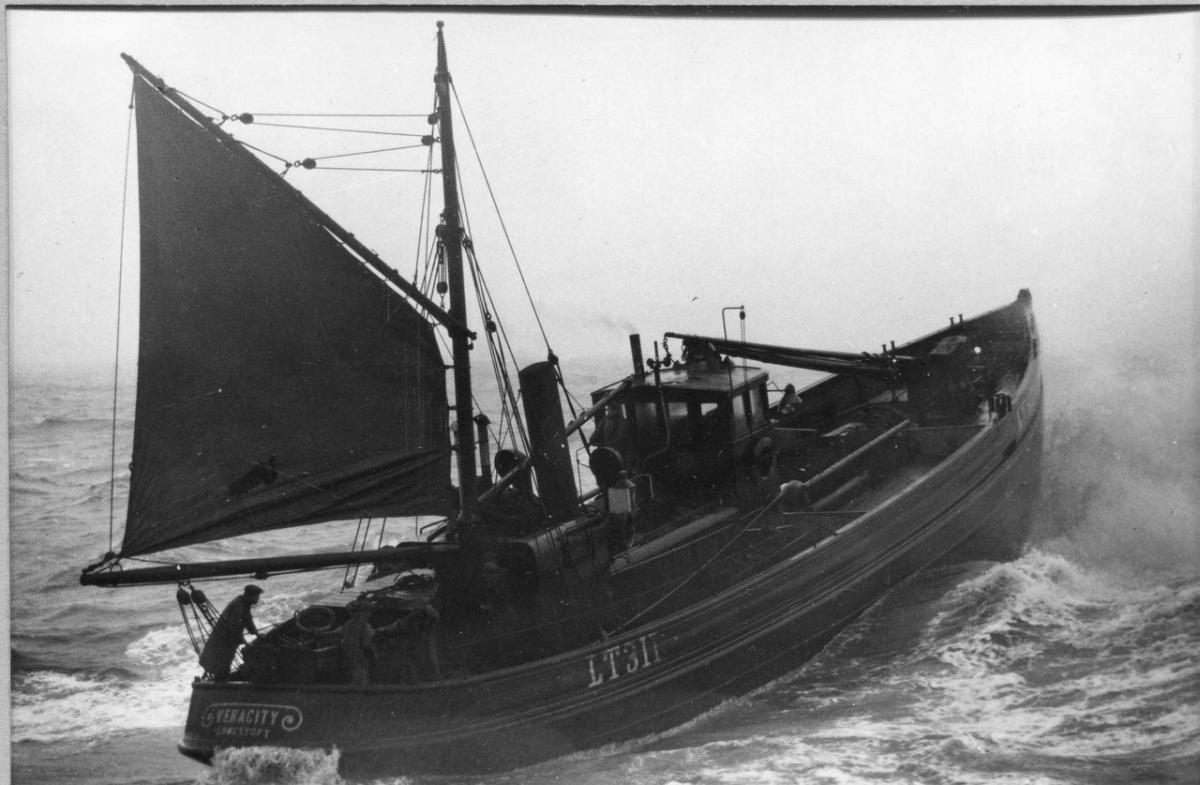
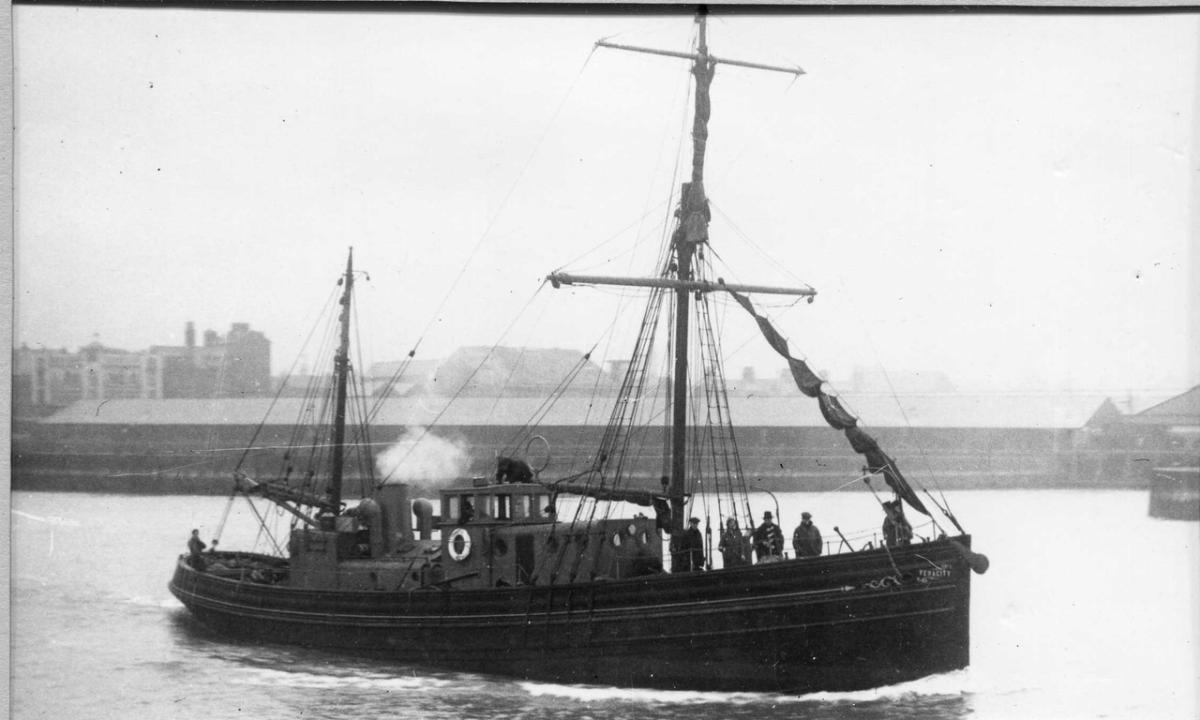
Lowestoft drifters were built to catch herrings, but one of them went hunting for much more valuable and elusive prey. The Veracity (LT 311) was the first purpose-built motor-drifter in England, constructed by Richards Ironworks Ltd. in 1926 and powered by a 200 h.p. Deutz diesel engine. Though having a conventional wooden hull, this vessel was revolutionary in her use of diesel power as opposed to coal-fired steam propulsion. As it turned out, she was twenty years ahead of her time, because it was only after World War Two that the Lowestoft fishing fleet adopted diesel power on a large scale. In his excellent monograph on the family firm, Lewis Richards (son of the founder, Samuel Richards) wrote of Veracity’s significance, emphasising her superior speed to that of steam vessels and her economy in use of fuel and identifying innate conservatism on the part of local boatowners as the main reason why the diesel engine did not replace steam triple-expansion.1 He saw the new means of propulsion as a way of enabling the local fishing industry to cope with a period of great difficulty, through its ability to reduce running costs, but the breakthrough never occurred and, within a decade of being built, the Veracity was withdrawn from herring-catching and laid up on the southern shore of Lowestoft’s inner harbour.
It was now that the vessel’s second career began. She was selected by a consortium of people involved in the recovery of hidden treasure to go to Cocos Island, with suitable crew on board, and serve as the expedition’s floating headquarters and supply vessel. She was converted for such work in the yard which had built her, the main task being to sheathe her hull in Muntz metal against the ravages of tropical marine worms (Lewis Richards refers to this, in his book).2 After the refit had been completed, she set sail for the Pacific Ocean, with a Lowestoft man among her crew. Henry Leighton (1910-93) had encountered one of the leaders of the venture completely by chance, in a Lowestoft hotel, and had agreed to join the Veracity as cook and catering manager, using skills which he had already acquired. The voyage was to be one which he never forgot, with its overtones of piracy, buried gold and desperate deeds upon the high seas. It was the stuff of fiction, but every bit of it was real (tape-recording made, 15 February 1982).
“It all started one evening in January 1935, when I walked into the Harbour Hotel to have a drink. Now, in January, there’s usually not many strangers about, but it happened that there was one this particular evening, and I got into conversation with him. And, during the conversation, he mentioned that he wuz in Low’stoft to buy a ship to take a crew and a party to Cocos Island in search of treasure. And I happened to make a remark that anybody might: ‘Well, I wish I was goin’ with you.’ He said, ‘Well, you can. There’s one more wanted, and if you’d like to think it over and let me know in the morning – come and see me and we’ll have a talk about it.’ This was Captain Arthur. Now, the ship actually belonged to his wife. She’d bought it. It was laid up after fishing. And, anyway, the next day, I went along and I agreed that I would go. I wondered at the time whether I’d made a big mistake or not, having never been to sea in my life. But I’d made a decision and I was going to stick by it. We tied everything up and I signed the contract and went and had a look at Veracity. It was laying in Richards’ yard and I was quite impressed by the alterations they’d done to it. They’d made a very comfortable yacht out of her and they’d encased her hull in Muntz metal because of the teredaworm.3 And this all had to be looked at again in Balboa before we actually went on to the Pacific island – Cocos.
“The expedition organisers had actually written round to various ports, enquiring about vessels which might happen to be laid up or for sale, and there were quite a number apparently at Lowestoft – and they thought that their best bet was to come where there were most vessels available. And, going round the mudflats [in the inner harbour], they came across Veracity. Among others. But Veracity was the one that took the eye. This was up in the inner harbour. That’s right, yes. And she was brought round to Richards’ shipyard and they had a ship’s architect come along and see what could be done. I presume it was Richards’ ship’s architect. And various suggestions were made, and these were agreed to and eventually carried out, with great success. There wuz a direction-finder installed and various other things to make her safe. The fish-holdwuz actually the saloon, where we had all the meals, but the crew’s quarters weren’t altered. The bunkswhere the fishermen used to sleep, they were still there, and I myself slept in one of ’em. There wuz two people slept in the foc’sle and a new cabin had to be put on deck in front o’ the wheelhouse. This wuz a two-berth cabin, which was to be used by the navigator and the commander. In bad weather, of course, those two never left the bridge. They were there all the while and made a very good job of it, too.
“Another thing they did wuz raise the foremast and give her these two cross-trees for sailing with when we got into the north-east trades [trade-winds]. That was to save the engine and to increase power as well, when needed. We had every intention of doing quite a bit of sailing, to save fuel, and we found actually that when we did use the sail it was capable of six to eight knots in a reasonable breeze. Yes, we had a square-rigged sail and the mizzen. And we had an old seaman with us, a Commander Worsley, who went to the South Pole with Shackleton, and he knew all about the sailing side o’ things. He was in charge of that. There wuz only four of us crew in Low’stoft and then we picked up the others in Dover, with the exception of another cook, a cabin boy and a wireless operator. The last three of all were picked up in the West Indies.4From Low’stoft, there wuz Captain Arthur and his wife, Laughlin, Edwards and myself. And before we left, we tested the compass and did some trials out here. It wuz then we discovered that the cross-trees were not quite what we anticipated. They exaggerated the roll o’ the ship, but it wasn’t to a terribly dangerous extent, so we kept them up.
“I think we were looked upon as crazy and what-have-you, and there was one very interesting remark when we left. My wife was on the South Pier waving cheerio and bon voyage (we were engaged then), and near her were two fishermen. And one said to the other, ‘Thass the last we shall see o’ them silly buggers!’ Not very encouraging. Anyway, we left Low’stoft on February 11th, 1935. And we left in glorious sunshine, about four o’ clock in the afternoon. The sea was like a lake and I thought, ‘Well, this is great!’ But we hadn’t been at sea very long and, o’ course, the normal thing happened at the time o’ year – a very big mist came down, which slowed us up considerably. And after about four or five hours in that, we then ran into a force eight gale, which was with us all the way to Dover! And, putting into Dover, I was congratulating myself that I hadn’t felt at all seasick. I thought, ‘This is going to be great! I’m goin’ to be O.K.’
“We spent just the one night in Dover and put to sea for Cocos the next morning with the rest of the crew. And it was a nice breeze when we left Dover, but we hadn’t been at sea more than about an hour when things began to hot up a bit. And we eventually found ourselves off Berry Head [Brixham] in a force ten gale. We could do nothing but just put the mizzen up and dodge around until we could get into Poole Harbour. And we put into Poole Harbour and moored quite near the King’s Head, and we spent two or three evenings in there. We just passed the time away until the gales eased. And when we thought they’d eased sufficiently (I think it was after about eight days), we set orf once again for Cocos.
“Well, we hadn’t been at sea many hours and the same thing happened – but even worse. We lost the dinghy; we lost all our crockery; the wireless set was ruined; everything was awash. The sea was in the ship, yuh know. Everything was soaked. And I was really ill then. But there we are – I suppose one has to get one’s sea legs! And, you know, I did think once or twice, ‘Well, I don’t know whether I’ve made the right decision.’ However, I thought, ‘Well, it’s not always goin’ to be bad weather.’ And we put into Brixham and spent ten days there, because there was so much to do. We had repair work to do and a dinghy to get hold of and install. The radio we didn’t bother about, but it took us two or three days just to dry out.
“But, once again, we managed to get to sea and things went better. We got into the Bay of Biscay and there was very little wind to speak of, thinking of what we had been through, but there was an enormous north-westerly swell – which I’m told is not very pleasant conditions in the Bay. But, after several hours, we eventually came into the sunshine, and the sea was calm and things were great. And I really began to enjoy being at sea. And I was cured of my sea-sickness by the chief engineer. He said, ‘I can cure you!’ I said, ‘Well, I wish you could.’ He said, ‘Well, I will if you do what I tell yuh!’ So I said, ‘Well, I’ll do anything.’ You see. And he got some sea water and filled a tumbler half full. He said, ‘Now, knock that back!’ Which I did. And I didn’t keep it long! But it did the trick. And, even in severe gales, afterwards I was never seasick again.
“Our next port of call was Casablanca. And we didn’t stay there very long – just long enough to build up stores and take on water and fuel. And then we were off once again. I did all the buying of the stores on the trip and, actually, when we got to the island, I used to do the catering. I also did all the cooking on the voyage, which I’d agreed to do. I’d been trained in catering for eight years before I went out there. That’s right, yes. My father was in the restaurant trade in Low’stoft. He originally started where the Odeon cinemawas (now W.H. Smith’s) and then he had the restaurant further down London Road North.5 And we got to sea from Casablanca and the storekeeper, Paynter, was taken ill with very sharp stomach pains. So we headed off to Santa Cruz and put in there and got a medical man aboard.6 And he said the water was bad that we’d taken on in Casablanca, so we had to pump all that out and get fresh water, and set off once more.
“Then our troubles began again, because we hadn’t only been two days out o’ Santa Cruz and the bearings in the engine started hotting up. And we had to stop the engines. We found that the lubrication system wasn’t working satisfactorily. But they stripped things down as best they could at sea and cleared them, and off we went again. And then we’d been going about, oh, another few hours (not more than twelve), and the engines just more or less blew up! They got red hot. It was terrible. It was about two o’ clock in the morning, and they shut them all off and we said, ‘Well, that’s that.’ So we set all the sails, the square-riggeds[on the two yards of the foremast] and the mizzen. And fair enough, because if we had the wind, we knew we’d be all right. But, as things happened, when we really wanted the wind, we didn’t get it! Having had all that lot before, we were now becalmed! And this went on for two or three days. And then we had a little breeze and got under way. And then the same thing – becalmed again. We’d been at sea about twelve days and weren’t even halfway to Barbados. Food supplies were definitely going to be a problem, and water. So I had a word with Captain Arthur and we agreed that the water had got be rationed straight away. And I suggested, being a very keen angler, that we try and catch some of the dolphin which were around us.
“Now, these dolphin were not the breed of dolphin that they train to do tricks. They were a different type of fish altogether. And they were very edible, actually, though we didn’t know this at the time. We didn’t know whether they were edible or not. We tried all sorts of things to catch them and in the end, of all things, we tried a jar of Bismarck Herrings which we happened to have aboard (Mrs. Arthur was very fond of them). I bound some of this onto a hook, and this produced a result. We got a dolphin – which we used for bait to get more dolphin. And we had dolphin in our diet nearly every day, in some shape or form, until we got to Barbados. And another thing we did wuz hang lights on the engine-room casin’ at night, and these flyin’ fishwould come out and hit the casin’ and drop down on the deck – and we’d pick ’em up an’ put ’em in a bucket and eat those for breakfast. And they were very similar to our herring. They were very, very nice. They were very rich, and so were the dolphin. Yes, and they both supplemented our food supply.
“As for the water – well, we all had a strict ration. We washed in sea water, and we took some special sea-water soap, which helped. But half an hour later, after you’d washed in the tropical heat and what have you, you were very sticky and uncomfortable. We set a sail, an old sail, in the hope of catching some water when it rained, but though we wanted the rain we didn’t get it. Like the wind! However, we did get some eventually for about three or four days, and we got a good breeze and were doing six to eight knots with all the sails set – which was quite useful. We had the square-rigged big sail and then we had a square-rigged tops’l as well. Yes. And to the knowledgeable I suppose this is quite normal, but when we were under full sail the ship was much more steady. We didn’t get that rolling, and it was very pleasant.
“We eventually got to Barbados, and I know we hadn’t been there many minutes before there wuz a terrific downpour.7 And we all got out into the rain and had a jolly good shower. This was when we were laying out in the bay before they towed us into harbour. We weren’t kept out in the bay too long and they towed us into the harbour and we were made very welcome. And Cockburns, which are a very well-known wine and spirit people, they presented us with a case of rum, which was very acceptable. And, I can tell you, very much appreciated! We got the engineers aboard the following morning and they told us it would be quite a long job to fix the engine (at least a fortnight), so we said, ‘Fair enough.’ I think we were all glad to know that we had a fortnight to rest up. And I went ashore the following morning to various shipping agents and bought up supplies, and we took on fuel and what have you so we were ready to go when the engines were done. We picked up another cook and a cabin boy, and we had a new stove fitted in the galley because the original one was a diesel one [i.e. heated by diesel fuel] which had the container of oil right over the stove. And, when you were in rough weather, it slopped over and the smell alone was enough to make you sick. And I honestly think that was what created my trouble in the first place.
“We actually arrived there on Easter Monday, in 1935. It was late April – the twenty-second or twenty-third, I think. Yes. And we were also there on the sixth o’ May, I think I’m right in sayin’, which was King George V’s Silver Jubilee. And there were great celebrations there. Well, I mean, we all know how the West Indians celebrate! And we were invited to a party ashore in the evening, but we were not allowed to go unfortunately. The following morning we set sail, and the first night at sea the old engine started to heat up again.8 And there was some feeling that the second engineer might be partly responsible, so he was withdrawn and I took his place in the engine-room. He must have neglected his lubricating, because I’m not an engineer (I never was an engineer, though I will say that the old chief did teach me quite a lot) – but we never did have any more trouble with the engines. We went into Curaçao one night and had the oil looked at [i.e. the lubricating oil], just in case it was dirty oil, but they said it was all right, so we put to sea again and went across the Caribbean to Colon and Christobal and through the old Panama Canal – which was a hectic experience.9
“You get in those locks in a little old drifter – well, we were like a rowing boat! The power of the water coming in there, it took us all our time to hold the ship in a position of safety, because we could have been dashed against the walls. You couldn’t have your engines going, you see. They’re vast locks and your engine wouldn’t be powerful enough to do any good in that terrific current. We got fenders over one side and then we lined the deck with quants and poles.10 And they had a mule the other side – you know, a mechanical mule, as they call it, for towing the boat through. And they were holding us off the side, you see, and this was how we got through the locks. There was a series of locks, I think I’m right in saying (it’s a long while ago now): three at Gatun, one at Pedro Miguel and two at Miraflores. They lift you up quite some way in the time that you’re in them. I could tell you the exact figures if I could look them up, but at the moment I just can’t remember.
“Anyway, having got to the other side, we tied up in Balboa and got in touch with the powers-that-be in Costa Rica – in Puntarenas – because they had confiscated all the gear from a previous adventure to the island, belonging to the company when they had the chartered yacht, Queen of Scots. But they didn’t get permission, or a licence, to search for treasure on the island, so everyone was arrested and the gear wasconfiscated.11Captain Arthur was not involved in the actual arrest, but he wasn’t allowed on the island on our expedition. The Costa Ricans wouldn’t give him a visa. He wuz Mr. X in a court case which concerned some eastern potentate and they didn’t think he was the right sort of person to go on Cocos Island. And the extraordianry thing was that they wouldn’t let his wife land either! This all seemed a little bit petty, but there we are. They made the rules and one had to abide by them. Anyway, they said that they would authorise our party to land, with the exception of Captain Arthur and his wife. But there was a problem. The ship belonged to Mrs. Arthur. So then there was a big argument whether they were going to let us go any further or not. In the end, it was agreed that Captain Arthur would return to London and see if he could get some satisfaction through the Foreign Office, and make arrangements, and then he would return.
“We went off to Puntarenas to pick up the gear. And the stuff was all there, ready, so we took a load on board and sailed for Cocos the next day. And we eventually arrived at the island – entirely uninhabited and very beautiful. A beautiful island! It’s volcanic, and it’s a series of ridges rising up above 600 feet, with a peak of over 2,000 feet. And it’s very, very densely vegetated. All jungle, really, inland. And when you got among these trees, they were full of little red ants. And they dropped off, down yuh neck, and that wuz just like burnin’ liquid on yuh, you know! More like as though you’d been thrashed with stinging nettles, or something like that. But we found a way of wearing our shirts outside our shorts, so that they dropped right through – otherwise, they’d take the skin right off yuh waist in no time at all. Oh, they were a problem.
“We landed the gear on the island, and I left the ship and helped with stowing the gear ashore. And the ship made two or three trips to the island to bring the stuff over, and they even brought some chickens over and landed those. And the camp, of course, was already built by the previous expedition. There was a large bunkhouse, probably eighty feet long I would think, with a storehouse at one end. Wood-built. Yes, all timber-built and it was very, very nice.You know, quite comfortable as things are, in the jungle like that. And the next morning, while Veracity was away collecting more goods and we had a sort of hour or two to spare, it was amazing the number of people who’d got hazel twigs (and one particular person had got an old gramophone spring), which they were using as divining rods!12 Wandering up and down the beach, looking for gold, you see! This was rather amusing, actually. And, I mean, some of them spent hours at it and they were quite surprised that they didn’t turn up something. But it calmed down eventually and we went to bed. And next morning, about six o’ clock, Dr. Harris (he was the geologist with us and he wuz a Scotchman), he was wandering up and down the bunkhouse with a stiff collar! Where he got this stiff collar from, goodness only knows, but he wuz walkin’ up an’ down with that just like it was a divining rod in his hand. I said, ‘What’s up, Jock?’ He said, ‘Shush, shush.’ I said, ‘what’s up, Jock?’ He said, ‘Well, can’t yuh see? I’ve lost my collar stud!’ And it looked as if he was he was trying to divine for it with a stiff collar!
“There were reputedly several lots of treasure been on the island, but the particular one we were searching for was the Lima Cathedral treasure. There wuz a life-size statue of the Virgin Mary, in solid gold, and there wuz pieces-of-eight, gold ingots, diamonds, emeralds, rubies. Oh, it was valued in 1935 at £25 million! It was Benito who stole it. Benito. Benito of the Bloody Sword. The story goes that when there was plundering along the coast there, the people took all this treasure from the cathedral for safe-keeping and put it aboard a British ship, which wuz in the harbour at Lima at the time. But the temptation wuz too much and the crew murdered the guards and put to sea. But they, in turn, were attacked by Benito, and the treasure was believed to either have been transferred from one ship to the other or towed in the British ship into Cocos. Benito wuz a Spaniard [Portugese] and this all happened in the 1600s – about 1660 roughly.13
“It would appear that, after the treasure was landed, neither ship was heard of again, and neither was Benito. But they were pretty confident that he actually landed the treasure, and some people said that if you found the treasure you’d find the skeleton of Benito. But whether there’s any truth in this, of course, we don’t know. But there’s very little doubt that there was treasure on the island. O yes, yes. And, having seen the island, there wuz numerous caves round the coastline and many a creek where you could have got a flat-bottomed boat up to bury stuff or hide it. And in the olden days, when these pirates were about, they quite often used to use Cocos to water the ships, because there was beautiful cold spring water come down from the mountains, you see. We watered our own ship with the water. We couldn’t get water anywhere else like that. Lovely!
“There wasn’t a lot of fruit on the island, but there were some limes and there was one orange tree. It was a very old one. And there were guava, and there were wild pigs, which we used to shoot. And they were a bit tough to what we get in this country, but they were quite edible. But the most edible thing around there, on the island, wuz the lobsters. Langoustes, they called them [Spiny Lobsters, or Rock Lobsters – members of the genus Panulirus]. And, at low tide, you’d walk among the coral and you’d just see one underneath and you’d put yuh hand in and drag him out. They’d got no nippers; they’d just got very rough, spiky heads. But if you got hold of ’em underneath and just dragged them out, and put ’em in a canvas bag, you could go out for an hour in the afternoon and have half-a-dozen beautiful lobsters. I suppose they weighed about two pound, and they were really good. Lovely. There wuz rainbow runner there [Elagatis bipinnulata], sailfish [Istiophorus platypterus]. Oh yes, there was plenty of food, if you spent the time looking for it.14
“The agreement was that the Costa Rican government should have 33⅓ per cent of whatever was found. They were protectin’ their rights, more or less. But I don’t think we worried too much about that, in any case. But they were very helpful, because the army sergeant who came onto the island with the Costa Ricans, we asked him if he would pick people who would be useful on the island. And these chaps were not all regulars [i.e. not military personnel]. They were picked from all walks of life. We had a hairdresser and an electrician and a carpenter, and they were a great help and we got on very well with them – though they kept to their own quarters. We were there from June to December – six months or so, yeah. We got there June 8thand left in the middle of December.15
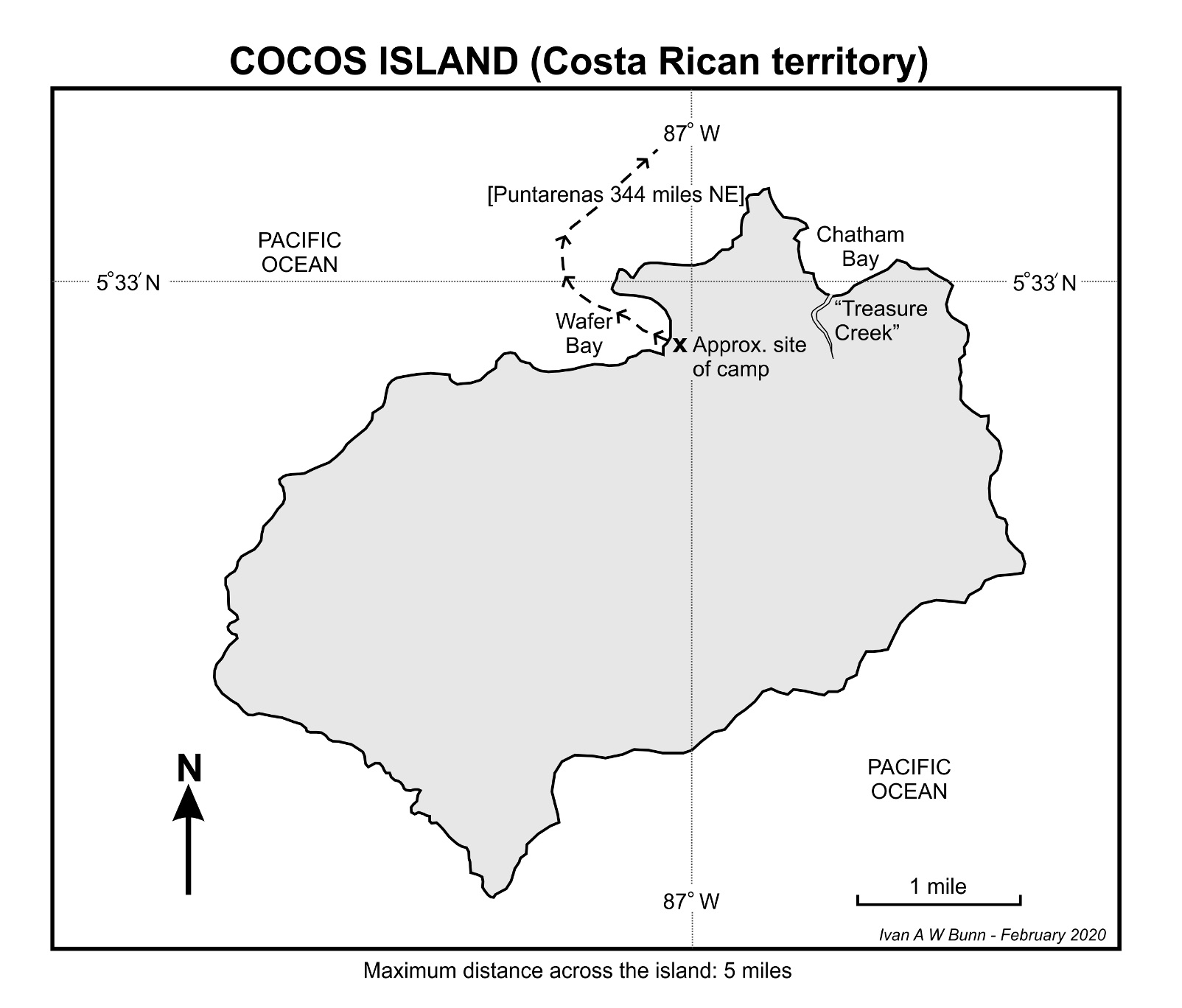
“Now, one thing that wuz all very surprisin’ wuz when we pulled into Chatham Bay, after we’d unloaded in Wafer Bay. We pulled into Chatham Bay and there wuz two chappies on the beach, frantically waving and shouting, and no sign of any ship or anything.16 So we thought, ‘Oh, these poor chaps have been shipwrecked or stranded in some way or other.’ Anyway, we put a dinghy ashore and brought them aboard and gave them a meal and asked them if they’d like to move aboard, and we’d take them to Costa Rica on the next journey. But they said no, they were quite happy to remain ashore – though they hadn’t got much food, and had only got very little of anything because the ship was wrecked and they’d just got ashore in what they were standing in, more or less. You see. Well, then one of them turns around and brings out a packet of cigarettes and offers us one! Well, if anyone gets cigarettes ashore – I mean, that seems a bit ridiculous, doesn’t it? So, from that, we got suspicious – but we told them to come aboard the next day and have breakfast. And they said no, they didn’t want to bother us like that, but they would like to be taken away when possible. Well, after about a couple of days, we were going to Costa Rica again, and we got these chappies aboard and said, ‘Look, we’ll drop you in Puntarenas and you can get yourselves up to San José, from where you can get to Panama.’ Which is where they were supposed to have originated from.
“Well, now, they didn’t want to do that. They’d rather wait till we went to Panama. Well, with this, we got more suspicious than ever. So we got them aboard the ship and kept them aboard, and the Costa Rican guards then had a good scout round and found a store. These chaps had got a radio and arms and what have you, and plenty of food, so we we knew that there was something not quite right. We contacted the authorities in Panama and they said, ‘Well, keep them there and don’t let them know you’ve informed us, and we’ll deal with it. Just play it quiet.’ And about three or four days afterwards, two American destroyers came into the bay, the USS Taylor and the USS Claxton, and said, ‘Right. We’ve come to fetch these bods. We’ve picked up their boat, which wuz layin’ offshore, and we’ll take that back to Panama and them with it.’ I think that they were people who knew Pete Bergman (who I will talk about a little later), and they knew he was coming back to the island and that he had taken treasure off and sold it in Chicago, when he wuz shipwrecked there previously. And they were not going to let him guide us to the treasure, whatever happened! I think this is what it was all about. But, anyway, the Americans took them off and, the same day they did that, Bergman wuz brought by Veracity to the island!
“Yes, Bergman had found treasure previously and sold it to a jeweller in Chicago for 11,000 dollars. And they [Treasure Recovery Ltd. – the company financing the expedition] found out through some various means where he was. I think he contacted the company to say he wuz in jail in Belgium and, if we liked to bail him out or get him out, he would come to the island and lead us to the treasure – with a contract that he should have ten per cent of whatever was found, you see. So this wuz agreed and they eventually got him out to Costa Rica (where he was attacked and his shoulder badly injured) and then to the island. And when he got to the island, he said, ‘Well, I know roughly where it is, and I’ve got some buried on the beach, which I left there to take with me when I left before. But I couldn’t get it all away.’ So we said, ‘Right.’ I think pieces-of-eight wuz the main thing which he took with him, but he wuz supposed to have taken some rubies as well. It was late June when he came [27 June]; we hadn’t been there long. No, no. And he wuz convinced that Wafer Bay wuz where the treasure wuz hidden, but he could never find it. I’ll admit that he didn’t try very hard! And after he’d been there about three or four weeks, he said that he wanted to get back to the mainland. His shoulder was playin’ up and what have you. And I must admit that he wasn’t fit, by any means – though that wuz partly from the life he’d led, I would think.
“After a few more weeks, we took him aboard ship. I’d now returned to the Veracity. I didn’t have all the time on the island and I’d returned to the ship to do some buying of stores in Costa Rica. And Bergman had been aboard one night, and we should have sailed the following morning, and he said, ‘Well, let me have one more look.’ He said, ‘I’d like to have a look ashore here, at Chatham Bay.’ We used to anchor there; it was more sheltered. And he wuz put ashore about half-past eight in the morning and we could watch him when he wuz going over the high part of the hills. And we watched him as far as we could, and he eventually turned up about half-past three in the afternoon with a little canvas bag, and it was full up with stuff. I said, ‘What have you got there, Pete?’ He said, ‘Oh, I’ve got some lovely shells.’ I said, ‘Oh, have yuh? Let’s have a look.’ Well, he just opened the top so I could peep in, and there were lots of shells in there. But I wouldn’t like to say there were shells all the way through, for the simple reason that all the while I’d been on the island, right up to the time I came orf, I only found about four really nice shells. And for him to do that in three or four hours, to fill a canvas bag, wuz a bit of a tall story.
“However, we took him back to Costa Rica the following day and we left him in hospital to get treatment for his shoulder and general condition, and we said we would call in the next day and see how things were. Well, when we got there the next day, he’d flown to Panama! Where he got the money from, I don’t know, but anyway he was in Panama.17 And we did hear later that he was trying to get some people interested in financing a ship to go to Cocos Island when we left, to lift the treasure for himself. But this never came off and I did hear later that he had returned to his native country, Belgium. But I was never able to contact him any more.
“He was shipwrecked on the island originally with a mate called Lane, who also came to the island.18He didn’t know as much. Ol’ Pete had said, ‘I’ll give yuh some o’ the stuff, but I’m not goin’ to tell yuh where it comes from.’ He used to go away each day and come back with a little, and he buried some of it on the beach where he was taken off. This was on his first trip, when he was shipwrecked. And he and Lane were picked up by a ship whose captain’s name was Hunter, and we contacted this Hunter and he verified the story that he had picked them up from the island and also that some treasure had been sold in Chicago. We didn’t do a terrific lot of digging ourselves. We did some digging in Chatham Bay and a bit of digging on the beach at Wafer Bay. We got down to six foot and then we were in trouble – the tide would come up and you’d be back to square one. We found a copper lifeboat-tank [a buoyancy aid] in one dig! See, we did a lot of divining. We took some electrical divining gear with us and this picked up the tank. But we didn’t get much else from it!
“If you went on the island, you would realise that you were wasting your time digging, because there was so many natural places where they would obviously hide stuff for quickness. But we never thought the treasure wuz actually buried. We thought it was in a cave, or in some rocks. See, there were so many places. I mean, all the way round the coastline wuz no end of caves and we were always looking at what we thought was the easiest landing-places. There was one place, called Treasure Creek, where a flat-bottomed boat could well get into – and we never did get to search that. And it was in that direction that Bergman went that morning.
“Now, these pirates were not mugs. I mean, they were crafty, and they were not going to bury that stuff where we would think it was most likely they would. I mean, they’d do just the opposite. And I feel that the people who searched on Cocos Island had all been going in the wrong area. There’s been a lot of them – Captain Campbell among them. Malcolm Campbell, yes! Yeah, we came across his old camp, actually. And there wuz one expedition went about ten or twelve years ago, and they went from Felixstowe as a matter of fact.19 I wrote to them and told ’em that I’d like to have a word with ’em, but they sailed before they got my letter. I didn’t know they were going, but I read a little bit in the Lowestoft Journal and tried to contact them.
“There’s a swamp on the island, between the camp and where you go inland from Wafer Bay, and then it’s quite level for a little way – grassy soil – and this is where the lime trees and orange tree are. And the number of old diggings in there is fantastic! I mean, there must be thirty or forty of them. People have all dug in the same place. Oh yes, definitely. There wuz several rocks there with writing on. Quite a lot of ’em were just the names of ships and the dates they were there. Some had called for water and some, of course, had been treasure-hunting. We were unfortunate. We didn’t find anything and funds ran out. The old Veracity did a fair mileage altogether. After we’d had the engines repaired in the West Indies, we didn’t have any more real problems. The engine was marvellous. Yeah, we were getting twelve knots out of it. Oh, we had some wonderful runs to Panama and back.
“We met a hurricane once. When we came from Puntarenas one night, we got into the tail end of a hurricane – so we set sail and just went with it. We had the engine turning over, just to give us some sort of steerage-way, but we went with it for, oh, twenty-four hours. And that was really something! But when we came out of it – unfortunately, we had a replacement for the guards on board that night and, boy, were they ill! Yeah, they had a really rough journey, and the old commandant on the island was really worried. See, we didn’t arrive when we should have done, and they knew this hurricane wuz in the vicinity. Yeah, they thought we’d probably been lost, but we turned up the next day, about twenty-four hours late.
“We were off the island one morning, about half-past ten, and there was two 10,000 ton American cruisers come into Chatham Bay. And we wondered what they were, obviously, and it wasn’t long before a ship’s pinnace came across and a naval captain came aboard and said that the President was on board and they would like to know, for security reasons, what we were doing there. So we told them, and they were very interested, and then they went back to their ship. Then, in the afternoon, they returned and invited us aboard for a meal and a cinema show, on the Houston, with the President.20 We had a very nice evening aboard and we were really royally treated. They even played the national anthem when we went into the cinema. Most of them, I think, only stood on one leg when they realised who we were! But, anyway, they really did treat us well. And I was talking to one or two of the sailors aboard and one of ’em said, ‘Did you come over in that?’ Meaning the Veracity, of course. And I said, ‘Well, yes, of course we did.’ He said, ‘Well, you goddamn limeys are sure crazy!’ I mean, people sail all over the place now, don’t they? But, in those days, it just wasn’t done, was it?21
“The following day, boats were going across from cruiser to cruiser – the Houston and the Portland – and the Americans came ashore with food and ice-cream, fruit, and everything you could think of. And they gave the whole of the shore-party a picnic. And Roosevelt himself went ashore, and they fixed up an awning for him and he sat there and chatted to us, and it was really marvellous. He was a marvellous man! To get where he’d got, with the handicap he had, was fantastic! He wuz there for about three days altogether and he’d come past in his boat, fishing.22 Sitting in the back. They’d got a special seat for him and he was sitting in the back, fishing. Sailfish, mainly. Yes, and he caught one which was over 100 pounds – which pleased him a good deal.
“The last day the Americans were there, I took a party across the island from Chatham Bay to Wafer Bay, to the camp.23And the boys there had been out and got some of these lobsters I’ve been previously talking about. And they’d made a marvellous lobster mayonnaise and gave these chaps a jolly good feed. Two of them were on the staff of the New York Times and there wuz a big report all about it in the New York Times magazine. When we went back aboard the Portland, the Medical Officer said, ‘I’m sure you must have got bitten by all those snakes, or one of them!’ I said, ‘What snakes?’ And he said, ‘There must be snakes over there in the undergrowth.’ I said, ‘Well, I didn’t see any. Did you?’ He said, ‘Yes, I did, as a matter of fact. And you’d better come down to my office and let me just have a look.’ And, o’ course, we went down and (you know how American ships were dry!) he had a bottle of snake-bite cure in there – which was very nice! Whisky!
“We all had a shower aboard and, while we were there, they had a cablegram to say that Roosevelt’s son had had a car accident on a railway crossing. He wasn’t badly injured and Roosevelt said, ‘Well, he’s crazy enough, he is! He’ll grow out of it!’ Ha, ha, ha. He wasn’t too concerned and, you know, the way he said it was marvellous. And that evening, they sailed. And, when they got out to sea, they flashed the signal lights: ‘Good luck. Hope you find the treasure. Franklin D. Roosevelt.’ It was done with Morse, which I thought wuz very nice.
“One o’ the things that spoilt the expedition, in the end, was the Costa Ricans not letting the Arthurs come to the island. If they’d been able to, I think that might have made a difference. They had this Lane chappie [Peter Bergman’s fellow-castaway] all sewed up and brought him out from England themselves, and I think we might have got somewhere with him. Yes, the Costa Ricans were a bit tough on us, though I spose that wuz only natural. Cash was running out, and they didn’t want to be caught, and they wouldn’t let the ship sail. And we said, ‘Well, look, we’ve got to get back to the island, otherwise there’ll be no food for them.’ And they said, ‘Right. We’ll go in a Costa Rican ship.’ So we bought the food and got it aboard their ship, and they were not going to let Finnis [the Veracity’s commander] and myself go on the island. They said, ‘No. No way!’ So I said, ‘Well, I’ve got to go.’ And there was an argument, and they put to sea, and they had to come back because they’d sprung a leak. So they transferred the stuff onto another ship and took that over. But in no way would they let us off. This wuz late November time. There wuz no time-limit on my contract. Oh no. Just the clause that there was repatriation at the end of the expedition. I had the princely sum of £8 a month, which I didn’t get half of!24 And I would have got a quarter of one per cent if the treasure was found. Which wouldn’t have been bad in those days.
‘O’ course, we had some wonderful times in San José when we used to go there. Oh, we did! Yes, yes. Edwards and I were very friendly (he wuz chief engineer), and we would have like to have gone back to Cocos just once more to go and look at this Treasure Creek site, where we felt Bergman went that day. But there was no question of it; we never got back to the island. I mean, we were stuck in Costa Rica, and we were given the sack and told to leave the ship. The Costa Ricans, yuh see, they said it was their ship, and then the firm [Treasure Recovery Ltd.] came through and gave us the sack. So we said, ‘Well, that’s very clever! We’ve no intention of leaving Veracity, unless we’re repatriated!’ And I went up to San José with Finnis, and they’d arranged one ticket home – and I wuz the lucky one who got it. All the others came home as D.B.S. [distressed British seamen]. I came home on the Cordilleras – a 12,000 ton liner. I arrived in Plymouth without a penny! I hadn’t got a penny in my pocket! Five o’ clock in the morning! There wuz a schoolteacher on board who’d won a lottery and she kindly lent me a fiver to get to London. And I wuz met in London with a cheque to give her. You see, I’d got a sister who lived in London, and that was the way I got out of that.
“I’d only got a small bag with me. Most of my stuff wuz left in Costa Rica. See, I had to fly from San José to Port Limon and they wouldn’t allow much.25 The weather was terrible. They wouldn’t let us take off. We should have taken off at eight o’ clock in the morning. It was eventually half-past ten before we took off! I picked the liner up at Port Limon, on the Atlantic coast. And we had to fly across The Cordilleras in terrible rainfall. And when we got to other side, I didn’t know whether I wuz in an aeroplane or a submarine! You couldn’t see anything but water. We got over Port Limon, and it wuz only a small plane with about eight passengers, and we went round and round and round. The ol’ pilot said, ‘Well, you know, things are a bit grim. We can’t find the actual landing strip, but we’re going to try and put you down anyway.’ This was because of the fuel situation, you see. He said, ‘Don’t bother. We’ll get down somehow.’ So he gradually eased it down and we suddenly saw the sea under us, with about fifteen feet to spare! And he just glided in to the beach and put us down there. And I’d got about fifteen minutes to get from there to the pier to pick up the liner! And I just made it.
“When I got home, it was the middle of winter and I just had a suit! No coat or anything. It was December 28th, and I came back from London to Low’stoft the same day. Yes, and I had yours truly waiting for me! [His fiancée, later his wife.] Yes, and that wuz the end of my marvellous trip. My parents just thought I wuz a bit crazy. Oh yes, yes. I don’t think they wholeheartedly agreed with the idea. Shall I put it that way? But you know how things were in 1935. The unemployment. This wuz it. And it’s a thing which has stood me in good stead. It’s something to talk about, something to think about. I met up with Edwards later. I met him just before the war, but I haven’t been in touch with anyone since. O’ course, a lot of ’em were ex-R.N. and probably one or two of ’em were lost in the war. Captain Arthur, I know, died – and Mrs. Arthur. So did Worsley. O’ course, Laughlin [second-in-command] wuz a youngster and Tucker [deckhand], who came from Brixham, wuz a youngster. But most o’ the others were older than me. I spose there could be one or two still knocking around.
“The Veracity was sold by the Costa Ricans to a coastal trading company, and she used to ply between the Orinoco and the Amazon with fruit, vegetables and light freight. And, unfortunately, in a fog, on the Orinoco, she came into collision with a merchant vessel and sunk. And that was rather an inglorious end! You know, I didn’t hear till some time after that she’d been sunk – and I felt a bit sad. O’ course, the beauty of it was that, once we got to Panama and took the cross-trees down, she behaved beautifully. No problems. She was a good sea ship. Yes, yes. Well, she had to be to get through what she did. She faced some really rough weather and I thought she served us jolly well. Yeah.
“The only reports of the expedition I saw in the English newspapers are what I wrote myself. I never heard of any of the others actually getting back, only from Edwards when he came to see me in Low’stoft. And he told me that some of them came back about three months after I did. Byrom [second engineer] stayed out there and signed on with Macaya Airways; Harris [geologist] stayed out there; Tucker [deckhand] came home as a D.B.S. and so did Finnis [commander], I think – and Worsley [sailing master]. But it was an unfortunate thing, that break-up. If we could only have broken up so that we could all have returned together, it wold have been so much nicer. I often thought to myself how nice it would have been to sail back in Veracity and come into Low’stoft harbour after that voyage. That would have been something, wouldn’t it? Yes, that would – but it wasn’t to be. The whole thing wanted better organisation. You see, it’s the same as everything else. It was dependent on an inflow of cash from shares on the Stock Exchange. It was floated with five bob shares [5s = 25p], you see, and of course if things had started to go well the money would have flocked in. But we just didn’t get that good bit of news to boost it. When Bergman’s story wuz put on to the market, by the press, the shares jumped and we sold several thousand. We got through a lot of money in the end. I’ve got the balance sheet somewhere. It’s very interesting to look at.26
“On the first expedition, they even had a sea-plane. They used to come and land in Wafer Bay. The firm was called Treasure Recovery Ltd. and our telegraph address was Pieces of Eight.27 Really! But, as I say having to rely on public funds like that, it was just a bit dodgy. Oh yes, I mean to feed, what, thirty to thirty-five people cost quite a bit. And then there was fuel for the ship and what have you. We used to buy quite a bit of oil fuel from Costa Rica, and I think probably what happened is that we got behind with the payments and the authorities there just jumped. I mean, they were very quick on jumping. They even slapped me in jail for doing nothing. I was just running to catch up with some friends after a cinema show in San José – but running after dark was against the law! Yes. And when we went ashore at Puntarenas, praps we’d take a load of washing with us. Well, they’d always check it over. It was the same when we loaded stores; they’d always go over the cases of food and other stuff. Oh, they were very watchful. But when you think about what we were doing, praps you couldn’t really blame them.”
As a postscript to this high-seas adventure, it is worth noting that a good deal deal of information relating to the Cocos Island treasure is available on the Internet. On 5 August 2012, The Daily Telegraph ran a story (so did The Daily Mail) about an expedition being planned to visit Cocos (now a UNESCO World Heritage Site) – though not solely for treasure-hunting. Scientific investigation was to have been a major part of the venture, with the area’s natural history featuring prominently. The Veracity’s voyage was not referred to in the article, but two earlier searchers for the Lima hoard were named: Franklin D. Roosevelt (with two friends) in 1910 and Malcolm Campbell during the 1920s. Henry Leighton, of course, met Roosevelt on the latter’s fishing vacation described above, while Campbell was mentioned by him as a previous visitor to the the island. The Telegraph piece also cited Errol Flynn, the Hollywood film actor, as looking for the treasure during the 1940s (as did that in The Daily Mail).
The Lima Cathedral treasure was reputedly removed by the Spanish ruling authorities in 1820, at a time of growing revolution in Peru, and put aboard a British ship (under guard) for safe transportation to Mexico. William Thompson, captain of the Mary Dear, had the escort murdered and then landed at Cocos to bury the treasure. He and his crew were later captured by the Spanish and all of them (with the exception of Thompson himself and the mate) were hanged for piracy. The two men were spared, on the promise of leading the Spanish to where they had hidden the treasure. On arriving at the island, they managed to escape into the jungle and evade capture. A year later, they were rescued by a ship putting in to take on fresh water. In her The New Book of Days (1941), a 365-piece anthology of mixed material for young readers, Eleanor Farjeon has as the entry for 18 February the story of Veracity’s voyage to Cocos Island – though she names the commander of the expedition as Captain Arthur Macfarlane, not plain Captain Arthur as Henry Leighton refers to him.
Anyone wishing to take the story further can carry out his or her own treasure-hunting at the keyboard of a computer or the touch-screen of an i-pad.
End Notes
1. L.E. Richards, Eighty Years of Shipbuilding (Lowestoft, 1956), pp. 23-4. A weekly fuel cost of £5 12s 6d is cited for the vessel, which was far less than a steam drifter’s coal bill. An earlier Veracity (LT 685) had been built at Richards in 1910 and was sunk by German destroyers (along with six other, similar vessels) in February 1918, while on patrol duties in the English Channel.
2. Muntz metal was an alloy of copper and zinc, named after its inventor, G.F. Muntz.
3. Teredo navalis: a species of saltwater clam which burrows into timber.
4. The Veracity’s total party was as follows: Captain C.W.A. Arthur and wife, Commander F.A. Worsley (sailing master) and wife, Commander Finnis R.N. (master), Commander Edwards R.N.V.R. (chief engineer), Lieutenant-Commander Laughlin (second-in-command), Mr. Byrom (second engineer), Dr. Harris (geologist), Mr. Atkinson (wireless operator), Mr. Paynter (storekeeper), Alec Tucker (deckhand), Henry Leighton (cook), Johnny (Barbadian cabin boy) and Casey (Barbadian cook).
5. Near the junction with Suffolk Road.
6. This port was Santa Cruz de Tenerife, in the Canary Islands, which is usually referred to today simply as Tenerife. Horatio Nelson lost his right arm there in July 1797, in an action against the Spanish.
7. The Veracity left Santa Cruz de Tenerife on 28 March and arrived in Barbados on 23 April.
8. The vessel actually left Barbados on the morning of 8 May.
9. Curaçao was an island off the coast of Venezuela (and a Dutch dependency); Colon and Christobal were towns on the Atlantic side of the Panama Canal.
10. The quants and poles referred to were held ready by members of the crew to push the vessel away from the sides of the lock, should it be driven too close. The fenders had been put in place to lessen any impact.
11. Treasure Recovery Ltd. had sent an expedition to Cocos Island in August 1934. It had arrived in September and begun to search for valuables without the Costa Rican government’s permission.
12. These were either hazel wands which had been taken out from England for divining purposes or twigs and small branches gathered on the island. Mr. Leighton could not remember which.
13. The whole story may seem to be fanciful (Lima, for instance, is situated inland – so if a vessel was lying in harbour, it would have been at Callao). However, the removal of the Lima Cathedral treasure actually did take place in 1820 – a time of revolt against the ruling authorities in Peru’s capital city.
14. If parts of this paragraph remind the reader of Lord of the Flies (especially the references to wild pigs), it is worth remembering that Peter Brook shot his memorable black-and-white film version of the novel here in the early 1960s.
15. The expedition began to founder in mid-November because of a lack of funds. Mr. Leighton left Costa Rica for England on 9 December.
16. The expedition base was at Wafer Bay, but the Veracity usually anchored in Chatham Bay because it was more sheltered and had a greater depth of water.
17. Bergman left Costa Rica on 28 August.
18. This shipwreck had occurred in 1929.
[1]9. The tape-recording session with Mr. Leighton, on which this chapter is based, took place on 15 February 1982.
20. The other cruiser was the Portland.
21. The cinema show on board the Houston took place on the evening of 9 October.
22. The two American cruisers anchored in Chatham Bay on 9, 10 and 11 October, before leaving for Pearl Harbour.
23. The party included the captain of the Portland and two journalists.
24. Mr. Leighton remarked about the irregularity of payment of the expedition members’ wages as the weeks went by. He himself, as buyer of all food stores, was entitled to a 2½ per cent discount on purchases, which he used to create “a bit of beer money” for himself and his colleagues.
25. This flight took place on 9 December.
26. Treasure Recovery Ltd’s two expeditions cost a combined total of £20,892 (£11,792 and £9,100 respectively). Other incidental expenditure brought the figure closer to £25,000. Overall, the whole venture cost nearly £64,000, about £30,000 of which was spent on purchasing the rights of an earlier company, Spanish Main Exploration Ltd.
27. Pieces of eight were Spanish silver coins first minted in 1497 and worth eight reals. They were also known as Spanish dollars and became synonymous with acts of piracy in South, and Central, American waters. Robert Louis Stevenson, in Treasure Island, has Long John Silver’s parrot (Captain Flint) constantly squawk the name of these coins as its identifying catch-phrase.
CREDIT:David Butcher
United Kingdom
Add new comment