
Lowestoft’s Famous Five (Naval Heroes – 17th-18th Century)
17th & 18th Century Naval Commanders
It is a claim – not made lightly by this writer – that no town of its size, in the whole of England, produced as many eminent top-rank Naval commanders as Lowestoft did between 1660 and c. 1720. During that time, no less than four admirals and five captains came from five local families mainly involved in fishing and maritime trade: the Allins, the Arnolds, the Ashbys, the Leakes and the Mighells. Their contribution to the nation’s maritime activity in times of strife deserves to be more widely known – especially, perhaps, in the town of their birth.
It is not the intention of this piece to give a full run-down of the various individuals’ service records, but details of the experiences of a number of them may be found in Edmund Gillingwater’s An Historical Account of the Ancient Town of Lowestoft (1790), pp. 376-415. Other sources of information include Wikipedia, the Three Decks naval history Internet site, and various other online sources.
1. Admiral of the Fleet Sir Thomas Allin (1612-1685) – probably the best known of all Lowestoft’s naval heroes – father Robert was a merchant – brother-in-law of Richard Utber (married to his sister Mary) and therefore uncle of John and Robert Utber – uncle also of Arthur and John Ashby through their father’s marriage to his sister Alice – knighted 24 June 1665, following the Battle of Lowestoft on 13 June (in command of the third-rate Plymouth – 60 guns) – later, Admiral of the Fleet and Comptroller of the Navy – in retirement, Captain of Sandgate Castle in Kent and Master of Trinity House – purchased the manorial titles of Lowestoft and Somerleyton in 1672 and established a country seat in the latter – buried in the Church there on 5 October 1685.
2. Rear-Admiral of the White Sir Richard Utber (1619-1669) – father John was a gentleman – brother-in-law of Thomas Allin, married to his sister Mary – father of John Utber and Robert Utber – knighted at some point following the Battle of Lowestoft (13 June 1665), at which he had commanded the third-rate Rupert (64 guns) – mainly served during the Second Dutch War (1665-67) alongside his brother-in-law – made Rear-Admiral of the White on 1 June 1666 – grave-slab in St. Margaret’s Church, located near the organ, gives his date of death as 18 November 1669 – burial date in parish recorded as 21 November.
3. Admiral of the Blue Sir John Ashby (1646-1693) – father Robert was a merchant – younger brother of Arthur Ashby and nephew of Sir Thomas Allin, his mother being Allin’s sister Alice – knighted on 16 May 1689, after the Battle of Bantry Bay (1 May 1689), against the French, in which he was commander of the third-rate Defiance (64 guns) – made Rear-Admiral of the Blue on 8 June 1689 and Vice-Admiral of the same on 17 February 1689/90 – followed by Vice-Admiral of the Red (3 June 1690) and Admiral of the Blue (20 December 1691) – died ashore, in a state of ill health, at Portsmouth on 12 July 1693 and was initially buried there – his mortal remains later interred in St. Margaret’s Church, with grave-slab and accompanying wall monument located at the east end of the south aisle.
4. Captain Sir Andrew Leake (pre-1670-1704) – father Andrew was a merchant – nephew of James Wilde (merchant), his mother Deborah being Wilde’s daughter – served with Sir John Ashby before being granted his own command – known as “Queen Anne’s handsome captain” because of his good looks – knighted after the battle of Vigo Bay (23 October 1702), against the French and Spanish fleets – killed at the Battle of Malaga, against the French, on 13 August 1704, in command of the third-rate Grafton (70 guns) – almost certainly buried at sea – probably safe to say that he was in line for promotion to Rear-Admiral – younger step-brother James Wells (Royal Navy Lieutenant) drowned at Lowestoft, along with a friend William Scholdam (gentleman), on 25 Sept4mber 1704 – both having gone out, offshore, in a small boat to view the town when a sudden squall overturned the vessel.
5. Vice-Admiral of the Blue James Mighells (1666–1734) – father Richard was a cooper – nephew of Sir John Ashby by father’s marriage to older sister Thomasine Ashby – commander of the fourth-rate Monck (64 guns) at the Battle of Malaga (13 August 1704), where he distinguished himself – further exemplary conduct in battle saw him promoted to Rear-Admiral of the Blue (18 March 1717/18) and of the White (28 March 1718), and then to Vice-Admiral of the Blue (7 March 1718/19) – finally, on 9 February 1723/24, he was made Comptroller of the Navy, holding the post until 12 March 1734 (1733, by Julian Calendar) – his death occurred on 21 March 1733/34 and a monument dedicated to him is to be found on the wall of the south aisle in St. Margaret’s Church – buried there on 27 March.
Captain John Utber (1643–1665) – older son of Sir Richard Utber and nephew of Sir Thomas Allin – Lieutenant of the fourth-rate Phoenix (38 guns) in 1664 and of the third-rate Plymouth (60 guns) in 1665 – served on board the latter, under his uncle, at the Battle of Lowestoft – made captain of the fifth-rate Guernsey (22 guns) afterwards – killed at the battle of Bergen, against the Dutch, on 1 August 1665 – his death noted on his father’s grave-slab in St. Margaret’s Church.
Captain Robert Utber (1649-1700) – younger son of Richard Utber – no Naval service details found regarding this officer – rank referred to on his grave-slab, located in the south aisle of St. Margaret’s Church near the organ and giving his date of death as 7 March 1699 (1700 by Gregorian Calendar) – parish register burial entry of 10 March describes him as Gent. (gentleman), a title probably assumed by him in retirement.
Captain Arthur Ashby (1640-1666) – older brother of Sir John Ashby – noted in the Lowestoft parish registers, by James Rous (Vicar), as being the first child he baptised on 9 February 1640 (1639, by Julian Calendar) – nephew of Sir Thomas Allin, as noted above with younger brother John – burial entry of 18 August 1666 worded thus: “Mr. Arthur Ashby, capt. that lost his hand” – commander of the fourth-rate Guinea (34 guns) – mortally wounded in the St. James’s Day Battle against the Dutch on 25 July 1666, fought off the North Foreland – loss of a hand suggests an earlier injury, perhaps sustained in naval activity.
Captain Thomas Arnold (1678-1737) – father Matthew was a brewer – Lieutenant of the fourth-rate Superb (64 guns), the former French third-rate prize Superbe – distinguished himself at the Battle of Cape Passaro (off the coast of Sicily) against a Spanish fleet on 11 August 1718 – made Captain of sloop-of-war Spy (4 guns) soon afterwards and sent to the West Indies – later made Captain of sixth-rate frigate Fox (20 guns) in 1727 and sent to the Carolinas – retired from the Royal Navy in 1732, with no further promotion in prospect and went to live in Great Yarmouth – died there on 31 August 1737 and was buried in the south aisle of St. Margaret’s Church on 2 Sept. 1737 – wall monument to him also located there.
Operational Details
• The English fleet was divided into three battle squadrons, named Red, White and Blue – in that order of preference. During the era covered here, the promotion from Captain to Rear-Admiral would therefore have been to the Blue Squadron first of all. From there, it went to Rear-Admiral of the White, followed by Rear-Admiral of the Red. This was then followed further by Vice-Admiral of the Blue, Vice-Admiral of the White and Vice-Admiral of the Red. Finally, it was Admiral of the Blue and Admiral of the White – there being no Admiral of the Red until 1805.
• In battle formation, the White Squadron led as “the Van” (front), the Red Squadron sat in the middle and the Blue Squadron made up the fleet’s rear.
• A ship’s rating was based on its size and the number of guns carried and was subject to variation. Ships of the first- and second-rate were the largest and most heavily armed (100 plus and 90-98 guns, respectively, on three decks). Third-rate vessels carried 60-70 guns on two decks, while those of the fourth-rate had 40-60 guns also on two decks. Fifth-raters carried 32-40 guns on a single deck, while those of the sixth-rate had 20-30.
• There would have been variation in the number of guns carried by vessels of the 1660s/70s and those of the early 1700s – particularly at fourth- and fifth-rate craft level, where the number of guns increased with the passing of time. The details immediately above relate to vessels of c. 1680-1700.
• All vessels, at the time covered here, from first-rate to fourth were classed as “ships-of-the-line” (reflecting the battle engagement pattern), with the fifth- and sixth-rate vessels being specifically referred to as “frigates”.
• The third-rate craft were, in many ways, the real “work-horses” of combat, with considerable fire-power, speed and manoeuvrability. Whereas the frigates were the “greyhounds of the seas”, used for patrolling, scouting, escorting and carrying despatches,
The Flagmen of Lowestoft
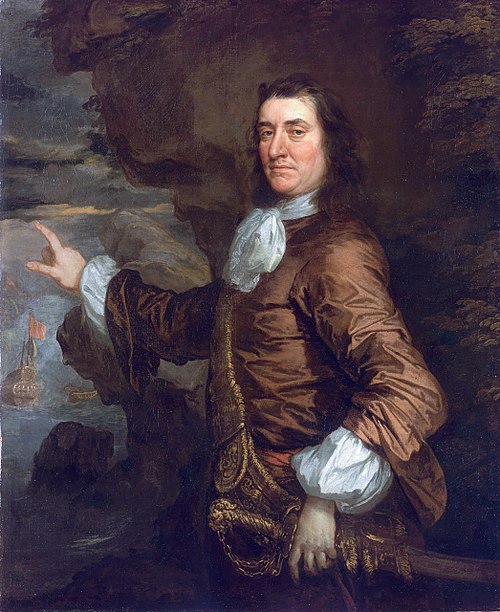
• This was a series of thirteen portraits of leading, senior Naval commanders involved in the Battle of Lowestoft, carried out in the workshop of the Dutch artist Peter Lely (later knighted in 1679). It was commissioned by James, Duke of York – younger brother of Charles II and leading Naval commander himself, who was Admiral of the Fleet on the day of the battle itself. The men commemorated were George Monck (1st Duke of Albemarle), Sir Thomas Allin (1st Baronet of the name), Sir George Ayscue, Sir William Berkeley, Sir John Harman, Sir Joseph Jordan, Sir John Lawson, Sir Christopher Myngs, Sir William Penn, Prince Rupert of the Rhine, Edward Montagu (1st Earl of Sandwich), Sir Jeremiah Smith and Sir Thomas Teddeman.
• The portraits of Sir John Lawson and Prince Rupert are in the Royal Collections, the other eleven in the National Maritime Museum, Greenwich.
• Details of all thirteen men’s function on the day of the battle are to be found on Wikipedia, together with their portraits.
CREDIT: David Butcher
United Kingdom
Add new comment