
A Seaside Excursion (1797)
Introduction
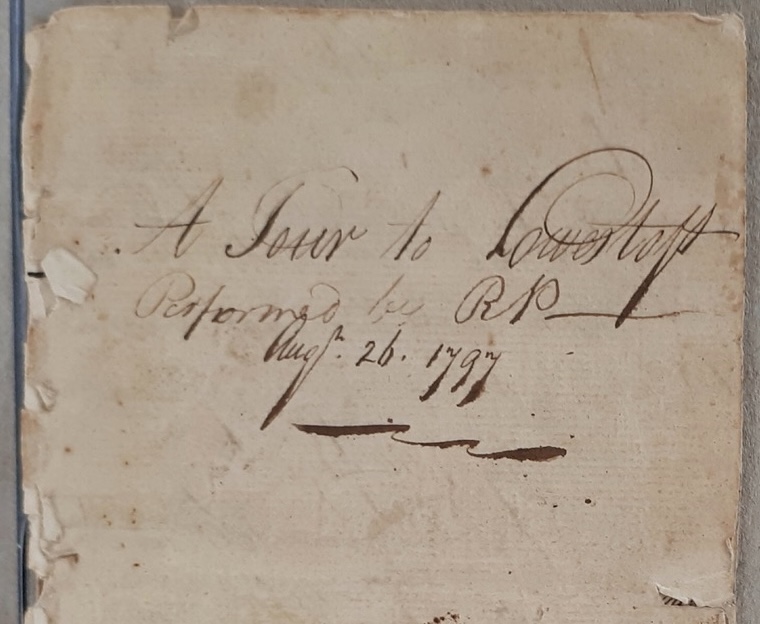
An account of this trip, taken by two young men, from Saffron Walden to Lowestoft and back, took place between Saturday 26 August and Sunday 3 September 1797. It is written on two pieces of rag-paper 7½ inches by 63/8 in size (190mm X 162), folded to form eight pages, and with a half-piece serving as the first two – the outer one of which is the title-page itself. Originally hand-stitched down the middle of the fold (and with this either failing or being removed, at some point), the document was later secured by a single staple in the middle. The handwriting is small and slender, with some of the letters (particularly towards the end of longer words) quite badly formed. There is no punctuation or paragraphing used, just periodic horizontal stokes of the pen placed at the bottom of the line to serve as breaks or pauses (represented below as mid-line dashes) – sometimes placed in the middle of what would be a sentence. And the miles covered during each stage of the outward and homeward journeys are written above the particular place where each night was spent. Occasional use of abbreviations is made and there are some spelling variants of today’s norms in evidence.
This most interesting document was kindly donated to the Lowestoft Archaeological & Local History Society by Charles Scott-Fox of Willand Old Village, Cullompton, Devon. It was written by his grandmother’s great-grandfather, Robert Paul (who was about eighteen years old at the time), and it presents a fascinating picture of the times. The journey there and back appears to have been made by carriage, either belonging to the young men or hired by them, and there was also an extra horse present to provide riding opportunity. The outward leg of the journey, as far as Lowestoft, contains a great amount of detail regarding the names of places along the way from Bury St. Edmunds onwards – but, there are no such references (apart from Attleborough) on the return home via Great Yarmouth, Norwich, Thetford and Bury.
The transcription below tries to follow the layout of the document as closely as possible, but without being able to represent it fully in its original form. No attempt has been made to change anything, including the variant spelling, but square brackets have been used in-text to clarify matters (where needed) and end-notes serve to add relevant information to things which require further information or explanation. Blank spacing-lines, where present, indicate the end of pages in the narrative (there are eight pages in all, plus the title-page) and readers will have to provide their own innate sense of punctuation to create sentence structure. It would not have been appropriate to have made any attempt to punctuate this piece of work because it would have compromised its integrity.
There are certain ambiguities in the text which cannot be fully resolved, with the first relating to Robert Paul himself and to his companion – the latter simply referred to as “Bro JP” (with “& Selfe”, following) in the first paragraph and as “Bro” in the final one. The implication has to be (in the absence of any other information) that the two men were brothers and that “Bro JP” does not refer to two separate individuals. Perhaps the fact of the travellers occupying a “two bedded room” in the Crown Inn at Lowestoft confirms two people only – while leaving their relationship to each other aside. Then there is the matter of two different dates given at the beginning of the piece: “Augt 26. 1797” providing the heading, followed by “Sett of from S Walden on the Saturday evening Aug 29”. The Saturday in question was indeed the 26th August, whereas the 29th was the following Tuesday. Surely, a “slip of the pen” is in evidence, here. Then there is the question as to how this particular “mini-memoir” was recorded and written down. Did its creator write it up at the end of each day? Or did he make notes of the daily occurrences and put pen to paper once he had returned to Saffron Walden. We shall never know, unfortunately, but must be grateful that such an interesting piece of personal experience has managed to survive down to the present day.
Route taken
The likely route taken, keeping to the main roads of the time and using modern identification, was probably as follows. Saffron Walden to Sawston (B184 & A1301) - Sawston to Cambridge (A1301) - Cambridge to Newmarket (A1303 & A1304) - Newmarket to Bury St. Edmunds (A 1304 & B1506 - much of the latter now forming part of the A14) - Bury St. Edmunds to Bungay (A143) - Bungay to Beccles (former A143, minor road & B1062) - Beccles to Lowestoft (minor road & A146) - Lowestoft to Great Yarmouth (former A12, now A47) - Great Yarmouth to Norwich (A149, A1064 & A47 – there being no “Acle Straight” in existence in 1797) - Norwich to Thetford (A11) - Thetford to Bury St. Edmunds (A134) - [Brother’s visit: Bury to Glemsford and back (B1066)] - Bury to Newmarket (B1506 & A1304) - Newmarket to Cambridge (A1304 & A1303) - Cambridge to Sawston (A1301) - Sawston to Saffron Walden (A1301 & B184).
Itinerary
- Day 1 - Saturday 26 August - Saffron Walden to Cambridge, via Sawston - 7.15 p.m. [19:15] to 9.55 p.m. [21:55] - overnight stay, Cambridge.
- Day 2 - Sunday 27 August - Cambridge to Bury St. Edmunds, via Newmarket - 6.15 a.m. [06:15] to 10.15 a.m. [10:15] - overnight stay, Bury St. Edmunds.
- Day 3 - Monday 28 August - Bury St. Edmunds to Beccles, via Great Barton, Ixworth, Stanton, Wattisfield, Rickinghall, Botesdale, Wortham, Palgrave, Stuston, Scole, Billingford, Thorpe Abbotts, Brockdish, Needham, Harleston, Redenhall, Wortwell, Denton, Earsham, Bungay, Wainford, Mettingham, Shipmeadow and Barsham - 6.15 a.m. [06:15] to 3.50 p.m. [15:50] - overnight stay, Beccles (White Lion inn).
- Day 4 - Tuesday 29 August - Beccles to Lowestoft, via Worlingham, North Cove, Barnby, Carlton Colville and Mutford Bridge - 5.30 p.m. [17:30] to 6.55 p.m. [18:55] - overnight stay, Lowestoft (The Crown inn).
- Day 5 - Wednesday 30 August - Lowestoft to Great Yarmouth (no places in between mentioned) - 10 a.m. [10:00] to 12 noon [12:00] - overnight stay, Great Yarmouth (The Wrestlers inn).
- Day 6 - Thursday 31 August - Great Yarmouth to Norwich - no leaving time given (but it was during the evening) and no places in between mentioned - arrived in Norwich at 9.15 p.m. [21:15] - overnight stay at the White Lion inn.
- Day 7 - Friday 1 September - Norwich to Bury St. Edmunds, via Attleborough and Thetford - 10.30 a.m. [10:30] to 8.45 p.m. [20:45] - overnight stay, Bury St. Edmunds.
- Day 8 - Saturday 2 September - Bury St. Edmunds to Cambridge - 4 p.m. [16:00] to 9 p.m. [21:00] - brother’s visit to Glemsford during the day - overnight stay at Cambridge.
- Day 9 - Sunday 3 September - Cambridge to Saffron Walden - 8 a.m. [08:00] to 10 a.m. [10:00].
Text
A Tour to Lowestoft
Performed by RP
Augt 26. 1797
Set of From S Walden on the Saturday evening Aug 29. [sic]1 ¼ past 7 oClock rode on Horse back far as Sawston and walkd to Cam[bridge] arrived there about 5 before 10 oClock2 – Sunday morning ¼ after 6 – Bro [Brother?] JP & Selfe sett of for Bury [St. Edmunds] – Breakfasted at Newmarket reach Bury ¼ after 10 oClock – 27 miles [from Cambridge] – heard Mr. Johns musings3 & afternoon drank tea with Mr Elton Thacker4 on Monday we went from Bury ¼ after 6 oClock – the first town was [Great] Barton – Ixworth – stirrup leather broke
Stanton Wattisfield Rickinghall Bottesdale – a fine park & Beautiful Water [Redgrave Hall]5 – [Thomas] Holt Esq
Wortham Palgrave Hustion [sic - Stuston] Arrived at Scole Inn [White Hart] at 10 oClock –
23 miles [from Bury St. Edmunds] – had Coffee Bread & Butter & Cold Beef for Breakfast Sett of from thence ¼ after 11 o Clock
Billingford
Thorp [Thorpe Abbotts], Broadish [Brockdish] Needham
Harl[e]ston a neat Town saw a sign Paul Upholder 6– a Chapel of ease very neat Redenhall a good Church 16167 The Mother Church to Harlstone Watter__Worl [Wortwell] and a Neat Red Brick Meeting house with burying Ground8 Saw some Fowles with with sticks Run thro their wings to prevent their going thro the Hedges9 – Denton Dr Sankys Seat Chanceler of Norwich10 – a very neat Red Brick House with beautiful Garden upon the right Flixton Hall11 – the seat of [Alexander] Adair Esq an old Mansion House Earsham – arrived at Bungay at 2 oClock saw the Castle situated upon a hill at the entrance of the town A town Irregularly built but good brick Houses – 2 Churches part one in ruins12 – Wainsforth [Wainford]13 – Mettingham – Shipmeadow – a thatchd Church with Brick and Stone Steeple – Barsham –arrived at Beccles at 10 min before 4 o’clock – 5½ miles [from Bungay] – came thro the back street the Houses built upon a hill a bank upwards of 20 feet high14 – Sett up at the White Lion Dinner Beefstakes [sic] Cold veal Cheese – NB Stakes Suppers – Accumling [Accomplishing] a comfortable Dinner15
A fine tower seperate from the Church most beautiful prospect from the Churchyard of the the Common villages adjacent – Neat Market House & Assembly room town irregularly built – some ruins one side of town16 – there are 30 Steps from the road [Puddingmoor] up into the Churchyard17 almost all the houses coverd with Pantiles – set off ½ after 5 oClock – Wallingham [Worlingham]18 North Cove – thatched Church
Seat of Mr. Farr
Barnaby [Barnby] – Carlton [Colville] – crossed a most beautiful lake19
Mumford [Mutford Bridge] – arrived a[t] Lowestoft – 8 miles [from Beccles] – at 55 Min past 6 oClock Took a little refreshment & walked on the Beach the Sea was rather rough & the sight was truly grand – saw many ships laying at anchor – & the Light Houses were lighted while we were walking we walked about the town20 – pretty town – one good street [High Street] at each end a platform or Garrison with Large pieces of Cannon21 about 10 oClock the Ip[swich] mail came Inn had a good supper22 – we slept in a two bedded room – about 2 oClock in the morning we were disturbed by a man calling waiter – Boots – Maid – Ostler fr [for] my friend wants somebody to help him in getting off his pantaloons – I asked him what he wanted the answer he made as above – we saw on our rising in the Morning the Sea from our Chamber window – arrose ¼ after 6 went to the Beach Bathd in the Sea with the Machines 9d pr hr23 returned had a good breakfast saw the China manufactory bought some trifles24
Sett of for Yarmouth about 10 oClock – arrived about 12 o Clock – sett up at the Wrestlers25 walked thro the town to the Jette [Jetty]26 there we saw a frigate of 40 guns and a vast many colliers etc wanted to go on board the frigate but the charge was to great 10/6 [10s 6d] for ½ hour27 – Saw Mr & Mrs Gillson, Mr White & 2 sons Mr & Mrs Pursham Mrs Finch etc – went to the key [South Quay] saw about 200 or 300 vessels –returned to our Inn had a plain Dinner wine after – our expenses for Dinner here was 10/6 for Dinner [10s 6d] – a proud bum[p]tious man – we through [thought] we were imposed upon – after Dinner we went to see the Barracks and from there to see the French frigate the Proserpine 14 guns28 – we saw the hole w[h]ere the ball entered which killd the Capt & First Lieut we also saw the prisoners about 27029
bough[t] some rings of them30 – before Dinner we went to Boultons Museum well worth seeing – Sett of for Norwich31 – about 3 miles before we reachd Norwich – 22 – [miles from Yarmouth]32 – (it was dark) we had a very heavy rain a Storm of Thunder & lightning – was very dismal – arrived at the Lion [White Lion] about ¼ after Nine – went on gentlemen’s walk33 returned had a good supper & to bed we went arrose about ½ after Six walked but it raining made it uncomfortable – calld for a Mr. Carver – he breakfast[ed] with us a good one – after Break[fast] we went to the Cathedral Barracks Parissian Gardens & Castle
Left Norwich ½ past 10 Clock for Attelborow [Attleborough] – 16 – [miles from Norwich] – Din[e]d – and set off for Thetford – 14 – [miles from Attleborough] – tea’d and from thense Bury [Bury St. Edmunds] – 12 – [miles from Thetford] – I reach Bury ¼ before Nine being on horse back – companion ½ after 10 Clock34 Next morning Bro went to Glemsford35 Aunt Hemsle took a ride in our chaise Cousin G Helfe went to see aunt & Uncle Thacker36 and we walked to their new New Brew house – returnd Dind – at Aunt Pauls – Left Bury at 4 oClock – 14 – [miles to Newmarket] – Drank tea at Newmarket – reached Camb[ridge] about 9 oClock – 27 – [miles from Bury St. Edmunds]37 – Slept that Night – I sett of for Walden [Saffon Walden] on Horseback being to late for the coach about 8 oClock reach Walden about 10 oClock found all back & So endeth my story RP
End-notes
1. A slip of the pen, here. The 29th was a Tuesday, and the day of arrival in Lowestoft. A perpetual calendar was used to check all the dates in Robert Paul’s account of his “tour”.
2. The distance between Saffron Walden and Sawston is 7½ miles and that between Sawston and Cambridge 6 miles. The first leg of this journey would have taken about an hour on horseback, the second something approaching two on foot.
3. This might well refer to a sermon preached at a Sunday morning service, in church.
4. Drinking tea was very much a social occasion and accomplishment among the well-to-do, at this time. It is not to be confused with the “afternoon tea” of the Victorian period, which was started by the Duchess of Bedford during the 1840s.
5. Redgrave Hall was well known for its fine landscaped grounds, designed by Capability Brown during the 1760s for Rowland Holt III (older brother of Thomas).
6. An “upholder” was an upholsterer/furniture dealer.
7. The church of St. Mary Redenhall has 1616 displayed upon it, as repairs to it were carried out that year.
8. This was Wortwell Congregationalist Chapel. It is still in use, but with its brickwork long painted over and coloured off-white.
9. The chickens had probably had their wings treated in this way to stop them flying away. The usual way of doing this was (and is) to shorten the primary flight feathers by clipping them.
10. The Chancellor of a Church of England diocese is its chief legal officer. The man referred to here mistakenly as Dr. Sanky was the Revd. Dr. George Sandby, who was also Rector of Denton (1750-1807) and who lived at Denton Lodge - a fine house with extensive grounds, situated not far from the road along which Robert Paul and his brother were travelling. He died 24 March 1807, at the age of ninety.
11. Flixton Hall (before it burnt down in 1847) was one of the finest houses of its kind anywhere, having been built in 1615 and reputedly designed by Inigo Jones. Such attribution. however, is doubtful. Robert Paul was travelling on the Norfolk side of the River Waveney, at this point, not the Suffolk one – so, he can’t have seen Flixton Hall, unless he crossed the river at Homersfield to view it and then retraced his steps. Perhaps he heard tell of it along the way.
12. St. Mary’s Church, Bungay, is what is left of a medieval Benedictine Nunnery. Some ruins remain in situ close to the church building, which is no longer in regular use for worship.
13. This shows that the party left Bungay by going down Bridge Street and over the River Waveney into Norfolk on the former A143 (a minor road, now), crossing Ditchingham Dam and bearing right into Pirnhow Street, continuing along it and back over the Waveney into Suffolk. They then took the main road leading from Bungay to Beccles (B1062).
14. The back road referred to is Ballygate – the road into the town from Bungay, linking directly to the B1062.
15. The White Lion in Beccles is still standing as No. 19 Smallgate, next to the Public Hall, and is a three-storey Grade II listed building of 1774 – built in red brick and of five bays width. It has not been in use as an inn for many, many years, but its imposing presence adds greatly to its surrounds as part of the urban landscape.
16. The ruins referred to may have been those of the church of St. Mary Endgate, a building which was demolished during the late 16th century as part of making Beccles into one parish instead of two. These remains were located in the southern sector of the town and the name Ingate (which serves as one approach to Beccles when coming from Lowestoft, via Worlingham) is a variant of Endgate. The -gate element derives from gata, an Old Norse word meaning “road” or “street”.
17. The steps referred to, from Puddingmoor up to the Churchyard, are known as “The Score”. This term has nothing to do with number, but is the same usage as the scores in Lowestoft – a steeply rising alleyway up the face of an incline.
18. The route taken out of Beccles was that of the minor road passing through Worlingham (which was once the A146 itself) and which joins the present A146 roundabout near Marsh Lane – this, serving as the eastern extremity of the Beccles bypass.
19. The lake referred to would have been Lake Lothing and the broad at Oulton, each stretch of water being on either side of Mutford Bridge.
20. The two lighthouses mentioned were the Lowlight (on the beach) and the Highlight (on the cliff-top). These had to be aligned, out at sea, by vessels wishing to negotiate the Stanford Channel (separating the Holm and Newcome sandbanks) and reach safe anchorage inshore. The harbour wasn’t built until 1827-30.
21. The reference here is to Lowestoft’s two defensive gun emplacements. The North Battery stood on the cliff-top in what is now Belle Vue Park (part of the North Common, at the time), the South (main) one on Battery Green Road where the car park is now located.
22. Reference to the Ipswich Mail Coach shows that the inn referred to was The Crown. The two men were obviously lodged in a bedroom facing the High Street, if the sea could be seen from it.
23. Bathing machines modelled on those used at Margate or Deal (accounts vary) were introduced to Lowestoft in either 1768 or 1769. The nine-penny hourly charge (4p) was a substantial one, being about a quarter of a labourer’s daily earnings.
24. The Porcelain Factory’s “trifles” were (usually) small pieces of ware with “A Trifle from Lowestoft” painted on them: objects such as small mugs, tankards and inkwells. But larger pieces were also decorated in this fashion (e.g. teapots) and other places in Norfolk and Suffolk were sometimes named in the inscription, instead of Lowestoft itself. It was all part of a local novelty and tourist trade.
25. The Wrestler’s Inn, on Church Plain, was perhaps Yarmouth’s premier hostelry at this time. When Horatio Nelson visited the town on 6 November 1800 (to receive the freedom of the borough), some of the men in the crowd assembled to greet him unhitched the horses pulling his carriage and did the job themselves, dragging the equipage to The Wrestlers!
26. Yarmouth Jetty was an early, simple, wooden pier, which was a notable feature of the seafront. It long pre-dated the construction of piers during the Victorian period (having been constructed c. 1560) and was demolished in January 2012, being deemed too expensive to repair and make good. It was built to facilitate the landing of catches of fish, as the main quayside along the river at Yarmouth was largely devoted at the time to general maritime trade of various kinds.
27. The sum of 10s 6d (52p) was a “half-guinea”, in the terms of that time – a substantial sum amounting to about a week’s wages for many people.
28. Gt. Yarmouth was an important North Sea naval base during the French Revolutionary War (1793-1802) and the two following Napoleonic Wars (1802-15).
29. The number of guns referred to (14) does not really fit in with a frigate’s armoury, which was about 38-40 guns on British craft (some of the larger French vessels carried up to 60). It fits with a sloop more readily, that type of vessel usually carrying about 14-16 guns. A frigate’s crew was around 300 men, that of a sloop 60-80. The 270 French prisoners seen might therefore seem to suggest a frigate – if they were all from the same craft. Robert Paul’s account seems to link the captives with the ship, but there may have been another explanation.
30. The French prisoners were obviously selling their valuables, to raise cash. When imprisoned in England, they often made novelties and models from wood and meat-bones to sell to people who would buy them. These have considerable antique value today. Following on from the previous end-note, Yarmouth did have a holding prison for foreign military or naval personnel at this time (largely, the latter), using converted fish-curing premises located at the southern end of town, not far from the main quayside and quite close to a road of today known as Nottingham Way. It is possible that this was a place for people (who were so inclined) to visit.
31. The route to Norwich would have been via what is now the A149 to Caister and the A1064 to Acle. There was no direct route across Halvergate Marshes at the time, the stretch of road used today (A47) being authorised by Act of Parliament in 1830 and the highway itself constructed during the following year.
32. The last six appended mileages have the number only. The word “miles” itself is missing.
33. The White Lion inn stood close to Gentleman’s Walk, which is the road running alongside Norwich Market. White Lion Street itself, named after this former hostelry, has the W.H. Smith shop standing on one corner of the junction with Gentleman’s Walk.
34. A journey made on horseback would have been quicker than one made by coach.
35. Glemsford (near Long Melford and Sudbury) later became a notable centre of the Suffolk silk industry. It still retains a working factory, though the industry of today is mainly based in Sudbury. From the account given, it appears that Robert Paul’s brother went to Glemsford (ten miles to the south of Bury St. Edmunds) on his own, leaving the former to meet with relations who lived in Bury itself.
36. Relatives, most likely, of the man referred to on Day 2 (Mr. Elton Thacker).
37. The 14 miles recorded for Bury St. Edmunds to Newmarket is included in the overall distance of 27 miles between Bury and Cambridge.
Norwich “extra”: if the Friday morning walk (7 September) was done in the sequence described (Cathedral, Barracks, Gardens and Castle), then the route taken can be reasonably guessed at. From the Cathedral, Robert Paul, his brother and Mr. Carver would have crossed the River Wensum over Whitefriars Bridge (al. Bridge of St. Martin’s) and proceeded along Barrack Street (A147) to their destination, which had been built in 1791. They would then have retraced their steps, crossing the Wensum again and finding their way through the side-streets and lanes down to the Baltic Wharf area of today. Located there, between St. Faith’s Lane, King Street and the river were two of Norwich’s four pleasure gardens of the time, My Lord’s Garden and the Spring Gardens - sitting side by side, with the former named after the Dukes of Norfolk who had once had a large residence there, before making Arundel Castle their chief dwelling. There may have been some visual attraction present which caused Robert Paul to make reference to the “Parissian Gardens”. From the gardens to the Castle was then a relatively short walk along King Street.
CREDIT: David Butcher (transcriber and editor) also the Lowestoft Archaeological and Local History Society
United Kingdom
Add new comment