
The Town Hall Raid (1933)
“I know not whether laws be right,
Or whether laws be wrong.
All that we know who lie in gaol
Is that the wall is strong;
And that each day is like a year,
A year whose days are long.”
(Oscar Wilde: “The Ballad of Reading Gaol”)
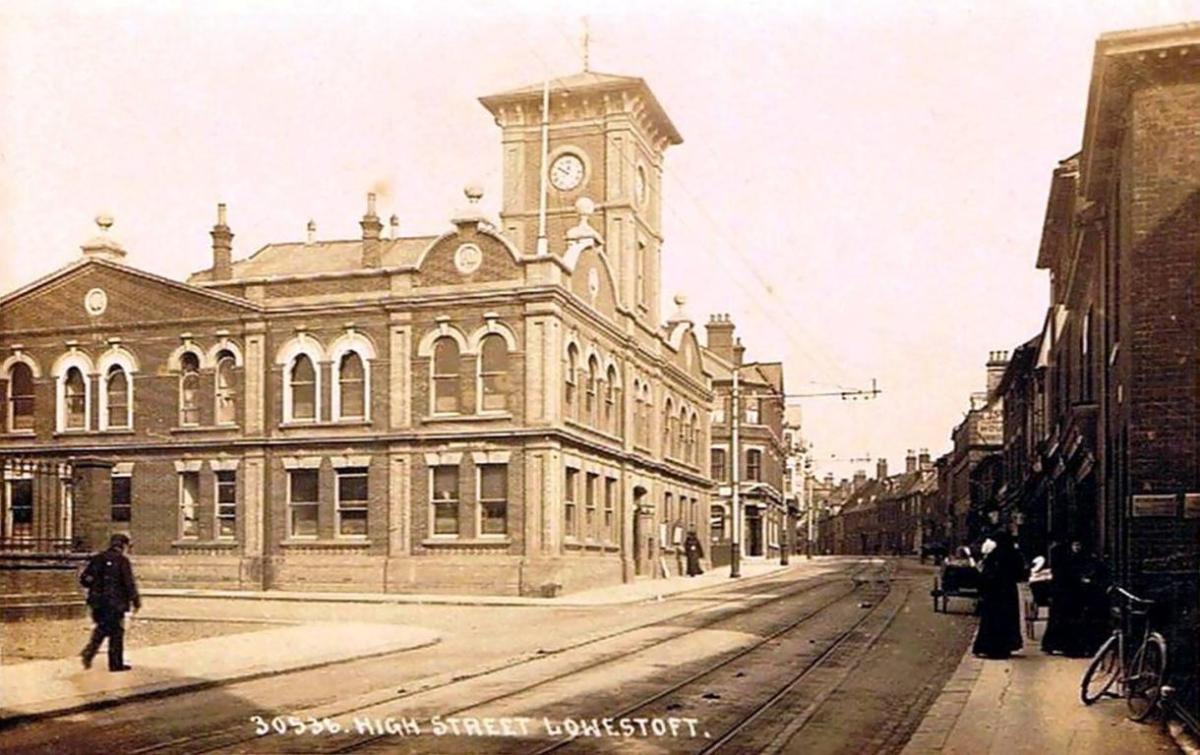
The 1920s and 30s were a time of high unemployment and hardship – and Lowestoft was no exception to the national trend. High levels of discontent accompanied the situation and found their most forceful expression (against the predicament of being jobless and at the mercies of a far from generous system of relief) in the so-called “Town Hall Raid” – also sometimes found referred to as the “Town Hall Riot”. Four days before this took place, however, nine men were charged in the local magistrates court of obtaining poor relief support payment under false pretences. Two of them had been working at a job and drawing relief at the same time, while the other seven had neglected to turn up for the task work assigned to them, which consisted of digging road material (sand and gravel) from Normanston Pit – which had been in use for this purpose for two hundred years or more and which is still present (though grown through with trees) near the junction of Lakeland Drive with Normanston Drive. With the exception of one man, who was discharged, all the accused were found guilty and were fined £2 each, with the threat of a seven day prison sentence for default of payment. Apart from this, a time-keeper at the Pit got a fourteen day sentence for stamping the absentees’ cards and receiving a sixpenny payment [6d] from each of them for doing so. While the cases were being heard, a sizeable crowd of people gathered outside the Courthouse in Regent Road.
In a way, this seems to have been the prelude to the main incident, for on Monday 8 May 1933 a crowd of about 100 unemployed men, plus a number of supporters and sympathisers, marched on Lowestoft Town Hall to protest about the withdrawal of the coal relief ticket payment and to lobby officials there as to the justice of their case. What the marchers did not know was that the authorities had got wind of their of their plan and had placed a number of policemen inside the building ready for their arrival. At 3.40 p.m., the crowd stormed the doors and in the ensuing fracas twenty-four of them (between the ages of seventeen and forty-nine) were arrested: twelve fishermen, eight labourers, two Fish Market hands, one net-store worker and one driver. They were taken immediately by charabanc down to Lowestoft Police Station (in Regent Road) and remanded for a week in Norwich Prison on charges of riotous assembly and assaulting the police. While the hearing was in progress, a large crowd of people gathered outside the Court and the wives of two of the men inside were arrested as the prisoners left for Norwich. After they had gone, members of the Great Yarmouth branch of the National Unemployed Workers Movement (who had come over to give support to the march) held a rally to consolidate feeling for the imprisoned men.
our wrists were all bleedin' when they took the handcuffs orf
Three further arrests were made on the following day, Tuesday 9 May, and these men also joined their compatriots in Norwich Prison – which made a total of twenty-seven in all. With the exception of one, who didn’t face a further hearing because he was regarded as being simple-minded, all of the accused were back in Lowestoft Court House by 8.30 a.m. on Monday 15 May to hear what was to happen to them. Proceedings took six hours in all and, during the morning, a large crowd gathered once again in Regent Road. After the process of justice had run its course, six of the rioters were committed to the Suffolk Assizes and released on bail, eighteen were bound over to keep the peace for twelve months in recognisance of the sum of £5, and two youths were put on probation. The two women who had caused an obstruction and assaulted police officers, as their husbands were being taken to Norwich on Monday 8 May, were also bound over. And the whole affair ended on Monday 29 May, at Bury St. Edmunds, when the six ringleaders (as the authorities deemed them, anyway) were bound over to keep the peace for three years. Failure to do so would result in immediate arrest and imprisonment.
All of this is interesting enough in itself – but, it is not all. At about the same time, over in Great Yarmouth, a similar event took place. On Tuesday 16 May 1933, the Yarmouth branch of the Unemployed Workers Movement held a rally in the Market Place and urged the people present to march on the Town Hall that evening to protest about the administration of Poor Relief. At about 7.30 p.m., a crowd of around 200 walked down the middle of the road , with sympathisers on both pavements, and held a demonstration in the Hall Quay/South Quay area. The police made thirteen arrests and twelve men (there was one probation order made) were committed to stand trial at the Norfolk Assizes on a surety of £10 bail each. The charges were riotous assembly, assaulting the police and causing an obstruction. The trial took place at Norwich on Saturday 3 June, when sentences of nine months hard labour were handed out to seven of the accused and six months to the other five. The punishment was much more severe than that meted out to the Lowestoft marchers because the assaults on the police were much more violent. All of the information above was culled from file copies of the Lowestoft Journal, kept in the newspaper’s former office at No. 147 London Road North, during the year 1980 – with all due thanks being given to George Smallman, Editor at the time.
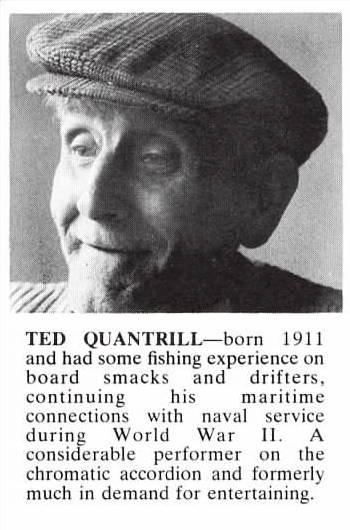
Edward Charles –“Ted”– Quantrill, fisherman (1911-88) was one of the men remanded to Norwich Prison for his part in the Lowestoft incident. Tape-recorded on 7 February 1980, he gave a most graphic account both of what happened at the time and what subsequently ensued. “There musta bin two or three thousand people unemployed in Low’stoff at that time. Yeah, someone hetta die afore you could git a job, then you’d jump in. A lot of us were on the Means Test ticket, which we hetta do three or four days work a week for cover. We used to go over to The Spike, as we called it – you know, the Workhouse [at Oulton] – an’ do what wuz called task work. We used to do all sorts o’ bloody jobs over there: makin’ beds, scrubbin’ wards out, gardenin’ – all sorts. You name it, they had it for yuh! Plantin’ taters wuz another thing. Sometimes, they’d go in the ground an’ sometimes they wun’t. Sometimes they’d go over the hedge to someone on the other side!
“Anyway, there wuz one time there when they cut our coal ticket orf, so we decided to make a deputation to the Town Hall. A lot of us used to go to a club in Duke’s Head Street. They called it the N.U.W.M. (National Unemployed Workers Movement) an’
they used to git us second-hand clo’s an’ that sort o’ thing. That gave yuh somewhere
to go an’ all, to git yuh orf the streets, an’ we used to pay tuppence [2d] a week to belong. When we could afford it, that wuz! Jack Cleveland [who lived at No. 4 High Street] used to run the club an’ some of us got talkin’ one day about the coal ticket bein’ cut orf. We decided we’d go an’ see the Mayor, but when we got up to the Town Hall we wun’t able to. Well, we all gathered outside the place an’, in the end, we decided to push our way in. What we dint know wuz that the Police were already inside! The grabbed about twenty of us to make an example of.
“I should say there wuz about a couple o’ dozen Pollce inside. An’ not only from Low’stoff. They’d come from all over the place when they got wind o’ what wuz goin’ on. They got the news that we were goin’ to march. Dun’t ask me how, though. A bloke outside said to me, ‘Don’t go in there, Ted. Thass all laid on. You’ll git pinched.’ But we dint take no notice. We started bangin’ an’ shovin’ aginst the door. All of a sudden, that give way an’ us at the front went flyin’ through. Soon as we got inside, the Police closed the doors on us. Some o’ the blokes got nearly as far as the Council Chamber upstairs. They broke the balcony doin’ it. Darkie Marshall got hit on the top o’ the hid with a truncheon ’cause he ripped an Inspector’s coat orf his bloody back, damn near. Yes, he got hit on top o’ the hid with a truncheon. Oh yeah, there were bloody drawn batons inside, dun’t you worry about that. I got caught by a great big bloke called Nolloth. He wuz holdin’ the doors aginst us (oh, he wuz a strong bloke!) an' when we burst through he caught me betwin his legs an’ held me like that for about a quarter of an hour!
“We played up hell for a while, then they got the better of us an’ took us away down to the Police Station. Instead o’ bein’ handcuffed individually, like they do today, we were all chained t’gether. They loaded us onto a charabanc an’ carted us orf down to the Station for a temporary hearin’. While we were in there, loads o’ people gathered outside. My missus wuz there, as well. So wuz Bunny Youngman’s missus. Yeah, an’ they both got pulled for tryin’ to stop the charabanc from takin’ us away to Norwich. See, we got charged with riot an’ assembly [riotous assembly]. Thass a charge, that is. They can read the Riot Act out, if they want to. Hoses and revolvers, the bloody lot! They held a quick hearin’ for us in Low’stoff Police Court. They’re gotta do that. They can’t just grab an’ take yuh away. The wuz about twenty of us an’ we all got remanded to Norwich Gaol for eight days. Time all this wuz goin’ on inside the Court, a lot o’ people gathered outside an’ the Police shut orf the main street [London Road North] to traffic. Buses wun’t allowed through an’ they even stopped the Grey-Green from passin’ [London bus company service]. At the hearin’, we all said we were bloody starvin’ an’ wanted the money. Well, not only the money, but the coal as well. Yuh see, they’d cut our coal ticket orf. That dint do no good. We all got shipped orf to Norwich, chained all together like I told yuh earlier.
“When we got there, the chief o’ the Prison dint half dress down the Low’stoff police inspector for doin’ that. See, our wrists were all bleedin’ when they took the handcuffs orf. That wuz bloody cruel, really. An’ not only that. It wuz dangerous, as well, all bein’ shackled together. If the charabanc had got involved in an accident, we’d have had a devil of a job gittin’ out. They took all our things orf us at the prison. You know, fags an' rings an’ stuff like that – an’ we got ’em back when we left. That wuz bloody tedious there in Norwich Gaol. They wun’t let us do no work. See, we were there on remand; we wun’t regular prisoners. Oh, that wuz bloody tedious. If I counted them bricks there on my cell wall once, I counted ’em a thousand bloody times, I did! At that time o’ day there wuz just one man to a cell. No smokes. No nothin’. Nowadays, they hev smokes, dun’t they? Oh yeah, thass improved a lot.
“ The prison wuz the one up there on Mousehold Heath. Yeah, an’ the grub wuz bloody terrible. We used to start orf in the mornin’ with porridge, an’ that wuz like swill. There wuz no milk with it, no sugar, no nothin’. One o’ the blokes, Arthur Moore, he kept refusin’ his. He couldn’t fancy it, yuh see. He ate it in the end, though ‘cause he got so hungry. Yeah, I remember the ol’ warder sayin’ to him, ‘You’ll eat the bugger afore you go. You’ll eat the cell door afore you go out, if you keep this up!’ An' he wuz right. Dinner wun’t too bad – taters with the jackets on an’ a little bit o’ meat. That wuz a little bit, as well. You could just about see the shadow of it on yuh plate. We got a cup o’ cocoa in the evenins an’ sometimes a Cornish pasty or somethin’ like that. But not much tea to drink. No, there wun’t much tea. An’ the knives you hed were like bits o’ bloody tin. They wun’t cut butter, they wun’t, an’ that wuz so you shouldn’t commit suicide. Coo to hell, you’d have bin a year cuttin’ yuh throat with one o’ them! An’ the forks! I dun’t know what the heck you’d call them. But they wun’t proper metal.
“We use to git exercise three times a day, about half an hour each go. We used to walk round the cell-block yard an’ we used to hefta march about a yard apart. We wun’t allowed to talk to each other – oh, the discipline wuz very strict – an’, as we went round, the warders used to count us orf one at a time to make sure we were all present and correct. When we went out on exercise one mornin’, who should se see but ol’ Joe Catchpole! He’d bin with us at the Town Hall, but the police dint pull him. They just told him to clear orf. See, he wuz harmless really, so they dint take much notice of him. [The man regarded as simple-minded, referred to in the third paragraph.] But, he kept sayin’ he wanted to go with the rest o’ the boys – so, in the end, they sent him to Norwich Gaol to join the rest of us. When he got there, he wun’t take his tan jumper orf an’ wear the prison uniform, so they let him stay as he wuz. I spose they could see what he was like. Anyway, there he stood this mornin’ out in the yard with this bloody tan jumper on! Laugh! O’ course, the rest of us were all in uniform. Yeah, we were all in rough ol’ grey stuff, with sort o’ sandal things on our feet. [Tan jumpers, so-called, were reddish-brown, below-waist, heavy cotton or calico slops worn by Lowestoft fishermen during the warmer months of the year. They were dyed with much the same agent as that used for treating sails: a mixture of salt-water, red ochre and horse-grease.]
“Our time to git up in the mornins wuz six o’ clock. Yeah, we used to be out at six an’ be all lined up by seven. You hetta do yuh bed, tidy yuh cell up an’ do yuh slop duty at seven. Breakfast wuz at eight. That wuz a regular routine, that wuz. Lights-out wuz at half-past nine. Well, they kept a very dim light on inside yuh cell, an’ outside, but you couldn’t read by it or anything like that. The only thing you were provided with to read in the cells were a Bible and a Book o’ Common Prayer. Nothin’ else. Oh, that wuz bloody tedious while you were locked in yuh cell. What I used to do wuz git my bed-board, shove it up aginst the winder (that hed bars on, o’ course), stand on it an’ hev a look outside. I overlooked Britannia Barracks [HQ of the Norfolk Regiment], where the soldiers were, an’ I used to watch them come out on duty an’ march up an' down. The ol’ band used to strike up, you know, an’ that used to help the time go by. I wuz lucky, really, havin’ a cell there.
“When we squared up our cells, first thing in the mornins, we hetta stand our bed-boards up on end aginst the wall. See, we hed a bed-board with four little legs on it, like a camp bed sort o’ thing, an’ that wuz as hard as that table [Indicating the one in the room]. I was used to that, though. I’d bin smackin’, see. I wuz on one smack [sailing trawler] where you dussn’t git in yuh bunk because the bloody bugs [bed bugs] would turn yuh out! Yeah, you’d stand the bed up an’ fold the blankets nice n’ neat. No mattress. No, no mattress. Coo to hell, you were in prison, wun’t yuh! No bloody mattresses. Then you’d fold yuh towel, so yuh name wuz showin’. You got issued with that when yuh went in an’ that had yuh name stamped on it. So did yuh bed linen. Just yuh surname. You never saw the same warder two mornins alike. I spose that wuz so you dint gut too familiar with each other. We were treated reasonably well, though. Yes, we were. But, o’ course, we hetta call the warders ‘Sir’. There wuz never no rough stuff with us. As long as you did as you were told, you were all right.
“The slop duty you hetta line up for every mornin’ wuz when you emptied yuh chamber pots. They were enamel ones an’ they used to make a clangin’ row as you rinsed ‘em out. You used to empty ‘em into a sink. You’d all line up an’ go inta a room where there wuz two sinks. There’d be two queues up to these sinks an’ each man would empty his pot, rinse it out an’ go back to his cell to wait for breakfast. You used the pot through the night, unless you wanted to do a number two, as we called it. You hetta press a button then, to sound a bell, an’ the duty warder would come an’ take yuh. Yeah, an’ he’d stand outside time you were inside. You hetta press the button in yuh cell durin’ the day as well, just the same. Yeah, you hetta be taken down an’ brought back just like durin’ the night. Oh, an’ twice a week, you hetta scrub yuh cell out. Down on yuh hands an’ knees! No long broom. Down on yuh hands an’ knees, scrubbin’ brush, carbolic soap an’ disinfectant. Oh, them cells were kept spotless. You dint see much o’ the other prisoners time you were in there. See, all of us were kept separate in one area o’ the prison. I’ll always remember my number, though. That wuz 482. Yeah, I’ll always remember my number.
“While we were in there, there wuz a parson for every denomination. They used to come an’ visit yuh. There wuz Church of England, Catholic, Salvation Army, the lot. An’ I’ll tell yuh another person who come in – the man who wuz in charge o’ the Yarmouth branch o’ the N.U.W.M. He wished us all the best because him an’ his lot were in sympathy with us. We attended Chapel on Wednesday an’ Sunday. That wuz the same sort o’ service as an ordinary church. You know, you sang hymns with the organ, then you got a sermon. The ol’ parson would make up a story how to be good, or somethin’ like that. How to be good! Thursday night, there wuz a regular lecture for the blokes inside. You went to a special hall for that an’ someone would come in an’ give yuh a talk.
“When we left prison, we met the Governor agin. He wished all the best an’ he shook
hands with all of us. Oh yeah, he sympathised. He seemed to know what it wuz all about. I mean, he had a damn good job, but there wuz thousands our side what didn’t have. Oh, he wuz very sympathetic, yeah. We went back to Low’stoff the same way as we come – by bus. Only, no handcuffs this time an’ plenty o’ cigarettes. When we arrived, everyone wuz there waitin’ for us. My missus, poor gal, an’ her mother an’ father, they were there. While, I wuz inside, my father-in-law had bin pushin’ my oldest boy about the town centre in a pram (course, he wuz only a babe then) an’ he had a placard on his back which said ‘Father gone to prison. Fighting for his rights.’
“When we got hoom, we went straight to the Magistrates Court. Yeah, at the old Police Station in Regent Road. My missus an’ Bunny Youngman’s wife hetta appear as well. Yeah, they played up hell when we got took to Norwich an’ they got put on probation for that. They used to go an’ see Jo Harris [Lowestoft’s first probation officer]. The best bloke in the town, he wuz. Yeah, my missus an’ Bunny’s missus hetta go an’ see him for a whole year. Most of us what’d bin involved in the Town Hall do got let orf. We got bound over for one year. Yeah, to keep the peace. Six o’ the blokes got sentenced to go down to Bury St. Edmunds assizes, so we all went down with ’em by coach. Yeah, an’ we had plenty o’ cigarettes an’ drink an’ everything, goin’ down there. A chap fixed up by the N.U.W.M. defended them an’ that never corst any of us a penny. The Yarmouth people fixed him up for us ’cause they were a bigger concern than Jack Cleveland’s Low’stoff branch. He wuz a barrister, this bloke, an’ he came from Yarmouth as well – but, I forgit what his name wuz now, Anyway, he got ’em orf an’ they got bound over as well.
“After that wuz all over, the local police watched us like a bloody cat watchin’ a mouse. That they did. Oh yeah, one little slip an’ you’d be charged agin. I dun’t know about goin’ back inside agin exactly, but you’d be charged all right. Then, about three or four months afterwards, I went down to the Labour Exchange an’ they give me a green card. I got a bloody job on the Sea Wall! With the Corporation, yeah. An’ not only me. Several more o’ the blokes what were involved in the Town Hall business got set on. Yeah, we worked on the Sea Wall. I spose I wuz on that three or four year altogether. I wuz up there at Pakefield at one time, workin’ on what they call the Jubilee Walk. Ent that a rum un?”
[The green card referred to above was given to unemployed people to help them to apply for specific work of one kind or another. The Jubilee Walk, or Jubilee Parade, was the section of sea defences ending at Kensington Gardens.]
• This article, with minor adjustments in places, was first published in 1982 as Chapter 6 in this writer’s book Living From The Sea – titled “Fishermen in Gaol”.
• The transcription of the tape-recording is written in the local dialect, as spoken, for authenticity and in as near a form as possible to its original delivery.
• All of this writer’s tape-recordings (running to 102 hours, in all), covering various aspects of the Lowestoft-area fishing industry c. 1910-60 – together with their hand-written transcripts – form part of the Suffolk County Oral History Collection and have been digitised for permanency. The work of recording was carried out 1976-83.
CREDIT:David Butcher
United Kingdom
Add new comment