
Lowestoft High Street Buildings
21 January 2024

Surviving internal timber framing
See also Overview and Commentary
| 1. No. 27 - former merchant’s house, with high-quality decorative ground floor work on ceiling beams and joists (scrolling grape-vine embellishment). Mid-16th century origins confirmed by the year 1551 being carved into south fire-place’s support beam. | 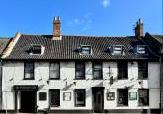 |
| 2. No. 30 - southern half of former merchant’s house (No. 29 being a later rebuild of the northern component). High-quality, decorative, roll-moulded ground floor work - mid-16th century. Entry room fronting the street is particularly impressive. | 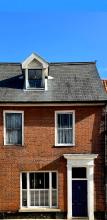 |
| 3. No. 31 - northern half of former merchant’s house (No. 32 being a mid-19th century remodelling of the southern component). Roll-moulded ground floor beams and joists - mid-16th century. Cast-iron stanchions in room fronting street suggest former jetty has been integrated with space below. | 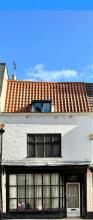 |
| 4. No. 35 - mid-17th dwelling built on northern part of No. 36’s plot. Interesting roof-trusses. | 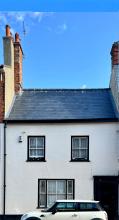 |
| 5. No. 36 - oldest house in Lowestoft, dating from late 15th century onwards. High-quality merchant’s dwelling, with sumptuous timber framing present in main ground-floor space and in the first-floor room fronting the street. | 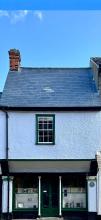 |
| 6. Nos. 43 & 44 - mid-late 16th century merchant’s house. Roll-moulded ground floor beams (especially noticeable in No. 44). Latter’s main first floor room has cambered timber ceiling and much of the original roof-trussing is still in place. |  |
| 7. No. 45 - vestigial evidence of probable mid-late 16th century origins. This is the house in which John Jex (merchant) hosted George II during the year 1737, when the latter (on a return journey, by sea, from Hanover) was put ashore in heavy weather suffering from sea sickness. After a period of recovery, he was taken by coach to Harwich - and, from there, to London. |  |
| 8. No. 46 - first floor room to rear of that at the front has mid-late 16th century roll-moulded joists in evidence. | 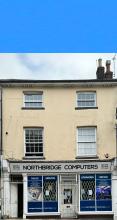 |
| 9. No. 55 - cellar beneath front of house has substantial mid-late 16th century beams supporting floor above. A 16th/17th century cross-wing to rear of house (northern part) might have visible signs of timber-framing (esp. in the roof). | 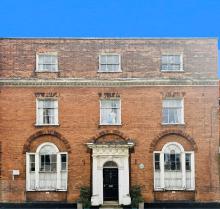 |
| 10. No. 68 - one small length of mid-16th century beam/joist, with scrolling vine-leaf motif, was once visible on the right hand side of the shop space, towards the back of it. The site of Nos. 64-69 was once occupied by a large inn called The Angel, whose messuage underwent subdivision during the 1650s. | 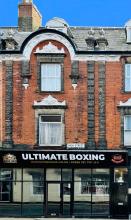 |
| 11. Nos. 75 & 76 - ground floor has chamfered bridging beams and wall-plates. Late 16th-early 17th century origins? | 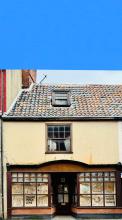 |
| 12. Nos. 78 & 79 - some boxing in of ground floor beams in evidence, which may mean poor original state. Until the 1960s, a mid-late 16th century cross-wing (with steep roof-pitch) had stood to the rear. | 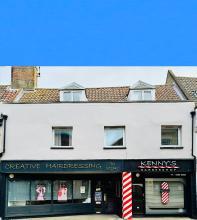 |
| 13. No. 80 - some boxed beams evident in places. The roof has complete original late 16th century trusses in place, with renewed pieces showing. A high-quality dwelling belonging to the Wilde family of merchants from 1586-1738, the plinth and dressed flint on the facade helping to show its high-status nature. | 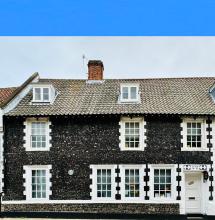 |
| 14. Nos. 81 & 81A - once formed one dwelling with Nos. 82 & 83, with partitioning probably carried out during late 18th/early 19th century. Some stud-work visible on ground floor. During major internal work (early 2000s), evidence of a former cross-wing was revealed by a bricked up interior doorway. From the late 16th century to the early 18th, this was the home of the wealthy Pacy family (mariners and merchants). | 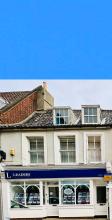 |
| 15. Nos. 82 & 83 - once formed one dwelling with Nos. 81 & 81A. Ground floor axial beams largely boxed in, but of mid-late 16th century origins - with some ovolo and cavetto moulding abutting the ceiling. Cast-iron stanchions placed near the shop windows suggest that the first floor was once jettied in the manner noted in No. 31. | 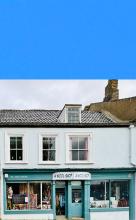 |
| 16. Nos. 102, 103 &104 - merchant’s house, probably dating from the first half of the 16th century, c. 1520-30. Middle section (No. 103) has the most elaborate timber-framing in the building. Richly roll-moulded beams and joists on ground floor, with cambered ceiling in the room above complete with jowelled wall-posts. When its first-floor cladding was removed and replaced during the 1980s, studwork was revealed, with herringbone-pattern brickwork between. | 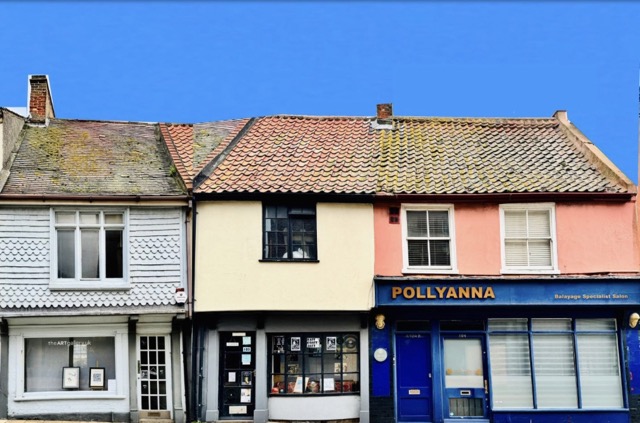 |
| 17. No. 140 - not seen, but possible roof-truss survivals. | 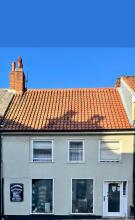 |
| 18. Nos. 147 & 147A - not seen, but possible first floor timbering and roof-trussing. |  |
| 19. No. 148 - once formed the southern part of The Bell inn and may have internal timber framing in places running through from No. 149. This hostelry was once important enough to have what later became Crown Street named after it - Bell Lane being in use for a good deal of the 17th and 18th centuries before finally giving way to the rival establishment. | 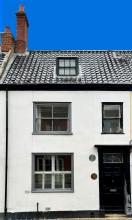 |
| 20. Nos. 149 & 149A - once formed the northern part of The Bell inn. Has a late 16th/early 17th century single-framed roof, with common rafters fixed to a central ridge-piece. The cellar below the northern bay has an interesting drainage sump, or well, with elaborate “basket-weave” brickwork. |  |
| 21. No. 150 - The Crown inn/hotel. May have early roof-trussing in the cross-wing, to the rear, running alongside Crown Street East. This roadway and its other half (Crown Street West) was once one a single through-way, before being cut in half by Jubilee Way in 1977, and it carried the name Crown Lane during the early 17th century - being then superseded by Bell Lane for a considerable length of time. | 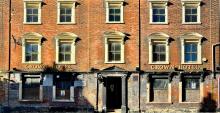 |
| CREDIT:David Butcher |
United Kingdom
Add new comment