
1500s

Mid-16th to Mid-18th Century
The Manorial System served both as the foundation of land ownership and management and of maintaining the peace and good order of each local community. It had its origins in Early Medieval times (what was formerly known as the Anglo-Saxon period) and was further shaped and developed following the Norman Conquest – which is now taken as being the start of the Late Medieval era.
Added: 24 March, 2025
The one thing missing from F.A. Crisp’s printed versions of the Lowestoft Parish Registers (1902) is any reference to the baptisms or burials of any infants born out of wedlock. Yet, such entries are there from the very first year of the first surviving register book: 1561. The best guess as to why this is so is probably to be found in attitudes of the time regarding illegitimacy being widely seen as a social disgrace, together with the more practical matter of who was to be responsible for the raising of the child – if it survived.
Added: 12 March, 2025
When Elizabeth I acceded to the English throne in November 1558, she had a number of problems facing her – not the least of which was the matter of what the country’s official brand of the Christian Faith was to be and what form it was to take.
Added: 2 March, 2025
Annot’s Free Grammar School
The single most important event in the process of public education in Lowestoft during the early modern period came in June 1570, when Thomas Annot (merchant) founded a free grammar school. A summary of the original deed of gift is to be found in the Rev. John Arrow’s Memorandum Book (he was Lowestoft’s parish priest, 1760-89) – Norfolk Record Office - PD 589/92, pp. 13-14. And it is also present in Edmund Gillingwater’s An Historical Account of the Ancient Town of Lowestoft (1790), p. 299.
Added: 21 February, 2025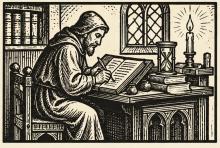
Among the many interesting features to emerge from close study of the 507 wills and 100 probate inventories which have survived for the period indicated in the title are the rates of literacy able to be determined in the various occupational groups which formed the town’s socio-economic structure. Even today, there would probably be argument (or at least discussion) among specialists in the field as to what literacy means. The same holds true for historians.
Added: 18 February, 2025
The first almshouses in Lowestoft were provided by John Manyngham, the parish vicar from 1457-78. The exact year of institution is not known, but they were located on the north side of Fair Lane (now Dove Street) near its junction with West Lane (now Jubilee Way). And they seem to have remained in operation, in some form – undoubtedly with alterations made – into the final quarter of the 19th century, when White’s Directory of Suffolk (1874), p.
Added: 19 January, 2025
For centuries, the use of alms boxes in parish churches throughout the whole of England was a means of collecting sums of money for charitable purposes – particularly the relief of poverty where it was known or seen to exist. During the 16th century, as a result of general cost inflation (aggravated by Henry VIII’s mindless extravagance and debasement of the coinage, to say nothing of the social and economic problems caused by the Dissolution of the Monasteries), the alleviation of financial distress in the lower levels of society became more and more of a challenge.
Added: 1 January, 2025
(Parish Register Entries)
The register entries below are presented in as close a way as possible to the original handwritten ones
Photo opposite - The interior of St. Margaret’s Church in 1786 - historic repository of the Lowestoft parish registers - captured by Richard Powles (1763-1807). This ink-and-wash study is to be found in Isaac Gillingwater’s ‘Drawings Illustrative of the History of Lowestoft, Mutford and Lothingland’ (Suffolk Archives, Ipswich - ref. no.193/2/1).

Authorisation for this Elizabethan taxation was granted by Parliament on 18 December 1566 and the official date of collection was 24 February 1568. Lowestoft’s stated contribution of £34 19s 8d was 47% of the Lothingland total of £74 8s 6d and its 112 tax-payers constituted 42% of the half-hundred’s contributors (267 in number). These figures confirm the town’s dominant position in its local area, just as those of the 1524-5 collection did over forty years earlier. The 1568 Subsidy was structured differently from its predecessor in the way that the assessment was made.
Added: 27 September, 2024
The Lay Subsidy of 1524-5 (1) see also (2)
This national taxation measure was approved by Parliament in 1523, to raise money for war to be waged with France and Scotland (who else!), and with a hoped for total of £800,000 as its aim. As with previous countrywide levies, it was based on the value of lands held and rented out (where this was the major source of income), on movable goods (where these served the same purpose) and on wages for men of labouring or servant status.
Added: 20 September, 2024