
1500s

What you see is the remains of the base of a beacon, one of a pair erected in 1552 (on the orders of the Marquis of Northampton), to warn of attack from the sea. Its companion was located just to the north of what is now the junction of Gunton Drive with Corton Road.
Added: 22 September, 2023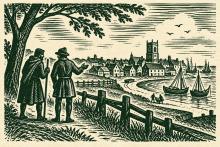
A number of rules and fees payable (applying to both residents and outsiders) surviving from the Late Medieval and Early Modern periods is to be found in documentation relating to the town, with Robert Reeve’s handwritten, unpublished ‘A History of Lowestoft and Lothingland’, vol. 4 (c. 1810) – Suffolk Archives (Ipswich), 193/3/4 – being a main source of information. A practising local solicitor, he was also Steward of the Manor during the late 18th and early 19th century and therefore well placed to be familiar with various aspects of its day-to-day running.
Added: 29 September, 2026
It is stated in the Book of Fiefs/Fees (al. Liber Feodorum) – an Exchequer listing of feudal estates compiled at the beginning of the 14th century – that Lowestoft was a manor in its own right by the year 1212. This possibly being when its status was raised from that of mere outlier to the Lothingland Half-hundred manor (as recorded in the Domesday Survey of 1086), whose hub was Gorleston.
Added: 28 September, 2026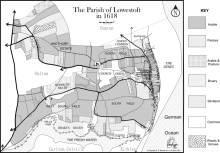
One of the most interesting features of local landscapes during the Late Medieval and Early Modern periods in any community (and Lowestoft was no exception) was the presence of areas not used for agriculture – usually because the soil was unsuitable for crops or too difficult to work, for one reason or another – and being generally referred as either common or waste. The former term referred to the land being available to people for various kinds of use and the latter derived from the Latin word vastus, meaning “empty” or “open”.
Added: 19 May, 2026
This fascinating document records settlement of the estate of a leading Lowestoft merchant, whose burial was recorded in the parish registers on 18 September 1636. It is located within the pages of the Lowestoft Tithe Accounts book (Norfolk Record Office, 589/80) – placed there by the Revd. John Tanner (Vicar of the parish, 1708-59), who had married into a branch of the Mighells family on 20 January 1713 (1712, by Julian Calendar dating) and who probably found the document among existing family papers. He obviously noticed, in the second set of accounts, that burial within the walls of St.
Added: 1 February, 2026
The national Muster Roll of 16 January 1584 (1583, by Julian Calendar reckoning) was a head-count of all adult males in England between the ages of sixteen and sixty, taking into account their military capability in terms of the weapons they held. It was carried out in anticipation of a possible Spanish invasion, launched across the North Sea from the occupied Netherlands (see Lothingland Invasion Scare of 1584,elsewhere, in the History pages of LO&N).
Added: 19 January, 2026
The national Muster Roll of 23 May 1535 was ordered by Henry VIII to take stock of England’s military capability, in terms of the country’s able-bodied adult males and the weaponry they possessed (there being no standing army of any kind) – this in anticipation of possible invasion from abroad, with a coalition of France and Scotland seen as being the likely source of aggression.
Added: 2 January, 2026
Introduction
Great Yarmouth’s attempted dominance of Lowestoft and control of the latter’s trade only came to an end during the second half of the 17th century, when its legally backed dominance was ended and the Suffolk town placed beyond its jurisdiction.
Added: 7 December, 2025
Introduction
The Church of England, as it stands today, is an organisation which originated in the need for a Tudor monarch (Henry VIII) to produce a male heir and secure his family’s tenure of the Crown and which then became part of a North European, Protestant, theological revolution. It is currently undergoing one of its periodic phases of change.
Added: 4 December, 2025
Reasons for the move
It is perhaps unwise to single out any one particular event in the life of a community over a period of about 1,500 years as being the crucial or formative one (other than its founding), but there is a good case for doing so where Lowestoft is concerned.
Added: 26 November, 2025