
1600s
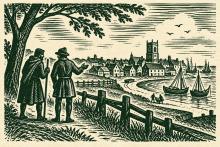
A number of rules and fees payable (applying to both residents and outsiders) surviving from the Late Medieval and Early Modern periods is to be found in documentation relating to the town, with Robert Reeve’s handwritten, unpublished ‘A History of Lowestoft and Lothingland’, vol. 4 (c. 1810) – Suffolk Archives (Ipswich), 193/3/4 – being a main source of information. A practising local solicitor, he was also Steward of the Manor during the late 18th and early 19th century and therefore well placed to be familiar with various aspects of its day-to-day running.
Added: 29 September, 2026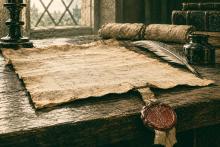
It is stated in the Book of Fiefs/Fees (al. Liber Feodorum) – an Exchequer listing of feudal estates compiled at the beginning of the 14th century – that Lowestoft was a manor in its own right by the year 1212. This possibly being when its status was raised from that of mere outlier to the Lothingland Half-hundred manor (as recorded in the Domesday Survey of 1086), whose hub was Gorleston.
Added: 28 September, 2026
Former Names for Lowestoft Streets, Roads and Scores
All of the older names listed below in italic font derive from documentation of one kind or another relating to the town – particularly those manorial records recording the transfer of property 1582-5 & 1616-1756, to the Revd. John Tanner’s transcriptions of these done up until 1720-25, and to the Manor Roll of 1618. All found as Suffolk Archives (Ipswich), 194/A10/4, 194/A10/ 5-19, 454/2 and 194/A10/73.
Added: 20 June, 2026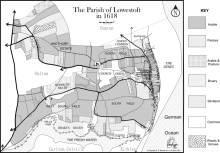
One of the most interesting features of local landscapes during the Late Medieval and Early Modern periods in any community (and Lowestoft was no exception) was the presence of areas not used for agriculture – usually because the soil was unsuitable for crops or too difficult to work, for one reason or another – and being generally referred as either common or waste. The former term referred to the land being available to people for various kinds of use and the latter derived from the Latin word vastus, meaning “empty” or “open”.
Added: 19 May, 2026
Reasons for the move
It is perhaps unwise to single out any one particular event in the life of a community over a period of about 1,500 years as being the crucial or formative one (other than its founding), but there is a good case for doing so where Lowestoft is concerned.
Added: 26 November, 2025
17th & 18th Century Naval Commanders
It is a claim – not made lightly by this writer – that no town of its size, in the whole of England, produced as many eminent top-rank Naval commanders as Lowestoft did between 1660 and c. 1720. During that time, no less than four admirals and five captains came from five local families mainly involved in fishing and maritime trade: the Allins, the Arnolds, the Ashbys, the Leakes and the Mighells.
Added: 21 November, 2025
Provision of credit in the community
The importance of scriveners as community bankers in London during the second half of the 17th century has been noted, as has their role as providers of funds elsewhere. Nor has the function of the goldsmith escaped attention. Lowestoft, being a town of modest size, had few named scriveners among its inhabitants (no more than six or seven have been identified between 1560 and 1730) and most of them had other occupations.
Added: 20 November, 2025
An Inventory of all and singular the goods and chattels, rights and credits, of Elizabeth Pacy late of Lowestoft in the county of Suffolk, widow, deceased, valued and apprized by John Wilde, Henry Warde, Samuel Smyth, John Aldred, John Fowler and James Pacy the 18th day of August Anno. Dm. 1682 as followeth vizt.
Added: 28 October, 2025
Inns
The configuration of roads and the importance of land transport have always been major influences on the development of towns and their inns. Large yards were necessary for stabling horses, and for standing carts and carriages; buildings were required for storing hay and other forage; and provision had to be made for watering the animals. Adequate accommodation was also needed for those people making overnight stops or staying in a place for longer.
Added: 18 October, 2025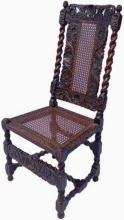
Lowestoft Houses – 16th-18th Century
The most commonly mentioned items of interior decoration during the later part of the 16th century, in the houses of the merchants and the better-off tradespeople and craftsmen, are stained or painted canvas cloths. These served to decorate the walls on which they hung and they probably also served as draught-inhibitors. They were present in bedchambers, as well as in halls and parlours, but no indication is given as to whether they had scenes depicted upon them or whether they were simply covered in patterns.
Added: 5 October, 2025