
1700s
It is stated in the Book of Fiefs/Fees (al. Liber Feodorum) – an Exchequer listing of feudal estates compiled at the beginning of the 14th century – that Lowestoft was a manor in its own right by the year 1212. This possibly being when its status was raised from that of mere outlier to the Lothingland Half-hundred manor (as recorded in the Domesday Survey of 1086), whose hub was Gorleston.
Added: 28 September, 2026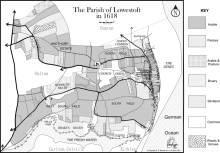
One of the most interesting features of local landscapes during the Late Medieval and Early Modern periods in any community (and Lowestoft was no exception) was the presence of areas not used for agriculture – usually because the soil was unsuitable for crops or too difficult to work, for one reason or another – and being generally referred as either common or waste. The former term referred to the land being available to people for various kinds of use and the latter derived from the Latin word vastus, meaning “empty” or “open”.
Added: 19 May, 2026
The pages reproduced below, in as near as possible their original format, are to be found in volume 3, section 4, of Robert Reeve’s four volume manuscript ‘A History of Lowestoft and Lothingland’ (c. 1810) – Suffolk Archives (Ipswich), 193/3/4. Nothing is recorded for the years 1719, 1722, 1728 and 1733. Reeve (a local solicitor), who lived at No. 49 High Street, was steward of the manor and he must have transcribed this material from an original source of some kind.
Added: 2 March, 2026
Reasons for the move
It is perhaps unwise to single out any one particular event in the life of a community over a period of about 1,500 years as being the crucial or formative one (other than its founding), but there is a good case for doing so where Lowestoft is concerned.
Added: 26 November, 2025
17th & 18th Century Naval Commanders
It is a claim – not made lightly by this writer – that no town of its size, in the whole of England, produced as many eminent top-rank Naval commanders as Lowestoft did between 1660 and c. 1720. During that time, no less than four admirals and five captains came from five local families mainly involved in fishing and maritime trade: the Allins, the Arnolds, the Ashbys, the Leakes and the Mighells.
Added: 21 November, 2025
Provision of credit in the community
The importance of scriveners as community bankers in London during the second half of the 17th century has been noted, as has their role as providers of funds elsewhere. Nor has the function of the goldsmith escaped attention. Lowestoft, being a town of modest size, had few named scriveners among its inhabitants (no more than six or seven have been identified between 1560 and 1730) and most of them had other occupations.
Added: 20 November, 2025
Saved by the Argus
One of the earliest balloon flights in England took place on Saturday, 23 July 1785, at 4.25 p.m. in Quantrell’s Gardens, Norwich – located in the city adjacent to present-day Queen’s Road (part of the A147) in the area now occupied by a large Sainsbury supermarket.
Added: 22 October, 2025
On 15 January 1737 – the year being 1736, by use of the old Julian Calendar – King George II (1683-1760) made a sudden and unplanned landing at Lowestoft, on a return journey from the North-western German province of Hanover – where he and his father, George I, were the rulers (as Electors) as well as being monarchs of Great Britain. Both of them made summer journeys, periodically, to spend time in their land of origin, and it was on his return from one of these that George II was forced to put ashore.
Added: 20 October, 2025
Inns
The configuration of roads and the importance of land transport have always been major influences on the development of towns and their inns. Large yards were necessary for stabling horses, and for standing carts and carriages; buildings were required for storing hay and other forage; and provision had to be made for watering the animals. Adequate accommodation was also needed for those people making overnight stops or staying in a place for longer.
Added: 18 October, 2025
A small house (early 18th century)
John Cousens (carter) lived with his wife Mary in a three-roomed house somewhere in the side-street area to the west side of the High Street. Their son, Benjamin (aged twenty-four years) had left home, but their daughter, Mary (aged twenty years) was possibly still living there. When the inventory of Cousens’s goods was made on 6 June 1711, his total estate was valued at £73 8s 9d. Out of this sum, £50 consisted of good debts and a further £16 17s 0d. of his working equipment and horses.
Added: 5 October, 2025