
1800s

This building, which stands in Arnold Street, is in need of some restorative tlc and is an important remnant of Lowestoft’s military past. Built and opened in 1872 for the Lowestoft Artillery Volunteer Company which (along with accompanying Rifle Volunteers) was formed in 1860. Designed by local architect W.O. Chambers.
Added: 22 September, 2023
Kirkley Cemetery is a burial ground in the Kirkley area of Lowestoft in Suffolk. Located on London Road South, the cemetery is maintained by Waveney District Council and is open for traditional and Green Burials. Thr two Memorial Chapels were designed by local architect J.L. Clemence in Early English gothic style.
Added: 22 September, 2023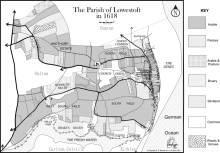
One of the most interesting features of local landscapes during the Late Medieval and Early Modern periods in any community (and Lowestoft was no exception) was the presence of areas not used for agriculture – usually because the soil was unsuitable for crops or too difficult to work, for one reason or another – and being generally referred as either common or waste. The former term referred to the land being available to people for various kinds of use and the latter derived from the Latin word vastus, meaning “empty” or “open”.
Added: 19 May, 2026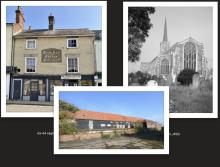
In some ways, buildings are every bit as much historical documents as written sources and can inform the observer of many aspects of human activity in days gone by. Where they have survived in original form, they have much to say of former economic and social conditions – be they domestic, ecclesiastical or industrial in nature. And, if altered and converted at different times, there is just as much to be learned from them. Let us take three of Lowestoft’s buildings, covering these three categories, and consider each one of them in turn within its context.
Added: 18 September, 2025
Malting and brewing
Much of the barley grown in Lowestoft would have been used to make malt, the light soils in the parish producing the thin-skinned, mealy type of grain best suited for the malting process. Altogether, there were at least three or four separate malt-houses in different parts of town, which were in operation at one time or another during the Early Modern period and a similar number attached to the town’s breweries.
Added: 8 September, 2025
The type of agriculture practised in Lowestoft during the Early Modern era was of mixed variety, as was the case with most other communities in lowland England. And it was not only mixed in combining crops and livestock; it was also mixed in the sense that many of the people who farmed the land had other interests. It is unfortunate that the two key documents which reveal so much about conduct of agriculture in the parish stand in isolation from each other.
Added: 6 September, 2025
Cattle
The amount of grassland of one kind or another revealed in the 1618 Manor Roll (about 170 acres), when compared with that discernible in the 18thcentury Tithe Accounts (about sixty-five acres of permanent pasture, or meadow, and an annual average of twenty-eight acres of the sown variety) may appear to suggest that fewer cattle were being kept in the parish by 1700 than had been the case one hundred years before.
Added: 2 September, 2025
It is unarguable that maritime influences were the major factor in shaping Lowestoft during the Late Medieval and Early Modern periods. Yet, agriculture was also an important element in the development of the town, creating employment for a number of the inhabitants (and limited wealth for a few) and leading to a number of associated trades and occupations. It also acted as a safety-net for the community, something that was always there as part of the economic structure – something that could, in periods of adversity, provide subsistence until better times returned.
Added: 23 August, 2025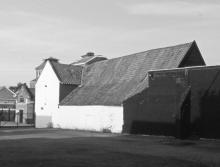
Grain
The potential value of Tithe Accounts books as a source of information regarding historical agricultural practice has long been recognised. The surviving Lowestoft tithe records (Norfolk Record Office, PD 589/80) begin to record details of agriculture in the parish in the year 1698, but there is no reference to the growing of corn until 1749 – the year in which the Rev. John Tanner began to draw the rectorial tithes.
Added: 18 August, 2025
The Novel David Copperfield is well known for its central figure’s connection with Blundeston, Great Yarmouth and the Peggotty family – but, scarcely known at all for David’s brief acquaintance with the town of Lowestoft, as revealed in Chapter 2 of the novel.
Added: 10 February, 2025