
1900s

Early in 1903 construction started of the Tramway from Florence Road in Pakefield to Yarmouth Road in north Lowestoft. A spur was built along Denmark Road to the tramshed (still there)in Rotterdam Road. It was 3 ft 6 ins gauge, with the rails imported from Germany.
Added: 23 September, 20231974 the High Light is now fully automatic.
Added: 23 September, 2023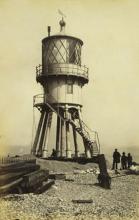
1923 Low Light extinguished, as the Stanford Channel was no more.
Added: 23 September, 2023
In the autumn of 1908 a hydroplane of the two-plane variety was tried with success on the Norfolk Broads, and over 20 miles per hour was reached with only 12 H.P. Surprise, as the little craft was named, was owned by Mr. M. Brooke, of Lowestoft, and had a length of 13 ft., with a 5 ft. 6 in. beam. She was built purely for experimental purposes, so did not take part in any of the public speed contests.
Added: 23 September, 2023Early in 1903 construction started of the Tramway from Florence Road in Pakefield to Yarmouth Road in north Lowestoft. A spur was built along Denmark Road to the tramshed (still there)in Rotterdam Road
Added: 23 September, 2023
Zeppelin was shot down over the sea near Lowestoft, the date of which coming close to the moment when Robert Leckie arrived at the station and yet to make his mark and be known as one of “the Zeppelin killers from Canada”.
Added: 23 September, 20231928 The bus service was extended to other areas, and in 1929 it was introduced along the route of the tramway.
Added: 23 September, 20231927 The first Corporation bus service was introduced, along the seafront. The redundant trolleybus poles were used for street lighting.
Added: 23 September, 20231920 - The Corporation installed poles and span wires were erected for trolleybuses. But the overhead wires were never installed, and trolley buses never graced our streets.
Added: 23 September, 2023
1914 - 1918 First World War eventually meant that Lowestoft Corporation Transport trams women drivers, inspectors and conductors were introduced
Added: 23 September, 2023