
modern

This building, which stands in Arnold Street, is in need of some restorative tlc and is an important remnant of Lowestoft’s military past. Built and opened in 1872 for the Lowestoft Artillery Volunteer Company which (along with accompanying Rifle Volunteers) was formed in 1860. Designed by local architect W.O. Chambers.
Added: 22 September, 2023
Kirkley Cemetery is a burial ground in the Kirkley area of Lowestoft in Suffolk. Located on London Road South, the cemetery is maintained by Waveney District Council and is open for traditional and Green Burials. Thr two Memorial Chapels were designed by local architect J.L. Clemence in Early English gothic style.
Added: 22 September, 2023
It is stated in the Book of Fiefs/Fees (al. Liber Feodorum) – an Exchequer listing of feudal estates compiled at the beginning of the 14th century – that Lowestoft was a manor in its own right by the year 1212. This possibly being when its status was raised from that of mere outlier to the Lothingland Half-hundred manor (as recorded in the Domesday Survey of 1086), whose hub was Gorleston.
Added: 28 September, 2026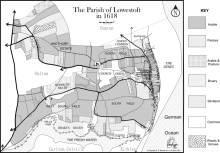
One of the most interesting features of local landscapes during the Late Medieval and Early Modern periods in any community (and Lowestoft was no exception) was the presence of areas not used for agriculture – usually because the soil was unsuitable for crops or too difficult to work, for one reason or another – and being generally referred as either common or waste. The former term referred to the land being available to people for various kinds of use and the latter derived from the Latin word vastus, meaning “empty” or “open”.
Added: 19 May, 2026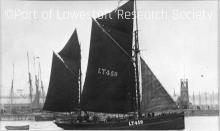
(LT 649)
If upon your port is seen
A little German submarine,
Do not fire shot nor shell.
Just turn around and run like hell!
(Fishermen’s parody of a navigation rhyme)

Tape-recordings made 1976-83
The recordings were made with local people, with the intention of producing a sound archive to record an important part of the Lowestoft area’s industrial and maritime history. They form the basis of six published works: The Driftermen (Reading, 1978), The Trawlermen (Reading. 1979), Living From the Sea (Reading, 1982), Following the Fishing (Newton Abbot, 1987), Fishing Talk (Cromer, 2014) and The Last Haul (Lowestoft, 2020).
Added: 11 March, 2026
“I know not whether laws be right,
Or whether laws be wrong.
All that we know who lie in gaol
Is that the wall is strong;
And that each day is like a year,
A year whose days are long.”
(Oscar Wilde: “The Ballad of Reading Gaol”)

[First published as the last chapter in the writer’s book The Last Haul (2020).]
Were you ever down the Congo river?
Blow, boys, blow.
Where the fever makes the white man shiver.
Blow, my bully-boys, blow.
(Traditional American capstan song: Blow, Boys, Blow)
Added: 25 February, 2026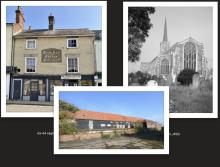
In some ways, buildings are every bit as much historical documents as written sources and can inform the observer of many aspects of human activity in days gone by. Where they have survived in original form, they have much to say of former economic and social conditions – be they domestic, ecclesiastical or industrial in nature. And, if altered and converted at different times, there is just as much to be learned from them. Let us take three of Lowestoft’s buildings, covering these three categories, and consider each one of them in turn within its context.
Added: 18 September, 2025
Malting and brewing
Much of the barley grown in Lowestoft would have been used to make malt, the light soils in the parish producing the thin-skinned, mealy type of grain best suited for the malting process. Altogether, there were at least three or four separate malt-houses in different parts of town, which were in operation at one time or another during the Early Modern period and a similar number attached to the town’s breweries.
Added: 8 September, 2025